
NHS Pay Calculator
See your NHS take home pay by band and pay step — this NHS salary calculator works out income tax, National Insurance, NHS pension contributions, London weighting and student loan for you.
Your NHS role
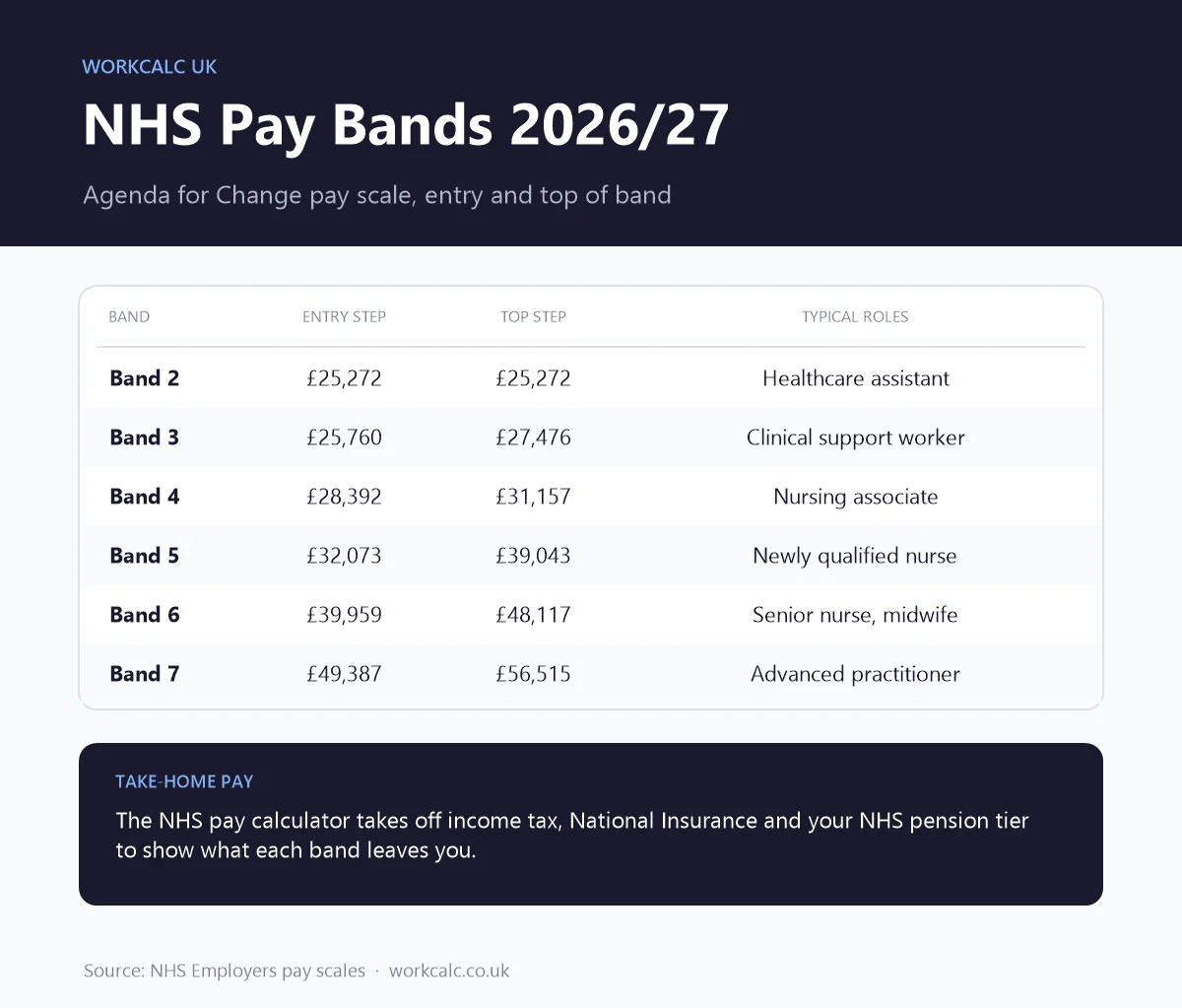
NHS pay bands 2026/27 — full Agenda for Change scale
England rates effective 1 April 2026, following the 3.3% award. Source: NHS Employers.
| Band | Entry step | Intermediate step | Top step | Typical roles |
|---|---|---|---|---|
| Band 2 | £25,272 | — | £25,272 | Healthcare assistant, domestic, receptionist |
| Band 3 | £25,760 | — | £27,476 | Clinical support worker, pharmacy assistant |
| Band 4 | £28,392 | — | £31,157 | Nursing associate, pharmacy technician |
| Band 5 | £32,073 | £34,592 | £39,043 | Newly qualified nurse, physiotherapist, paramedic |
| Band 6 | £39,959 | £42,170 | £48,117 | Senior nurse, specialist practitioner, midwife |
| Band 7 | £49,387 | £51,932 | £56,515 | Advanced practitioner, ward manager |
| Band 8a | £57,528 | £60,417 | £64,750 | Matron, principal pharmacist, service manager |
| Band 8b | £66,582 | £70,896 | £77,368 | Head of service, consultant practitioner |
| Band 8c | £79,504 | £84,346 | £91,609 | Deputy director, senior clinical lead |
| Band 8d | £94,356 | £100,140 | £108,814 | Director of service, chief pharmacist |
| Band 9 | £112,782 | £119,583 | £129,783 | Executive director, chief scientist |
How this NHS take home pay calculator works
Use it as an NHS wage calculator for any band from 2 to 9. Almost every NHS role outside medicine sits on Agenda for Change, the national pay system covering more than a million staff — nurses, paramedics, healthcare assistants, allied health professionals, scientists, administrators and managers. Two things set your basic pay: your band (2 to 9) and your pay step within that band.
The 2026/27 scales took effect on 1 April 2026 following a 3.3% award, and for the first time in six years staff saw the new rates in their April payslip rather than waiting for backdated payments. The England scale runs from £25,272 at Band 2 to £129,783 at the top of Band 9.
NHS take home pay for a Band 5 nurse, line by line
Band 5 entry is the most-searched figure any NHS salary calculator gets asked for, so it is worth working all the way through. This is a newly qualified nurse in England, full time, no London weighting, no student loan.
NHS Band 5 take-home pay — entry step, 2026/27
That is an effective deduction rate of 23.7% — but a third of what comes off is pension, which is deferred pay rather than money lost. Add a Plan 2 student loan and the monthly figure drops to roughly £2,020.
The NHS pension line most people misread
The NHS Pension Scheme — still called NHS superannuation on some older payslips — uses six tiers, from 5.2% to 12.5%. Two details catch people out, and both work in your favour.
First, your tier is set on actual pensionable pay, not whole-time equivalent. This changed in October 2022 and a surprising amount of online guidance is still wrong about it. A part-time Band 6 earning £28,000 actual pay sits in the 6.5% tier, not the tier their full-time colleague on £42,170 pays.
Second, the scheme is a net pay arrangement. Your contribution comes off before income tax is calculated, so you get relief at your marginal rate automatically — no claim needed. But National Insurance is still charged on the full gross figure, which is why the saving feels smaller than the headline percentage suggests.
| Pensionable pay | Contribution rate | Typical band |
|---|---|---|
| Up to £13,259 | 5.2% | Part-time roles |
| £13,260 – £28,854 | 6.5% | Band 2, Band 3, part-time |
| £28,855 – £35,155 | 8.3% | Band 4, Band 5 entry |
| £35,156 – £52,778 | 9.8% | Band 5 top, Band 6, Band 7 entry |
| £52,779 – £67,668 | 10.7% | Band 7 top, Band 8a |
| Above £67,668 | 12.5% | Band 8b and above |
London weighting: the floors and ceilings matter
Staff in and around London receive a High Cost Area Supplement. It is a percentage of basic salary, but with a minimum and maximum payment that changes the picture at both ends of the scale:
| Zone | Percentage | Minimum | Maximum |
|---|---|---|---|
| Inner London | 20% | £5,794 | £8,746 |
| Outer London | 15% | £4,870 | £6,137 |
| Fringe | 5% | £1,346 | £2,270 |
A Band 2 in Inner London would get £5,054 on the straight 20%, but the floor lifts it to £5,794. A Band 9 would get £25,957 on the percentage alone, but the ceiling caps it at £8,746. So the supplement is proportionally most valuable at the bottom of the scale and least valuable at the top.
How part-time NHS salary and pay is worked out
Divide your contracted hours by 37.5 to get your whole-time equivalent, then apply that to the full-time salary. Someone on 22.5 hours is 0.6 WTE, so a Band 5 at entry earns £19,243.80 rather than £32,073.
Because the pension tier follows actual pay, that same person sits in the 6.5% tier rather than the 8.3% their full-time colleague pays. Part-time staff pay a lower percentage on a smaller amount, which is the system working as intended.
Moving up a pay step
Progression is not automatic on your anniversary — it depends on a satisfactory appraisal. The waiting periods are:
- Bands 2, 3, 5, 6, 7, 8 and 9: two years at the entry step
- Band 4: three years at the entry step
- Bands 5 to 9, intermediate to top: two years for Band 5, three years for Bands 6 and above
The step-ups are worth real money. Band 5 entry to top is £6,970 of basic pay, and Band 6 entry to top is £8,158.
Related tool Pay Rise Calculator: what the 3.3% award or a step-up adds after tax →What this NHS pay calculator does not include
- Unsocial hours enhancements — Section 2 payments for nights, weekends and bank holidays, which are pensionable and can push you into a higher contribution tier
- Overtime and on-call — paid on top for Bands 2 to 7
- Doctors and dentists — separate contracts entirely, not Agenda for Change
- Scotland, Wales and Northern Ireland — separate pay awards, and Scotland has its own income tax bands and a 36-hour full-time week
- Salary sacrifice schemes — lease cars, cycle to work and childcare reduce both gross pay and take-home
Every figure in this NHS pay calculator comes from the NHS Employers 2026/27 pay scales, with pension tiers from NHSBSA and tax thresholds from HMRC. Leaving the NHS or facing restructure? NHS redundancy pay is worked out separately under Section 16 — see the NHS Redundancy Calculator. To see how the same salary compares outside the NHS, use the Take-Home Pay Calculator, or check what an hourly rate works out to across a year.
Frequently asked questions
Common questions about NHS pay, bands and take-home pay.
How much is NHS Band 5 take-home pay?
A Band 5 at the entry step earns £32,073 in 2026/27. After an 8.3% NHS pension contribution, income tax and National Insurance, take-home pay is roughly £24,483 a year or £2,040 a month. Add a Plan 2 student loan and that drops to about £2,020 a month. London weighting increases both the gross and the net figure.
What are the NHS pay bands for 2026/27?
The 2026/27 Agenda for Change scales for England run from £25,272 at Band 2 to £129,783 at the top of Band 9, following the 3.3% award effective 1 April 2026. Bands 2 to 4 have an entry and a top step; Bands 5 to 9 also have an intermediate step. Band 1 has been closed to new entrants since December 2018.
How much do NHS staff pay into the pension?
Member contributions run through six tiers from 5.2% to 12.5%, based on actual pensionable pay rather than whole-time equivalent pay. A Band 5 on £32,073 falls in the 8.3% tier. Your employer contributes a further 23.7% on top, which is far above a typical private sector employer contribution.
Is the NHS pension taken before tax?
Yes for income tax, no for National Insurance. The NHS Pension Scheme is a net pay arrangement, so your contribution is deducted from your pay before income tax is worked out, giving relief at your marginal rate automatically. National Insurance is still charged on the full gross figure, which is why the saving is smaller than people expect.
How does London weighting work in the NHS?
The High Cost Area Supplement adds 20% of basic salary in Inner London, 15% in Outer London and 5% in the Fringe zone, each with its own floor and ceiling. Inner London pays between £5,794 and £8,746, Outer between £4,870 and £6,137, and Fringe between £1,346 and £2,270. Lower bands receive the minimum payment and higher bands are capped at the maximum.
How is NHS part-time pay calculated?
Divide your contracted hours by 37.5 to get your whole-time equivalent, then apply that fraction to the full-time salary for your band and step. Someone on 22.5 hours is 0.6 WTE. Because the pension tier is set on actual pensionable pay, part-time staff often sit in a lower contribution tier than a full-time colleague on the same band.
Does this calculator include unsocial hours pay?
No. Section 2 enhancements for nights, weekends and bank holidays sit on top of basic pay and vary with the shifts actually worked, so they cannot be predicted from band alone. Enhancements are pensionable, which means earning them regularly can push you into a higher pension contribution tier.
When do NHS staff move up a pay step?
Bands 2, 3, 5, 6, 7, 8 and 9 require two years at the entry step before moving up. Band 4 requires three years, as does the move from the intermediate step to the top of Bands 5 to 9. Progression also depends on a satisfactory appraisal rather than being automatic on the anniversary.
Are NHS pay scales the same across the UK?
No. England, Scotland, Wales and Northern Ireland negotiate Agenda for Change pay separately. England and Wales applied 3.3% for 2026/27 while Scotland agreed a separate award, and Scotland also uses its own income tax bands and a 36-hour full-time week. The scales in this calculator are the England rates published by NHS Employers.