
NHS Pension Calculator
This NHS pension calculator finds your contribution tier, what it really costs after tax relief, what your employer adds on top, and how much annual pension you build each year.
Your pensionable pay
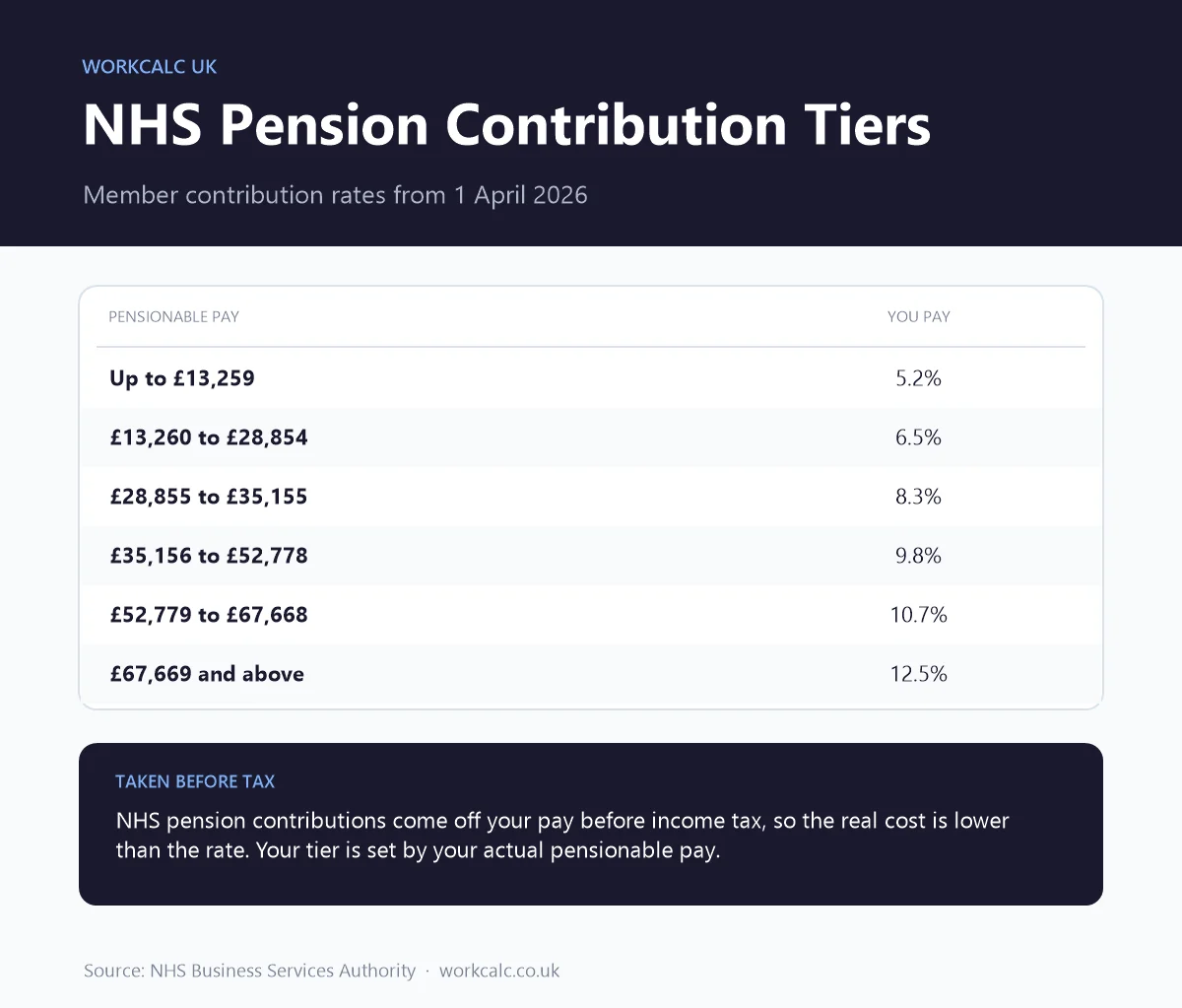
NHS pension contribution rates 2026/27
Six tiers, effective 1 April 2026, set on actual annual pensionable pay. Source: NHS Employers.
| Pensionable pay | Rate | 2025/26 range | Typical band |
|---|---|---|---|
| Up to £13,259 | 5.2% | Up to £13,259 | Small part-time contracts |
| £13,260 – £28,854 | 6.5% | £13,260 – £27,797 | Band 2, Band 3, part-time |
| £28,855 – £35,155 | 8.3% | £27,798 – £33,868 | Band 4, Band 5 entry |
| £35,156 – £52,778 | 9.8% | £33,869 – £50,845 | Band 5 top, Band 6, Band 7 entry |
| £52,779 – £67,668 | 10.7% | £50,846 – £65,190 | Band 7 top, Band 8a |
| £67,669 and above | 12.5% | £65,191 and above | Band 8b and above |
How the NHS superannuation pension calculator works out your contribution
Every active member of the NHS Pension Scheme — still labelled NHS superannuation on some payslips and ESR screens — pays a percentage of pensionable pay, deducted automatically through payroll. There are six tiers running from 5.2% to 12.5%, and your rate applies to the whole of your pensionable pay rather than just the slice inside the band — this is not a marginal system like income tax.
That distinction matters enormously for part-time staff. A Band 6 working half time earns around £24,000 actual pay and sits in the 6.5% tier — not the 9.8% their full-time colleague pays. Percentage rate and total pounds both scale with hours, which is the system working as intended.
Why the thresholds moved but the rates did not
The contribution rates have been unchanged since April 2024. What moves each April is the pay threshold for each tier, and since 2025/26 that has followed a deliberate two-step process:
- Step 1 — CPI indexation. Every 1 April the pay ranges rise by the previous September's CPI. For 2026/27 that was 3.8%.
- Step 2 — pay award top-up. If the Agenda for Change award later turns out higher than that CPI figure, the ranges are adjusted again and backdated.
For 2026/27 step 2 did not happen, because the 3.3% pay award was lower than 3.8% CPI. That is good news: thresholds rose faster than pay, so most members did not drift into a higher tier despite getting a pay rise. The whole point of the two-step design is to stop a pay award leaving someone worse off.
What your NHS pension contribution actually costs
The headline percentage overstates the cost, because the NHS scheme is a net pay arrangement. Your contribution comes out of gross pay before income tax is calculated, so you get relief at your marginal rate automatically — nothing to claim.
National Insurance, though, is still charged on your full gross pay. That is why the saving is smaller than people expect, and it is the main practical difference between the NHS scheme and a salary sacrifice arrangement.
Band 5 entry, £32,073, full time
So an 8.3% headline rate is really costing 6.6% of pay. Meanwhile your employer is putting in £7,601 — more than three and a half times what you pay net.
Related tool NHS Pay Calculator — see the pension line inside your full payslip →Tax relief is worth more than 40% for some
Two groups get relief far above the headline rates, and neither is well understood:
| Pensionable pay | Contribution | Tax relief | Effective relief |
|---|---|---|---|
| £32,073 (Band 5 entry) | £2,662 | £532 | 20.0% |
| £55,000 | £5,885 | £2,123 | 36.1% |
| £66,582 (Band 8b entry) | £7,124 | £2,850 | 40.0% |
| £105,000 | £13,125 | £6,250 | 47.6% |
| £129,783 (Band 9 top) | £16,223 | £9,037 | 55.7% |
The £55,000 figure is 36.1% because the contribution straddles the higher-rate threshold — part gets 40% relief and part gets 20%. The £105,000 figure is 47.6% because contributions claw back the tapered personal allowance, the notorious 60% effective band. And at Band 9 top the contribution restores a personal allowance that had been tapered away entirely, which is why relief reaches 55.7%.
How much NHS pension you are actually building
The 2015 scheme is career average revalued earnings, not final salary. Each year you bank a slice of pension worth 1/54 of that year's pensionable pay — about 1.85%.
Average NHS pension per month
People often want a monthly figure rather than an annual one. On the projection above, £39,400 of annual pension is about £3,283 a month before tax — though that is 30 years of full-time Band 5 service with steady pay growth, so treat it as an upper marker rather than a typical outcome. Divide any annual pension figure by 12 to get the monthly equivalent; the calculator shows the annual figure because that is how NHSBSA quotes it.
Each slice is then revalued every 6 April by CPI plus 1.5%, a rate set by HM Treasury, for as long as you stay an active member. That 1.5% above inflation is the most valuable and least appreciated feature of the scheme — your built-up pension grows in real terms every year you keep working.
The compounding is what makes career average work. A Band 5 starting today on 2% pay growth and 2% CPI builds roughly £39,400 of annual pension over 30 years. Without revaluation the same accruals would total just £17,800.
Should you opt out of the NHS pension?
Opting out raises take-home pay immediately, and in a tight month that is a real temptation. What you give up is substantial:
- The 23.7% employer contribution — around £7,600 a year on a Band 5 salary, gone entirely
- Guaranteed inflation-protected benefits — not a pot exposed to market risk
- Death in service cover of twice pensionable pay, plus survivor benefits
- Ill-health retirement cover, which is difficult and expensive to replace privately
The main legitimate exception is members hitting the annual allowance, usually Band 8c and above or those with large pay rises. That is a regulated advice question, not a payroll one.
If cost is the issue, 50/50 style partial options do not exist in the NHS scheme as they do in the Local Government Pension Scheme, but you can apply for a short break rather than opting out permanently. Re-joining within five years keeps active revaluation on your earlier service; a break of more than five years does not.
Normal pension age and taking it early
In the 2015 scheme your normal pension age is your State Pension age — 67 for most current staff, 68 for those born from 1978 onwards. You can take benefits from 55, rising to 57 in 2028, but each year early reduces the pension by roughly 5%.
If you are made redundant at or above minimum pension age, the cost of removing that reduction can be met from your redundancy payment. The numbers are not intuitive, so get a written estimate first — see the NHS Redundancy Calculator for how the payment itself is worked out.
What this NHS pension calculator does not cover
- 1995 and 2008 section benefits — final salary service built before April 2015, which is preserved separately
- The McCloud remedy — the age discrimination fix covering 2015 to 2022 service, where members choose between legacy and 2015 benefits at retirement
- Annual allowance and lifetime limits — pension input amounts can trigger tax charges for higher earners
- Added pension, ERRBO and AVCs — voluntary top-ups bought separately
- Scotland and Northern Ireland — SPPA and HSC run their own schemes with their own tier tables
Tier figures come from NHS Employers' member contributions guidance, with accrual and revaluation rules from NHSBSA. For a personalised figure, request a Total Reward Statement through the NHSBSA member portal — that uses your actual record rather than assumptions.
Frequently asked questions
Common questions about NHS pension contributions and the 2015 scheme.
How much do I pay into my NHS pension?
Member contributions run through six tiers from 5.2% to 12.5%, set on your actual annual pensionable pay. A Band 5 on £32,073 pays 8.3%, which is £2,662 a year or £222 a month before tax relief. After relief at the basic rate the real cost is closer to £177 a month.
What are the NHS pension contribution rates for 2026/27?
From 1 April 2026 the six tiers are 5.2% up to £13,259, 6.5% to £28,854, 8.3% to £35,155, 9.8% to £52,778, 10.7% to £67,668, and 12.5% above that. The rates themselves have not changed since April 2024 — only the pay thresholds move, uprated by the September CPI figure of 3.8%.
Is my NHS pension tier based on full-time equivalent pay?
No. Since October 2022 the tier has been set on actual annual pensionable pay, not whole-time equivalent pay. A part-time member earning £28,000 actual pay sits in the 6.5% tier even if their full-time equivalent salary would place them higher. A lot of online guidance still describes the old whole-time equivalent rule.
How much does my employer pay into my NHS pension?
The employer contribution rate is 23.7% of pensionable pay. NHS organisations remit 14.38% directly to NHSBSA and NHS England pays the remaining 9.4% centrally on their behalf. On a Band 5 salary the employer is putting in around £7,601 a year, which never appears on your payslip.
Do I get tax relief on NHS pension contributions?
Yes, automatically. The scheme is a net pay arrangement, so your contribution comes out before income tax is worked out and you get relief at your marginal rate without claiming. National Insurance is still charged on your full gross pay, so the saving is smaller than the headline rate suggests.
How much pension do I build up each year in the NHS?
The 2015 scheme is career average with an accrual rate of 1/54, so each year you add one fifty-fourth of that year's pensionable pay to your pension. On £32,073 that is £594 of annual pension earned in a single year. Each year's slice is then revalued by CPI plus 1.5% for as long as you remain an active member.
What is the NHS pension revaluation rate?
Active members have their built-up pension revalued each 6 April by the Consumer Prices Index plus 1.5%, a rate set by HM Treasury. This is one of the most valuable features of the scheme because it means your accrued pension grows faster than inflation every year you keep working. Once you leave, deferred benefits are revalued by CPI only.
Should I opt out of the NHS pension?
Opting out increases your take-home pay but gives up an employer contribution worth 23.7% of pensionable pay, plus guaranteed inflation-protected benefits and death in service cover. For most staff that is a poor trade. Members with annual allowance problems are the main exception, and they should take regulated financial advice rather than simply opting out.
What is the normal pension age in the NHS 2015 scheme?
Normal pension age in the 2015 scheme is your State Pension age, which is 67 for most current staff and 68 for those born from 1978 onwards. You can take benefits from age 55, rising to 57 in 2028, but each year taken early reduces the pension by roughly 5%.