
NHS Redundancy Calculator
Work out your full NHS redundancy package under Section 16 — the earnings floor and cap, part-time pro-rata, the statutory comparison, and how much of it is tax-free.
Your NHS service
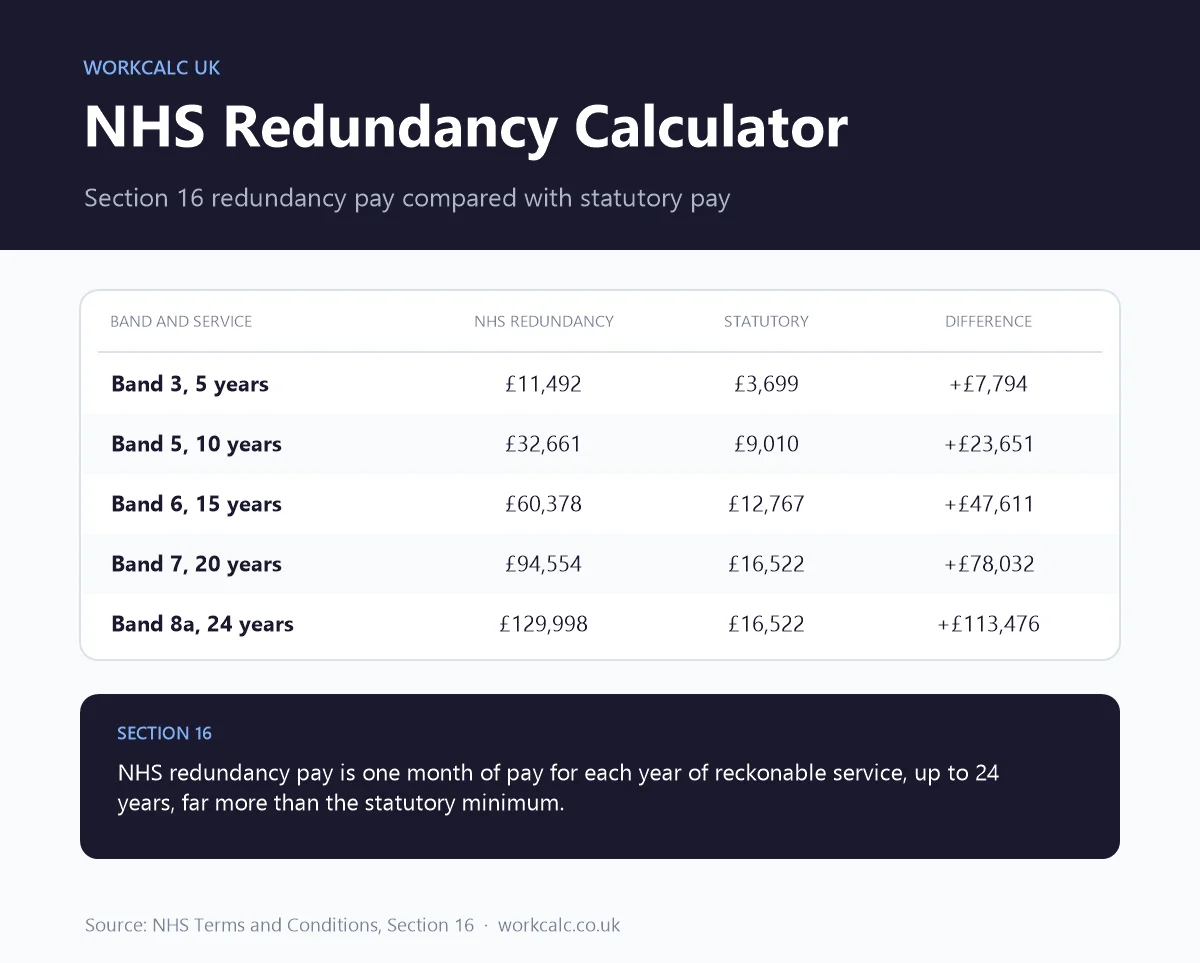
NHS redundancy pay against the statutory minimum
Full-time staff, age 45 at the redundancy date, on the 2026/27 top-of-band rate. Statutory figures use the £751 weekly cap from 6 April 2026.
| Band & service | FTE salary | NHS contractual | Statutory | Difference |
|---|---|---|---|---|
| Band 3, 5 years | £27,476 | £11,492 | £3,699 | +£7,794 |
| Band 5, 10 years | £39,043 | £32,661 | £9,010 | +£23,651 |
| Band 6, 15 years | £48,117 | £60,378 | £12,767 | +£47,611 |
| Band 7, 20 years | £56,515 | £94,554 | £16,522 | +£78,032 |
| Band 8a, 24 years | £64,750 | £129,998 | £16,522 | +£113,476 |
| Band 8d, 24 years | £108,814 (capped at £80,000) | £160,615 | £16,522 | +£144,093 |
How redundancy in the NHS is calculated
Redundancy in the NHS sits under Section 16 of the NHS Terms and Conditions of Service Handbook, and it is far more generous than the statutory scheme. Where statutory redundancy pay caps a week's pay at £751 and counts a maximum of 20 years, NHS contractual redundancy pays a whole month per year with no weekly cap at all.
Three details control the answer, and getting any of them wrong changes the figure substantially:
- Only complete years count. Fractions of a year are disregarded entirely. Fourteen years and eleven months counts as fourteen years.
- A floor and a cap apply to the salary. The calculation treats your full-time equivalent salary as at least £23,000 and no more than £80,000.
- The maximum is 24 years. Thirty years of service produces the same payment as twenty-four.
What counts as a month's pay
Section 16.7 defines a month's pay as whichever of these is more beneficial to the employee:
- one twelfth of the annual salary at the date of termination, or
- 4.35 times a week's pay, calculated under sections 221 to 224 of the Employment Rights Act 1996
Worth knowing: NHS Employers' own published worked example uses the 1/12 method, so your trust may quote you the slightly lower figure. If it matters to you, the handbook wording is what governs.
NHS redundancy package example — Band 6, 15 years' service
NHS redundancy pay, Band 6 top of band, full time
The same person under the statutory scheme would receive £12,767 — 17 weeks at the capped rate of £751. NHS terms are worth £47,611 more, or nearly five times the legal minimum.
Need your band salary? NHS Pay Calculator — every band and step on the 2026/27 scale →Continuous service versus reckonable service
These are two different tests and both have to be satisfied. The distinction is the single most misunderstood part of NHS redundancy.
| Continuous service | Reckonable service | |
|---|---|---|
| What it does | Decides whether you qualify at all | Decides how much you are paid |
| Minimum | 2 years (104 weeks) | No minimum once you qualify |
| Break tolerated | No more than one statutory week | Up to 12 months |
So a break of six months does not stop earlier NHS employment counting towards the payment, but a break of two weeks immediately before redundancy could stop you qualifying. Service with any NHS employer counts, not just your current trust.
When service does not count
- Service already used for a previous redundancy or loss of office payment
- Service for which you have already taken NHS pension benefits — including partial retirement
- Service offset against a Mutually Agreed Resignation Scheme payment
Employment outside the NHS is at the employer's discretion. NHS Employers suggests it would be reasonable to include relevant outside employment, but this should be agreed when you join rather than argued at the point of redundancy. GP practice service does not count automatically, because a GP practice is not an NHS employer under Annex 1.
How part-time NHS redundancy is worked out
The order of operations matters. The floor and cap are applied to your full-time equivalent salary first, and your whole time equivalent fraction is applied at the very end.
NHS Employers' own worked example
Doing it the other way round — capping the actual £50,000 rather than the £100,000 FTE — would produce a very different and incorrect answer.
NHS redundancy pay and tax
The first £30,000 of a genuine redundancy payment is free of both income tax and National Insurance. Anything above that is taxed as income at your marginal rate, though still with no National Insurance.
Where the £160,000 figure comes from
You will see a "£160,000 cap" quoted on other NHS redundancy pages, usually described as a separate public sector limit. It is not a separate rule. It is simply what the two existing caps multiply out to: £80,000 ÷ 12 × 24 years = £160,000.
Using the handbook's 4.35 method the arithmetic maximum is actually £160,615. Either way, no additional cap sits on top of Section 16 — the ceiling is a consequence of the salary cap and the 24-year limit, not a third restriction.
Voluntary redundancy and MARS in the NHS
The national formula is the same for voluntary and compulsory redundancy. Some trusts add local enhancements to encourage volunteers — extra months, outplacement support, longer notice — but these sit outside Section 16 and must be confirmed in writing. Anyone using a voluntary redundancy NHS calculator should treat the national figure as the floor, not the ceiling.
A Mutually Agreed Resignation Scheme (MARS) is a different route entirely, covered by Section 20 rather than Section 16. MARS payments are calculated on reckonable service under the model scheme, and crucially a MARS severance payment is offset against any later redundancy payment — so taking MARS now reduces what you could claim if your post is made redundant afterwards.
Things that can remove your entitlement
- Suitable alternative NHS employment. If you start a suitable alternative NHS role with no break, or a break of four weeks or less, you are not entitled to the redundancy payment at all. Employers must look for suitable alternatives first, so this happens often.
- Bank-only contracts. The handbook does not cover contractual redundancy for bank staff — it is down to your local contract.
- Under two years' continuous service. No entitlement under either NHS or statutory terms.
Taking your NHS pension early
If you have reached minimum pension age with two years of scheme membership, you can choose to take your pension early on redundancy. The cost of removing the early retirement reduction is met from your redundancy payment, and you keep any balance. If the cost is more than the payment, you can top up the difference yourself.
This can be an excellent deal or a poor one depending on your age and service, and the numbers are not intuitive. Get a written estimate through Pensions Online before committing — the decision is usually irreversible.
What this calculator does not cover
- Notice pay and accrued holiday — paid separately on top, both fully taxable
- Pension strain costs — the capitalised cost of early retirement, which only your employer can quote
- Doctors, dentists and very senior managers — not on Agenda for Change, so Section 16 does not apply
- Concurrent posts — staff with two NHS contracts have service apportioned between them under specific rules
- Scotland, Wales and Northern Ireland — separate handbook sections with their own provisions
Every figure in this NHS redundancy calculator follows NHS Employers' redundancy arrangements guidance and Section 16 of the handbook. If you are leaving the NHS, also check your accrued annual leave, which must be paid out separately, and your notice period.
Frequently asked questions
Common questions about NHS redundancy pay under Agenda for Change.
How is NHS redundancy pay calculated?
Under Section 16 of the NHS Terms and Conditions of Service Handbook you receive one month's pay for each complete year of reckonable service, up to a maximum of 24 years. A month's pay is the more beneficial of one twelfth of your annual salary or 4.35 times a week's pay, and it is worked out on a full-time equivalent salary subject to a floor of £23,000 and a cap of £80,000.
How much redundancy pay do NHS staff get?
It depends entirely on length of service. A Band 6 at the top of the band with 15 years of service would receive around £60,378 under NHS terms, against roughly £12,767 under the statutory scheme — nearly five times more. The maximum possible NHS contractual payment is 24 months of pay at the £80,000 cap.
How many years do you need for NHS redundancy pay?
You need at least two years of continuous NHS service, meaning 104 weeks with no break longer than one statutory week. Once you qualify, reckonable service is used to calculate the payment, and earlier NHS employment counts provided any break was 12 months or less. Only complete years count — part years are disregarded entirely.
Is NHS redundancy pay taxable?
The first £30,000 of a genuine redundancy payment is tax-free and no National Insurance is due on it. Anything above £30,000 is taxed as income at your marginal rate. Pay in lieu of notice and any accrued holiday paid out are fully taxable and subject to National Insurance, and they do not use up the £30,000 allowance.
What counts as reckonable service for NHS redundancy?
All continuous NHS employment with one or several NHS employers counts, provided no break in service exceeded 12 months. Service does not count if it was already used for a previous redundancy or loss of office payment, or if you have already taken NHS pension benefits in respect of it. Employers have discretion to recognise relevant employment outside the NHS.
How is NHS redundancy calculated for part-time staff?
The earnings floor and cap are applied to your full-time equivalent salary first, then the result is multiplied by your whole time equivalent fraction. NHS Employers give the example of someone on 0.5 whole time equivalent earning £50,000, whose full-time equivalent is £100,000, so the £80,000 cap applies before the 0.5 is applied.
Is NHS voluntary redundancy calculated differently?
The national formula is identical for voluntary and compulsory redundancy — same months per year, same floor and cap, same 24-year maximum. Some trusts offer local enhancements as an incentive for voluntary redundancy, such as extra months or outplacement support, but these are set locally and are not part of Section 16. Always get any enhancement confirmed in writing.
Can I lose my NHS redundancy payment?
Yes. If you take up suitable alternative employment in the NHS with no break, or a break of four weeks or less, you are not entitled to the redundancy payment. Employers are required to look for suitable alternative work before making anyone redundant, so this situation is common in practice rather than unusual.
Can I take my NHS pension early if I am made redundant?
If you have reached minimum pension age and have two years of scheme membership, you can choose to take your pension early. The cost of removing the early retirement reduction is met from your redundancy payment, and you receive any balance left over. If the cost exceeds the redundancy payment you can make up the difference yourself, but always get a written estimate before deciding.