
Redundancy Tax Calculator
Work out the tax on a redundancy payment — including why notice pay never gets the £30,000 exemption, which is the part almost every settlement letter glosses over.
Your settlement
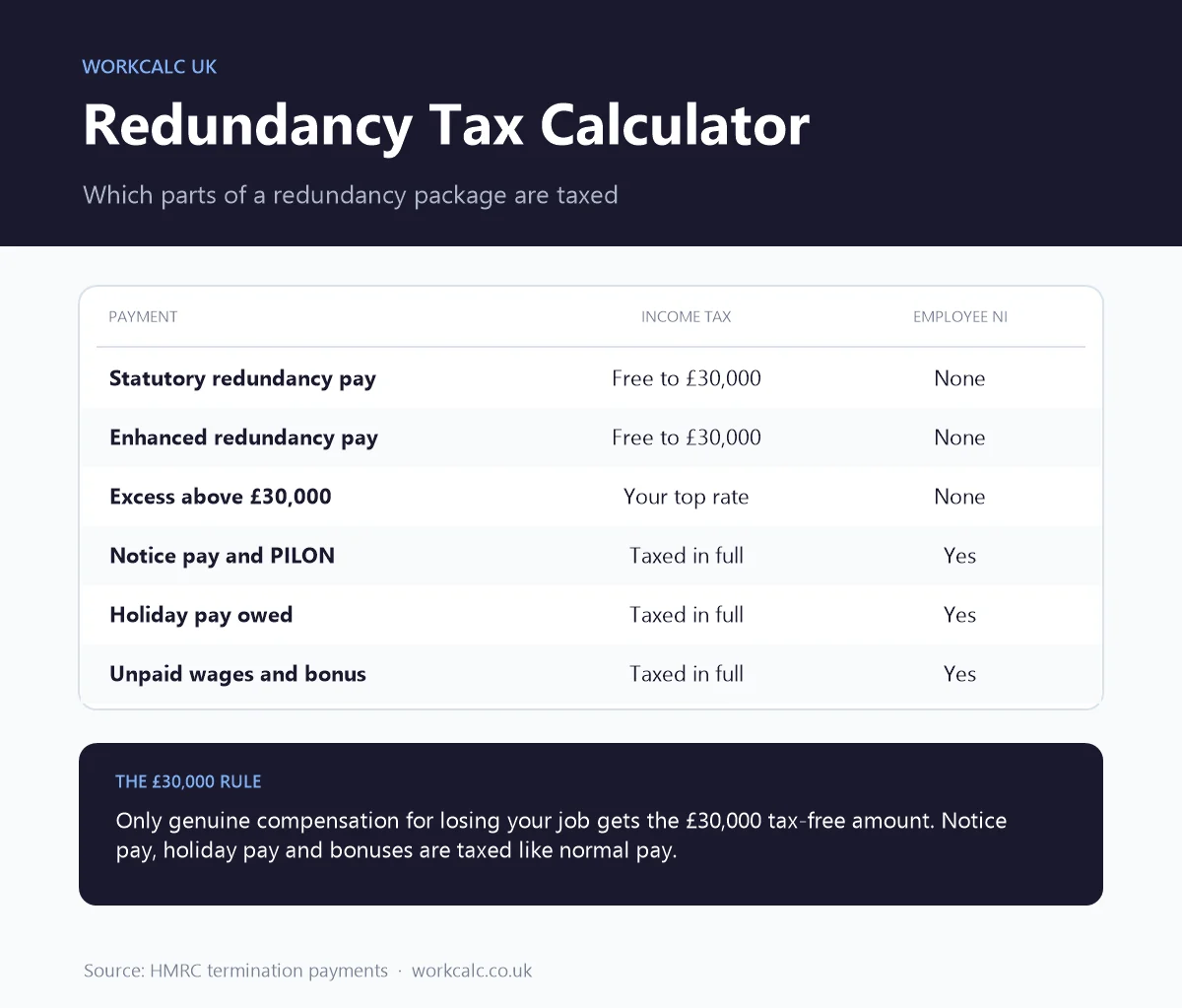
Tax treatment of redundancy pay — what is taxed and what is not
The £30,000 exemption only covers genuine compensation for losing your job. Everything else is earnings.
| Payment | Income tax | Employee NI | Uses the £30,000? |
|---|---|---|---|
| Statutory redundancy pay | Free to £30,000 | None | Yes |
| Enhanced / ex-gratia compensation | Free to £30,000 | None | Yes |
| Excess above £30,000 | At your marginal rate | None | — |
| Notice pay / PILON / PENP | In full | Full Class 1 | No |
| Holiday pay owed | In full | Full Class 1 | No |
| Unpaid wages and earned bonus | In full | Full Class 1 | No |
Is redundancy pay taxable? Do you pay tax on redundancy?
Partly — and the split matters more than the headline. Do you get taxed on redundancy pay? Some of it, yes. Genuine compensation for losing your job is free of income tax and National Insurance up to £30,000. Everything else in the package is treated as normal earnings and taxed in full.
Is redundancy pay taxed in full? No — but that distinction is why a £45,000 settlement rarely leaves £30,000 untouched. What the letter calls each element is less important than what it actually is.
Related guide Is redundancy pay taxable? The £30,000 rule and the 0T trap after your P45 →Why notice pay is never tax free
This is the part that catches almost everyone, and it has been the law since April 2018.
If you are paid for notice you did not work — whether it is called pay in lieu of notice, PILON, or wrapped into a compensation figure — the post-employment notice pay rules treat it as earnings. It attracts income tax and full National Insurance, and it gets no share of the £30,000.
The PENP formula
On £3,000 a month with two months of unworked notice, PENP is £6,000 — fully taxable, whatever the settlement agreement calls it.
A worked example
£45,000 package, £20,000 already earned this year
Change nothing except the other income. On £60,000 already earned this year, the same £45,000 package leaves £38,800 — because the taxable parts land in the higher-rate band instead of the basic one.
You pay no National Insurance on the excess
An unusually favourable rule that a lot of guidance gets wrong. On a genuine termination payment:
- No employee National Insurance on the first £30,000
- No employee National Insurance on the excess above £30,000 either — only income tax applies
- Your employer pays Class 1A National Insurance at 15% on the excess, since April 2020
So a higher-rate taxpayer keeps 60% of the excess, not the 58% they would keep on ordinary salary. Notice pay is different — that attracts full employee National Insurance like any other earnings.
Related tool Employers NI Calculator — the 15% cost on the employer's side →How much tax will i pay on 60 000 redundancy?
If the whole £60,000 is genuine compensation, £30,000 is tax-free and £30,000 is added to your income for the year:
| Other income this year | Tax on the £30,000 excess | You keep |
|---|---|---|
| £20,000 | £6,000 | £54,000 |
| £40,000 | £9,946 | £50,054 |
| £60,000 | £12,000 | £48,000 |
If part of that £60,000 is notice pay, more is taxable and employee National Insurance applies to that slice as well.
Statutory redundancy uses up the exemption
Statutory redundancy pay is a genuine termination payment, so it eats into the £30,000 rather than sitting outside it.
The maximum statutory payment for 2026/27 is £22,530 — 30 weeks at the £751 weekly cap. Someone receiving the maximum has only £7,470 of exemption left for any enhanced amount on top.
Paying it into a pension
The main way to reduce tax on the excess is to ask your employer to pay some of it directly into your pension. Done this way it avoids income tax entirely rather than deferring it, and there is no employee National Insurance to save because none was due anyway.
Three conditions: it must be agreed before the payment is made, it counts against your annual allowance of £60,000, and unused allowance from the previous three years can often be carried forward. On a large payment this is worth regulated advice rather than a calculator.
What this calculator does not cover
- Injury or disability payments — these can be exempt entirely, outside the £30,000
- Foreign service relief — relevant if part of your employment was overseas
- Non-cash benefits — a car or medical cover continuing after termination counts towards the £30,000
- Restrictive covenant payments — taxable in full and separately
- Scotland — different income tax bands change the figures on the taxable slices
Every redundancy payment tax figure here uses HMRC thresholds for 2026/27 and the statutory redundancy cap of £751 a week. To work out the statutory payment itself, see the NHS redundancy calculator for Agenda for Change staff. Before signing a settlement agreement you will normally need independent legal advice, which your employer usually pays for — use it to check how each element has been labelled.
Frequently asked questions
Common questions about redundancy money tax and how payments are treated.
Is redundancy pay taxable?
Partly. Genuine compensation for losing your job is free of income tax and National Insurance up to £30,000, and statutory redundancy pay counts towards that. Anything above £30,000 is taxed at your marginal rate. But notice pay, holiday pay and earned bonuses are fully taxable from the first pound and get no share of the exemption.
Is redundancy pay tax free?
The first £30,000 of a genuine termination payment is, but that rarely covers the whole package. Notice pay is treated as earnings under the post-employment notice pay rules, so it is taxed in full and does not use up any of the £30,000. In a typical £45,000 settlement only £30,000 escapes tax.
Do you pay National Insurance on redundancy pay?
You pay no employee National Insurance on a genuine termination payment — not on the first £30,000 and not on the excess above it either. Only income tax applies above the threshold. Your employer pays Class 1A National Insurance at 15% on the excess, but that is their cost, not yours.
How much tax will I pay on £60,000 redundancy?
It depends on the split. If the whole £60,000 is genuine compensation, £30,000 is tax-free and £30,000 is added to your income for the year and taxed at your marginal rate. For someone otherwise earning £40,000 that means roughly £9,946 of tax. If part of the £60,000 is notice pay, more of it is taxable.
What is post-employment notice pay?
PENP is the value of notice you did not work, calculated as basic pay for your last full pay period multiplied by unworked notice days divided by days in that period, less any taxable pay in lieu already given. It is taxed as earnings with full National Insurance and gets none of the £30,000 exemption, whatever the settlement letter calls it.
Does statutory redundancy pay count towards the £30,000?
Yes. Statutory redundancy is a genuine termination payment, so it uses up part of the exemption. The maximum statutory payment for 2026/27 is £22,530, which leaves £7,470 of the exemption for any enhanced or ex-gratia amount on top.
Is holiday pay taxed when you are made redundant?
Yes, in full. Accrued holiday you are owed is contractual earnings, not compensation for losing your job, so it is subject to income tax and full National Insurance from the first pound. The same applies to outstanding wages and any bonus you had already earned.
Can I reduce the tax on my redundancy payment?
The main option is asking your employer to pay some of the excess above £30,000 directly into your pension, which avoids income tax entirely rather than deferring it. This has to be agreed before the payment is made and is subject to your annual allowance. Take regulated advice on a large payment before agreeing terms.