
Part-Month Salary Calculator
Work out what you are paid for a part month when you start a new job, leave one, or take unpaid days. Compare the four methods UK employers use, calendar days, 1/365, working days and 1/260, and see which one your contract points to.
Gross pay before tax and National Insurance. Your contract or payroll policy decides which method applies. Bank holidays from GOV.UK for 2026 to 2028.
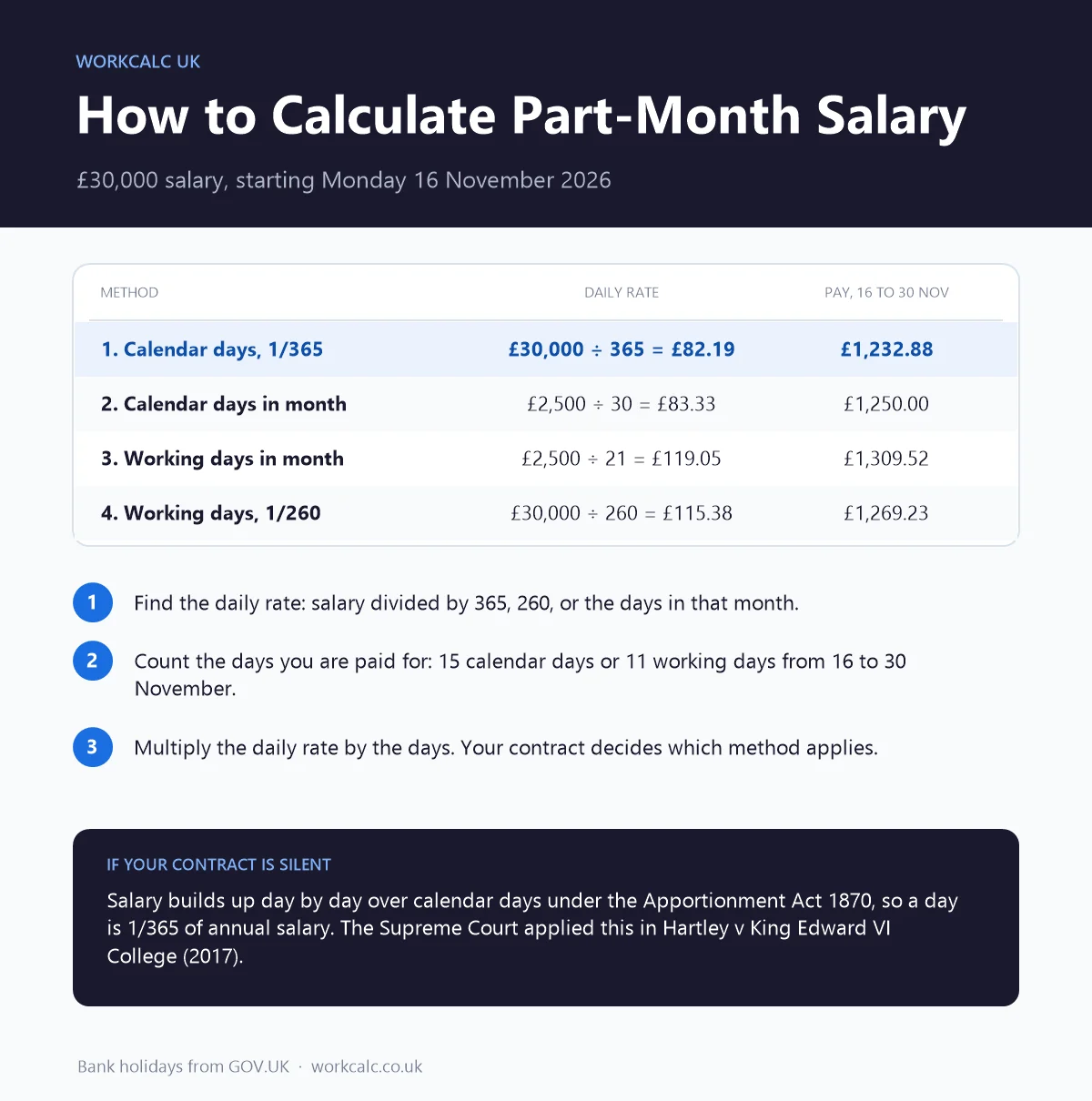
To work out part-month salary, find a daily rate and multiply it by the days you are paid for. If your contract does not say how, UK law treats salary as building up over calendar days, so the daily rate is annual salary ÷ 365. On £30,000, starting on Monday 16 November 2026 earns £1,232.88 for November on that basis. Other methods give £1,232.88 to £1,309.52.
The four ways to calculate part-month pay
Employers in the UK use one of four methods. All of them take a daily rate and multiply it by the days you are paid for. They differ in what counts as a day and what the salary is divided by:
- Calendar days, 1/365 of salary. Annual salary ÷ 365 × calendar days paid. Every day counts, including weekends. This is the legal default where a contract is silent.
- Calendar days in the month. Monthly salary ÷ days in that month × calendar days paid. The daily rate changes from month to month, because February is shorter than March.
- Working days in the month. Monthly salary ÷ working days in that month × working days paid. Common in payroll software, and the daily rate changes with the number of working days.
- Working days, 1/260 of salary. Annual salary ÷ 260 × working days paid, where 260 is 52 weeks of 5 days. Often used for daily rates, unpaid leave and holiday pay.
Methods 2 and 3 always add up to exactly one month's pay for a full month. Methods 1 and 4 do not, so they are usually only used for the part month itself.
Worked example: £30,000, starting Monday 16 November 2026
The 15 calendar days from 16 to 30 November include 11 working days, because the period starts and ends on a Monday. That is why the working-day methods pay more here. A period that starts on a weekend would usually tip the other way. The gap between the highest and lowest result is £76.65.
Which method applies to you?
Check your contract, offer letter or staff handbook first. Phrases such as "pay will be calculated on a daily basis of 1/260th of annual salary" or "pro rata for the days worked in the month" tell you which method your employer uses. Payroll teams usually apply the same method to new starters, leavers and unpaid leave.
If your contract says nothing
Salary is then treated as building up day by day. The Apportionment Act 1870 says periodic payments such as salary accrue from day to day and are split by time, which means calendar days. In Hartley v King Edward VI College (2017) the Supreme Court applied this to teachers paid an annual salary in 12 monthly instalments and held that a day's pay was 1/365 of the annual salary, not 1/260. That is why the calculator leads with the 1/365 result.
If your employer uses a method that gives you less than your contract or the law requires, raise it with payroll first, then through the grievance procedure. An underpayment of wages can be taken to an employment tribunal as an unlawful deduction.
Starting a new job part way through a month
Your first payslip covers only the days from your start date to the end of that pay period. Two other things often make it look odd:
- Payroll cut-off dates. Many employers close each month's payroll a week or more before payday. If you start after the cut-off, your first part month may be paid with your second full month instead. The payroll calendar shows typical cut-off dates for each 2027 payday.
- Tax on the first payslip. A P45, or statement A on the starter checklist, gives you the 1257L code on a cumulative basis, so you may pay little or no tax at first if you have not worked earlier in the tax year. Statement B gives 1257L on a week 1 or month 1 basis, and statement C gives the BR code, which taxes everything at 20% until HMRC sends a proper code.
The salary calculator shows what a full month of the same salary leaves after tax, which is the better guide to your normal take-home pay.
Leaving part way through a month
Your final pay normally includes salary up to your last day of employment, worked out on the same part-month basis, plus pay for any holiday you have built up but not taken. For example, leaving on Friday 12 March 2027 on a £30,000 salary gives £986.30 for March on the 1/365 method and £1,086.96 on working days in the month.
If you have taken more holiday than you have built up, your employer can only take the excess back from your final pay if your contract allows it. The Holiday Accrual Calculator works out your balance, and the Notice Period Calculator works out your last day.
Part-month pay for unpaid leave and strike days
The same methods apply in reverse when pay is deducted for unpaid leave, unauthorised absence or industrial action. A deduction worked out at 1/260 of salary takes more for each day than one at 1/365, which was the point at issue in the Hartley case. If your contract does not set a method, a deduction for one day should normally be 1/365 of annual salary.
Daily rates by month, 2026 and 2027
How much a day is worth on a £30,000 salary (£2,500 a month) under the two monthly methods: the monthly salary divided by the days in the month, or by its working days. Working days count Monday to Friday, with bank holidays treated as paid days. If your employer leaves bank holidays out, a working day is worth a little more.
| Month | Working days | A day: calendar | A day: working |
|---|---|---|---|
| Nov 2026 | 21 | £83.33 | £119.05 |
| Dec 2026 | 23 | £80.65 | £108.70 |
| Jan 2027 | 21 | £80.65 | £119.05 |
| Feb 2027 | 20 | £89.29 | £125.00 |
| Mar 2027 | 23 | £80.65 | £108.70 |
| Apr 2027 | 22 | £83.33 | £113.64 |
| May 2027 | 21 | £80.65 | £119.05 |
| Jun 2027 | 22 | £83.33 | £113.64 |
| Jul 2027 | 22 | £80.65 | £113.64 |
| Aug 2027 | 22 | £80.65 | £113.64 |
| Sep 2027 | 22 | £83.33 | £113.64 |
| Oct 2027 | 21 | £80.65 | £119.05 |
| Nov 2027 | 22 | £83.33 | £113.64 |
| Dec 2027 | 23 | £80.65 | £108.70 |
On the 1/365 method a day is always worth £82.19 on £30,000, and on the 1/260 method always £115.38, whatever the month. For other dates and patterns, use the Working Days Calculator.
Sources
- Apportionment Act 1870, section 2
- Hartley and others v King Edward VI College [2017] UKSC 39
- Employment Rights Act 1996, Part II (protection of wages)
- HMRC, Starter checklist for PAYE
- GOV.UK, UK bank holidays 2026 to 2028
Part-month salary: frequently asked questions
Quick answers about pay for a part month.
How do I calculate part-month salary in the UK?
Work out a daily rate, then multiply it by the days you are paid for. The usual daily rates are your annual salary divided by 365, your monthly salary divided by the days in that month, or your monthly salary divided by the working days in that month. On £30,000, starting on 16 November 2026 gives between £1,232.88 and £1,309.52 depending on the method.
Is part-month pay worked out on calendar days or working days?
It depends on your contract or your employer's payroll policy. If the contract does not say, salary is treated as building up day by day over calendar days under the Apportionment Act 1870, which gives a daily rate of 1/365 of annual salary. The Supreme Court applied this in Hartley v King Edward VI College in 2017.
How much will I be paid if I start halfway through the month?
Roughly half a month's pay, but the exact figure depends on the method. On a £30,000 salary, starting on Monday 16 November 2026 gives £1,232.88 on the 1/365 method, £1,250.00 on calendar days in the month and £1,309.52 on working days in the month.
Why is my first payslip different from my salary?
Two things change a first payslip. You are only paid for the days you were employed, and your tax depends on your starter details. A P45, or statement A on the starter checklist, gives the 1257L code on a cumulative basis, so the first payslip can include tax-free allowance built up since April. Statement B gives 1257L on a week 1 or month 1 basis, and statement C gives the BR code, which taxes everything at 20%.
How is final pay worked out when I leave mid-month?
Your final payslip normally includes salary up to your last day, worked out with the same part-month method, plus pay for any holiday you have built up but not taken. If you have taken more holiday than you have built up, your employer can only deduct it if your contract allows.
What is the daily rate of a £30,000 salary?
On the calendar-day basis it is £30,000 divided by 365, which is £82.19. On a working-day basis it is £30,000 divided by 260, which is £115.38 for a Monday to Friday worker. Which one applies depends on whether you are being paid for calendar days or working days.