
Employers NI Calculator
An employer NI calculator for 2026/27 — work out employer National Insurance on any salary, with the Employment Allowance, zero-rate categories for young staff, and what an employee really costs you in total.
Your payroll
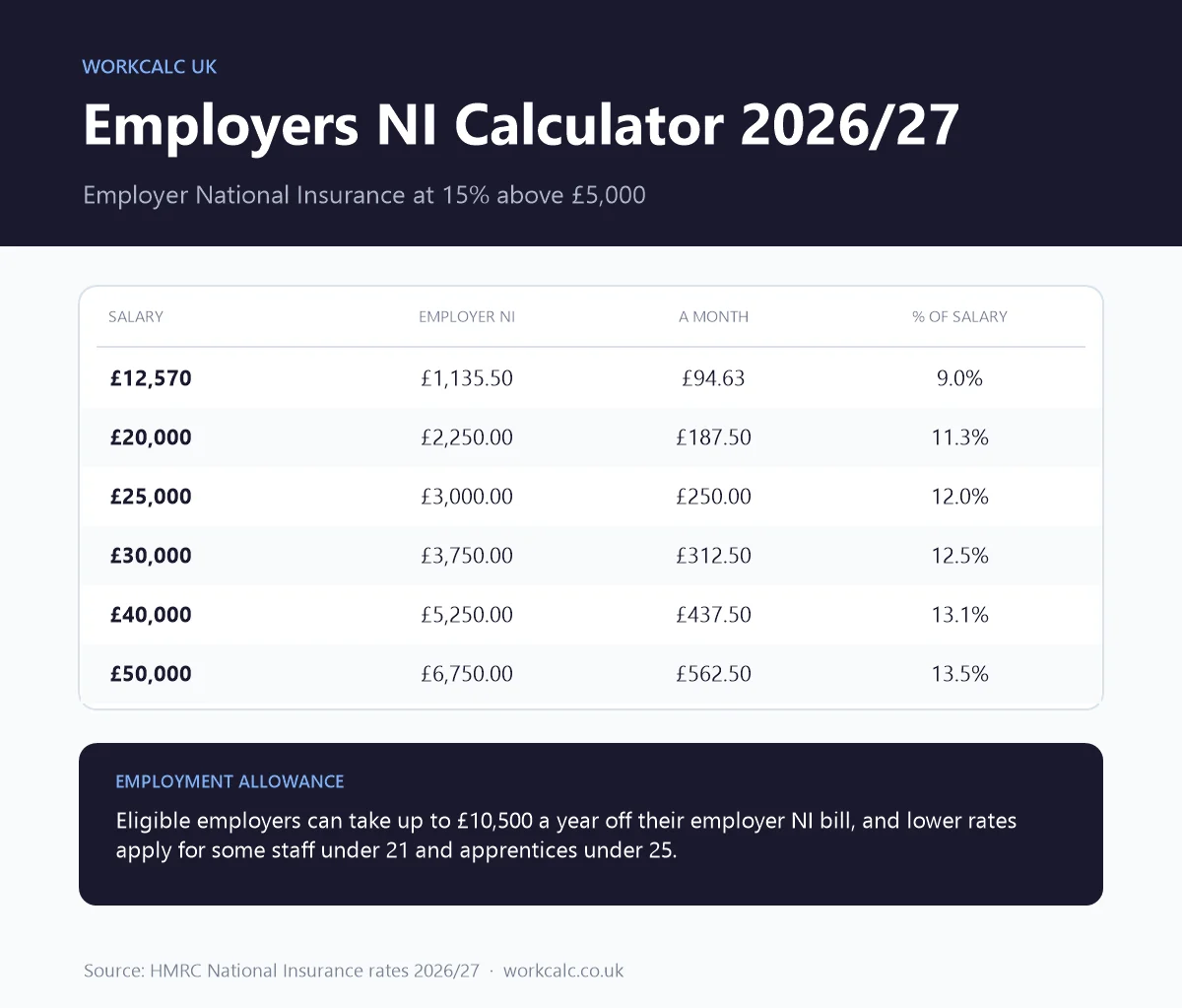
Employer national insurance calculator — cost by salary
15% on earnings above the £5,000 secondary threshold, before any Employment Allowance. Divide the annual figure by 12 for the employers NI calculator monthly equivalent.
| Salary | Employer NI | Per month | % of salary | Total cost with 3% pension |
|---|---|---|---|---|
| £12,570 | £1,135.50 | £94.63 | 9.0% | £13,895.40 |
| £20,000 | £2,250.00 | £187.50 | 11.3% | £22,662.80 |
| £25,000 | £3,000.00 | £250.00 | 12.0% | £28,562.80 |
| £30,000 | £3,750.00 | £312.50 | 12.5% | £34,462.80 |
| £40,000 | £5,250.00 | £437.50 | 13.1% | £46,262.80 |
| £50,000 | £6,750.00 | £562.50 | 13.5% | £58,062.80 |
| £60,000 | £8,250.00 | £687.50 | 13.8% | £69,570.90 |
| £100,000 | £14,250.00 | £1,187.50 | 14.3% | £115,570.90 |
How this employer NIC calculator works
Employer National Insurance contributions — secondary Class 1 NIC — are a cost paid by the business on top of wages. They are never deducted from the employee. To calculate employer NIC, the arithmetic is straightforward:
On a £30,000 salary that is £25,000 charged at 15%, giving £3,750 a year or £312.50 a month. Calculate employers national insurance separately for each employee, then deduct the Employment Allowance once from the combined total.
Worked example — one employee on £30,000
How much employer national insurance has increased
Two changes landed together in April 2025 and both remain in force for 2026/27: the rate rose from 13.8% to 15%, and the secondary threshold was cut from £9,100 to £5,000. The threshold cut gets far less attention but does most of the damage.
| Salary | Old: 13.8% above £9,100 | Now: 15% above £5,000 | Increase |
|---|---|---|---|
| £25,000 | £2,194.20 | £3,000.00 | +£805.80 (37%) |
| £30,000 | £2,884.20 | £3,750.00 | +£865.80 (30%) |
| £50,000 | £5,644.20 | £6,750.00 | +£1,105.80 (20%) |
Note the pattern: the increase is proportionally largest on lower salaries, because dropping the threshold by £4,100 matters more when the salary is smaller. Employers of part-time and lower-paid staff took the biggest hit.
The Employment Allowance — £10,500 off your employer NIC bill
The Employment Allowance reduces your total employer NI bill by up to £10,500 a year. Two things about it are widely misunderstood.
First, it applies once across your whole payroll, not per employee. Second, the old £100,000 eligibility cap has been removed, so size no longer disqualifies you.
| Staff on £30,000 | Employer NI | After allowance |
|---|---|---|
| 1 | £3,750 | £0 |
| 2 | £7,500 | £0 |
| 3 | £11,250 | £750 |
| 5 | £18,750 | £8,250 |
| 10 | £37,500 | £27,000 |
Under-21s and apprentices are zero-rated
This is the largest saving available and it is badly under-used. For employees under 21, and apprentices under 25 on an approved scheme, employer National Insurance is zero up to the upper secondary threshold of £50,270.
| Salary | Standard (cat A) | Under 21 / apprentice | Saving |
|---|---|---|---|
| £25,000 | £3,000.00 | £0.00 | £3,000.00 |
| £30,000 | £3,750.00 | £0.00 | £3,750.00 |
| £50,270 | £6,790.50 | £0.00 | £6,790.50 |
| £60,000 | £8,250.00 | £1,459.50 | £6,790.50 |
The saving caps out at £6,790.50, which is 15% of the gap between £5,000 and £50,270. Armed forces veterans in their first year of civilian employment attract the same zero rate under category V.
What an employee actually costs your business
An employers national insurance calculator only tells you part of the story. Salary is only part of it. Adding employer NI and the minimum auto-enrolment pension takes a £30,000 hire to nearly £34,500:
True cost of a £30,000 employee
Pension contributions are on qualifying earnings — the slice between £6,240 and £50,270 — not the whole salary, which is why 3% of £30,000 is £712.80 rather than £900. Benefits in kind add further cost through Class 1A National Insurance, also charged at 15%.
How to reduce your employer NI contributions
- Claim the Employment Allowance if eligible — £10,500 is often the whole bill for a small team. Run each option through the employer NI contribution calculator above before deciding.
- Use salary sacrifice — every £1,000 sacrificed into a pension saves the employer £150, because sacrificed pay is not salary
- Check your NI categories — under-21s, apprentices under 25 and veterans should not be on category A
- Set director salaries deliberately — £5,000 produces no employer NI; £12,570 costs £1,135.50 but may be covered by the allowance if you have other employees
Salary sacrifice is the most reliable saving because it is entirely within your control. Many employers pass part of the 15% back into the employee's pension, which improves the scheme at no net cost — see the Salary Sacrifice Calculator.
Related guide Is salary sacrifice worth it? What employees and employers save →What this calculator does not cover
- Class 1A on benefits in kind — 15% on company cars, medical insurance and similar, reported on P11D
- The Apprenticeship Levy — 0.5% for employers with a pay bill above £3 million
- Freeport and Investment Zone relief — reduced rates for qualifying new hires in designated sites
- Directors' annual earnings basis — directors are assessed cumulatively across the year, not per pay period
- Employee National Insurance — a separate 8% deduction from the employee, covered by the Take-Home Pay Calculator
Every figure in this employer NI contributions calculator uses HMRC rates and thresholds for 2026/27, unchanged from 2025/26 and frozen until at least 2030/31. Confirm against GOV.UK before making payroll or budget commitments.
Frequently asked questions
Common questions about employer National Insurance in 2026/27.
How much is employer National Insurance in 2026/27?
Employers pay 15% on each employee's earnings above the secondary threshold of £5,000 a year, which is £417 a month or £96.15 a week. On a £30,000 salary that is (£30,000 − £5,000) × 15% = £3,750. The rate and threshold are unchanged from 2025/26.
How do I calculate employers NI?
Subtract the £5,000 secondary threshold from the annual salary, then multiply by 15%. For £35,000 that is £35,000 − £5,000 = £30,000, then × 15% = £4,500. Do this for each employee separately, then deduct the Employment Allowance once from your total bill rather than per person.
What is the Employment Allowance for 2026/27?
£10,500 a year. It reduces your total employer National Insurance bill, not the amount per employee. The £100,000 eligibility cap was removed, so all eligible employers can claim the full amount regardless of payroll size. On £30,000 salaries it covers the employer NI for the first two employees outright.
Can a sole director claim the Employment Allowance?
No. If you are the only director and the only employee subject to employer Class 1 National Insurance, the company cannot claim it. This is why many single-director companies set a salary of exactly £5,000, which sits at the secondary threshold and produces no employer NI at all while remaining deductible against Corporation Tax.
Do you pay employer NI for under-21s and apprentices?
Not on most salaries. For employees under 21, and apprentices under 25, employer National Insurance is zero up to the upper secondary threshold of £50,270. Employing a 20-year-old on £30,000 saves the full £3,750 that would be due for someone aged 21 or over.
How much has employer NI gone up?
Substantially. Before April 2025 the rate was 13.8% with a £9,100 threshold; it is now 15% above £5,000. On a £30,000 salary the bill rose from £2,884 to £3,750 — a 30% increase. On £25,000 the increase is 37%, because the threshold cut hits lower salaries hardest.
What is the total cost of employing someone?
More than the salary. On £30,000 you would pay £3,750 in employer National Insurance plus around £713 in minimum auto-enrolment pension contributions, giving a total of £34,463 — roughly 115% of the headline salary. Higher pension contributions, benefits and Class 1A National Insurance push this further.
Does salary sacrifice reduce employer National Insurance?
Yes. Because sacrificed pay is no longer salary, employer National Insurance is not charged on it. Every £1,000 an employee sacrifices into a pension saves the employer £150. Many employers share part of that saving with the employee, which costs nothing and improves the scheme's value.