
Day Rate Calculator
A contractor day rate calculator that works both ways. Convert a day rate to salary and back — with realistic billable days, the employer costs a salary hides, and what an umbrella actually leaves you.
Your contract
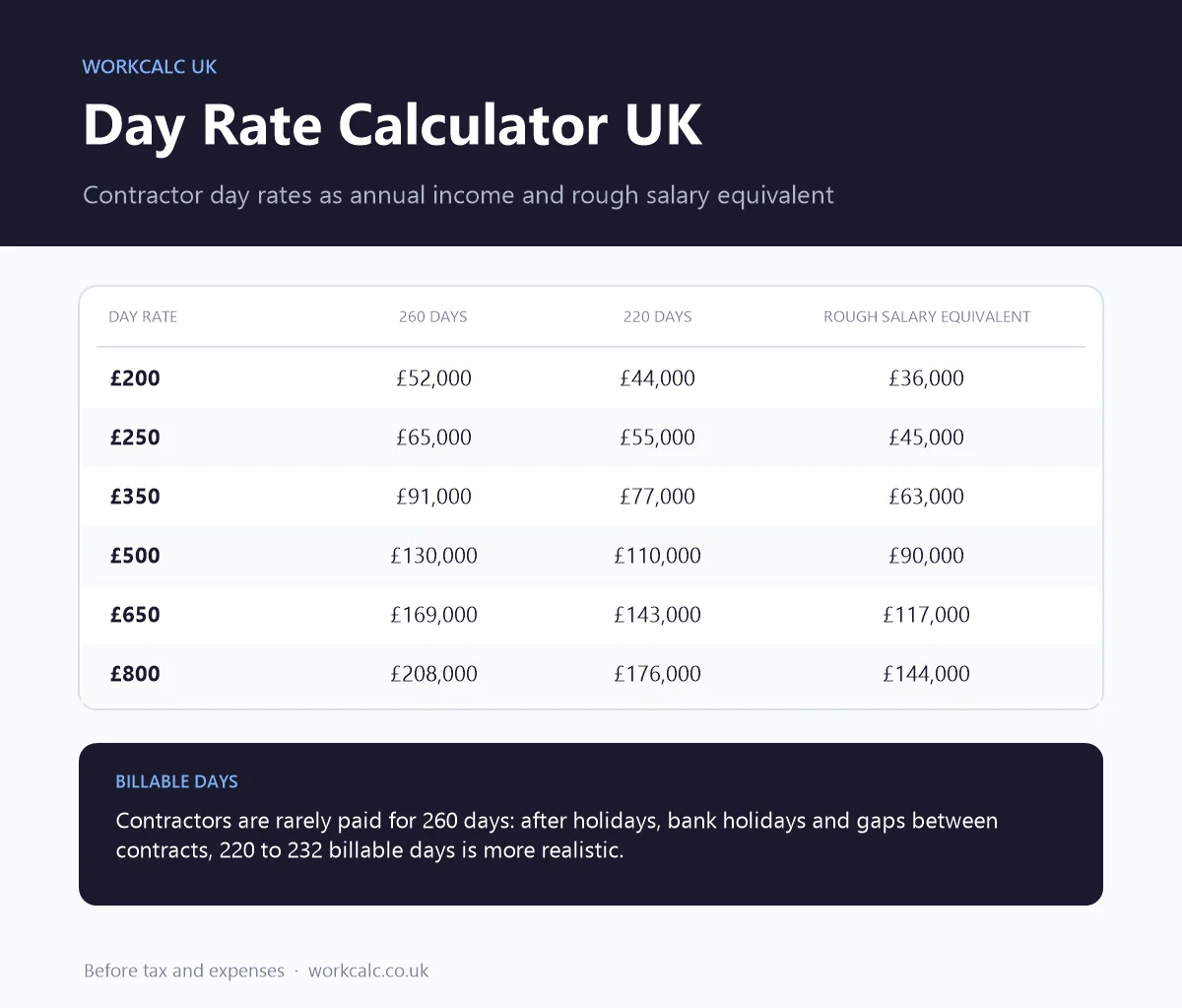
Day rate salary calculator — quick reference
Gross annual value at three billable-day assumptions, and the salary that matches it.
| Day rate | 260 days | 232 days | 220 days | Rough salary equivalent |
|---|---|---|---|---|
| £200 | £52,000 | £46,400 | £44,000 | £36,000 |
| £250 | £65,000 | £58,000 | £55,000 | £45,000 |
| £350 | £91,000 | £81,200 | £77,000 | £63,000 |
| £500 | £130,000 | £116,000 | £110,000 | £90,000 |
| £650 | £169,000 | £150,800 | £143,000 | £117,000 |
| £800 | £208,000 | £185,600 | £176,000 | £144,000 |
Day rate to salary calculator — how the conversion works
To calculate day rate from salary, or salary from a day rate, the arithmetic is trivial. Getting the second number right is not.
At £500 a day the answer ranges from £130,000 to £100,000 depending entirely on what you assume about billable days — a £30,000 swing from the same rate.
Nobody bills 260 days
There are roughly 260 weekdays in a year. Almost every day rate calculator multiplies by that figure, and it is the single biggest reason contractors overestimate their income.
| Assumption | Days | At £500 a day |
|---|---|---|
| Every weekday | 260 | £130,000 |
| Less 28 days holiday | 232 | £116,000 |
| Plus a little sickness and bench time | 220 | £110,000 |
| A cautious first year | 200 | £100,000 |
220 is a reasonable planning figure for an established contractor. If you are new, or working in a market with short contracts, 200 is safer. Every unbilled day is a day you are paying yourself nothing.
Why your daily rate has to beat the salary equivalent
Working out how to calculate a daily rate from an annual salary by simply dividing is misleading, because a salary quietly comes with things a day rate does not.
What a £50,000 employee actually costs an employer
So a £50,000 salary is a £250 day rate, not the £216 you get from dividing. And that still ignores holiday pay, sick pay, redundancy rights, and the fact that a contractor carries accountancy fees and insurance.
Inside IR35 day rate calculator — the umbrella deduction most people miss
This is where day rate expectations collide with reality. When you work inside IR35 through an umbrella company, the advertised rate is not your salary. It is the assignment rate the client pays the umbrella, and employment costs come out of it first.
£500 a day, 220 days, inside IR35
This is why inside-IR35 roles are typically advertised at a higher rate than outside-IR35 ones. When comparing, always convert the assignment rate to gross pay before you compare it with a salary.
Related tool Employers NI Calculator — the 15% coming out of your rate →Outside IR35 and limited company working
Outside IR35 you can operate through a limited company and take a mix of salary and dividends. The usual structure is a small salary — often exactly £5,000, which sits at the secondary National Insurance threshold — with the balance drawn as dividends after Corporation Tax.
That is generally more efficient than PAYE, but it is not free money. Corporation Tax runs from 19% to 25%, dividends are taxed on top, and you carry accountancy fees, insurance and the risk of a status challenge. The gap between inside and outside is narrower than it was before the 2021 reforms.
Related tool Self-Employed Tax Calculator: income tax, Class 4 NI and your first Self Assessment bill →What a day rate has to cover
- Holiday — 28 days unpaid is roughly 11% of your billable capacity
- Sickness — no sick pay, so every day off is lost income
- Pension — no employer contribution, so budget 3% to 8% yourself
- Bench time — gaps between contracts, the hardest cost to predict
- Accountancy and insurance — typically £1,500 to £3,000 a year combined
- No redundancy rights — contracts usually end on short notice
What this calculator does not cover
- Limited company tax — Corporation Tax, dividend tax and expenses need their own modelling
- VAT and the Flat Rate Scheme — relevant above the £90,000 registration threshold
- Pension contributions through the umbrella — these reduce taxable pay and can be very efficient
- Expenses — most umbrella workers cannot claim travel and subsistence under the supervision, direction and control rules
- Scotland — different income tax bands change the take-home figures
This day rate calculator uk uses HMRC income tax and National Insurance thresholds for 2026/27. Switch the direction toggle to use it as a salary to day rate calculator instead. To model a specific salary in detail, use the Take-Home Pay Calculator, or the Hourly to Annual Converter if you are paid by the hour rather than the day.
Frequently asked questions
Common questions about day rates, contracting and IR35.
How do I convert a day rate to a salary?
Multiply the day rate by the number of days you expect to bill in a year. Using 232 days — every weekday minus 28 days of leave — a £500 day rate is £116,000 a year. Using all 260 weekdays gives £130,000, but that assumes you never take a holiday and are never between contracts.
How many billable days are there in a year?
There are about 260 weekdays, but nobody bills all of them. Take off 28 days for holiday and you are at 232. Most contractors also lose days to sickness, training and gaps between contracts, so 220 is a realistic planning figure and 200 is prudent for a first year.
What day rate matches a £50,000 salary?
Around £250 a day over 232 billable days. That is not £50,000 divided by 232, which gives £216 — the higher figure accounts for the employer National Insurance and pension your employer currently pays on top of your salary, worth about £8,000 a year.
How much do you keep on an inside IR35 day rate?
Roughly 60% of the assignment rate. On £500 a day over 220 days the assignment value is £110,000, but after the umbrella deducts employer National Insurance, the Apprenticeship Levy and its margin, your gross pay is about £94,892 and your take-home is around £65,595.
Does the umbrella company take employer National Insurance from my rate?
Yes, and it surprises most people. The assignment rate is what the client pays the umbrella, not your salary. Employer National Insurance at 15% and the Apprenticeship Levy at 0.5% come out of that figure before your gross pay is worked out, along with the umbrella's own margin.
What is the difference between inside and outside IR35?
Inside IR35 means the engagement is treated as employment for tax, so income tax and National Insurance are deducted through PAYE, usually via an umbrella company. Outside IR35 means you can operate through a limited company and pay yourself a mix of salary and dividends, which is generally more tax-efficient but carries the risk of a status challenge.
Should I charge more as a contractor than my salary equivalent?
Yes, substantially. A contract day rate has to cover holiday, sickness, pension, gaps between contracts, accountancy fees, insurance and the absence of redundancy rights. A common rule of thumb is that a contract rate should be at least 30% above the pure salary equivalent to leave you no worse off.
How do I work out a daily rate from an annual salary?
Divide the annual salary by your billable days. On 232 days a £75,000 salary is £323 a day. If you are pricing a contract rather than comparing jobs, add the employer costs and a margin for unbilled time — that £75,000 role costs an employer around £86,000 in total, which is £371 a day.