
UK Minimum Wage 2026 — Every Rate by Age
The national minimum wage 2026 rates in full, by age band — what each is worth over a year, and how to check whether you are actually being paid it.
Your situation
UK minimum wage 2026 — full rate table
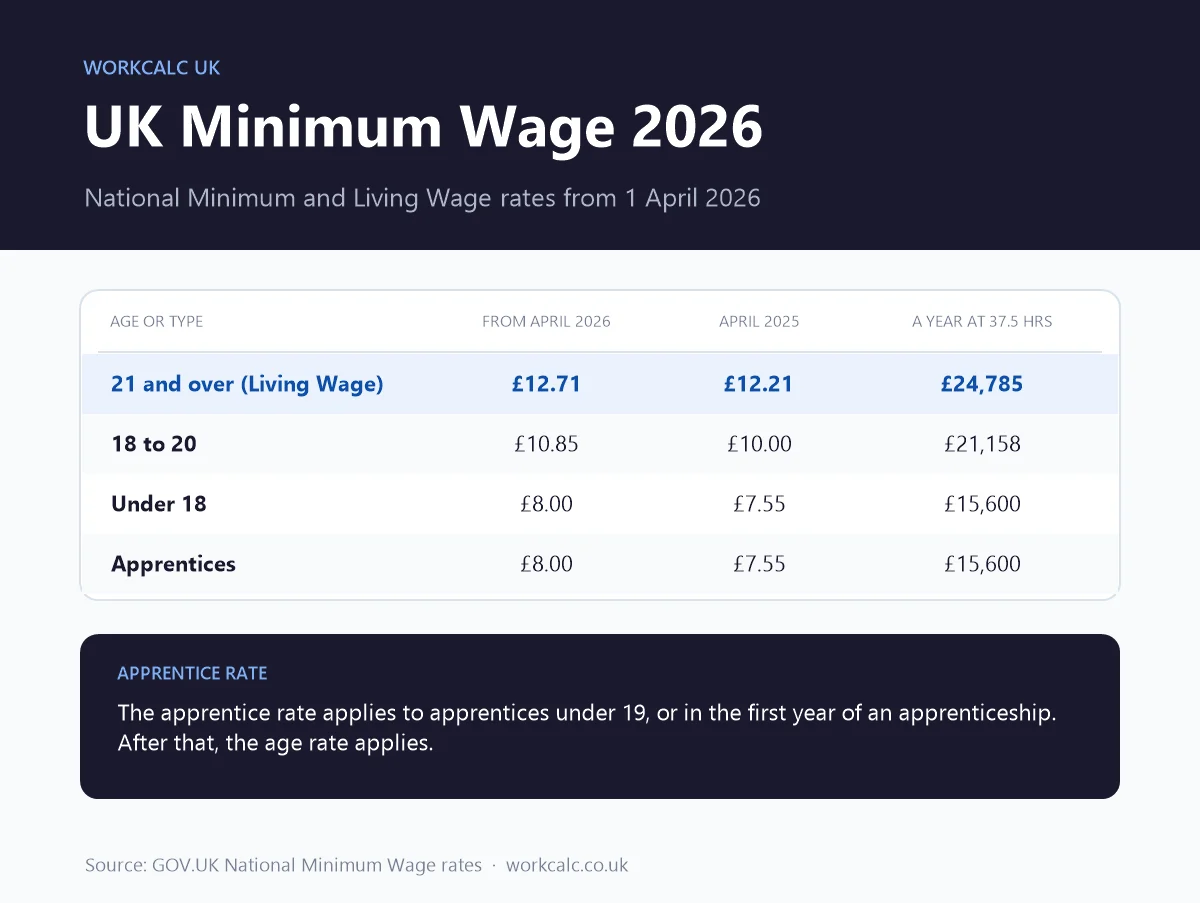
The minimum wage 2026 uk rates in force from 1 April 2026 across all four nations. Annual figures assume a 37.5-hour week.
| Who it applies to | From April 2026 | Was (April 2025) | Increase | A year at 37.5 hrs |
|---|---|---|---|---|
| 21 and over — National Living Wage | £12.71 | £12.21 | +4.1% | £24,785 |
| 18 to 20 | £10.85 | £10.00 | +8.5% | £21,158 |
| Under 18 | £8.00 | £7.55 | +6.0% | £15,600 |
| Apprentices — under 19, or first year | £8.00 | £7.55 | +6.0% | £15,600 |
| Accommodation offset (daily maximum) | £11.10 | £10.66 | +4.1% | £77.70 a week |
What is the minimum wage 2026?
From 1 April 2026 the UK minimum wage 2026 rates are:
The top rate is the national living wage 2026 figure and the others are the national minimum wage 2026 rates. Both are legally binding, both apply UK-wide, and both are set by the UK government following recommendations from the Low Pay Commission each autumn.
£12.71 an hour: minimum wage per day, week, month and year
These are the gross amounts the minimum wage pays for common working patterns, before tax and National Insurance. Monthly figures are the yearly total divided by 12, which is how monthly pay is normally worked out.
National Living Wage, £12.71 an hour (21 and over)
| Hours a week | A week | A month | A year |
|---|---|---|---|
| 7.5 (one day) | £95.33 | £413.08 | £4,956.90 |
| 8 (one day) | £101.68 | £440.61 | £5,287.36 |
| 10 | £127.10 | £550.77 | £6,609.20 |
| 15 | £190.65 | £826.15 | £9,913.80 |
| 20 | £254.20 | £1,101.53 | £13,218.40 |
| 25 | £317.75 | £1,376.92 | £16,523.00 |
| 30 | £381.30 | £1,652.30 | £19,827.60 |
| 35 | £444.85 | £1,927.68 | £23,132.20 |
| 37.5 | £476.63 | £2,065.38 | £24,784.50 |
| 40 | £508.40 | £2,203.07 | £26,436.80 |
| 48 (average weekly limit) | £610.08 | £2,643.68 | £31,724.16 |
A single 7.5-hour shift at £12.71 pays £95.33, an 8-hour shift £101.68 and a 12-hour shift, common in care work and warehouses, £152.52. If you are paid every four weeks rather than monthly, multiply the weekly figure by 4: you get 13 pay days a year instead of 12, so each one is a little smaller.
£10.85 an hour (18 to 20)
| Hours a week | A week | A year |
|---|---|---|
| 8 (one day) | £86.80 | £4,513.60 |
| 16 | £173.60 | £9,027.20 |
| 20 | £217.00 | £11,284.00 |
| 30 | £325.50 | £16,926.00 |
| 37.5 | £406.88 | £21,157.50 |
| 40 | £434.00 | £22,568.00 |
£8.00 an hour (under 18 and apprentices)
| Hours a week | A week | A year |
|---|---|---|
| 8 (one day) | £64.00 | £3,328.00 |
| 16 | £128.00 | £6,656.00 |
| 20 | £160.00 | £8,320.00 |
| 30 | £240.00 | £12,480.00 |
| 37.5 | £300.00 | £15,600.00 |
| 40 | £320.00 | £16,640.00 |
Minimum wage after tax
Take-home pay on the National Living Wage for a worker aged 21 or over, with a 1257L tax code, in England, Wales or Northern Ireland, with no pension or student loan. The gross figures are in the first table above.
| Hours a week | Take-home a year | A month | A week |
|---|---|---|---|
| 20 hours | £13,036.85 | £1,086.40 | £250.71 |
| 30 hours | £17,795.47 | £1,482.96 | £342.22 |
| 35 hours | £20,174.78 | £1,681.23 | £387.98 |
| 37.5 hours | £21,364.44 | £1,780.37 | £410.85 |
| 40 hours | £22,554.10 | £1,879.51 | £433.73 |
At 20 hours a week the yearly pay is only just above the £12,570 personal allowance, so almost all of it is kept. A workplace pension or student loan would lower these figures. The Hourly to Annual Salary Calculator works out any rate and hours after tax.
Minimum wage by age — what changes on each birthday
Your entitlement changes on your birthday, and your employer must apply the new rate from the start of the next pay reference period after it. The steps are large.
| Birthday | Rate goes from | To | Extra per year at 37.5 hrs |
|---|---|---|---|
| Turning 18 | £8.00 | £10.85 | +£5,557 |
| Turning 21 | £10.85 | £12.71 | +£3,627 |
Turning 18 is the biggest single jump in the UK pay system — a 36% rise overnight. Turning 21 adds a further 17%. Between them, the same job pays £9,184 a year more at 21 than it did at 17.
Minimum wage 18 year old — £10.85 from April 2026
£10.85 an hour, up from £10.00 in April 2025 — an 8.5% rise, the largest of any band. That is deliberate: the government has been narrowing the gap between the 18–20 rate and the National Living Wage with the long-term aim of a single adult rate.
At 37.5 hours a week that is £21,158 a year gross. The gap to the 21+ rate has closed from £2.21 an hour in 2025 to £1.86 in 2026.
Minimum wage for 21 year old — the full National Living Wage
£12.71 an hour — the full National Living Wage. Since April 2024 this has applied from age 21 rather than 23, so 21 and 22 year olds moved up two years earlier than under the old rules.
On a 37.5-hour week that is £24,785 gross, or about £21,364 after income tax and National Insurance.
Related tool Hourly to Annual Converter — turn any rate into yearly pay →The apprentice rate, and when it stops applying
The apprentice rate of £8.00 is the most misapplied rate in the system. It applies only if you are:
- Under 19, at any stage of the apprenticeship, or
- 19 or over and in the first year of your apprenticeship
A 20-year-old in the second year of an apprenticeship is owed £10.85, not £8.00. Over a year at 37.5 hours that is a difference of £5,557.
Minimum wage Scotland, Wales and Northern Ireland — is it different?
No. The National Minimum Wage and National Living Wage are reserved to the UK government and apply identically in all four nations. Minimum wage is not devolved, and there is no separate Scottish or Welsh minimum wage.
What does differ is income tax. Scotland sets its own bands, so someone on the National Living Wage in Glasgow keeps a slightly different amount from someone on the same rate in Leeds. On £24,785 the Scottish taxpayer pays marginally less, because the Scottish Starter rate is 19%.
The real Living Wage is a different thing entirely
Two similar names cause constant confusion:
| National Living Wage | Real Living Wage | |
|---|---|---|
| Set by | UK government | Living Wage Foundation |
| Legally binding? | Yes | No — voluntary |
| Based on | A target share of median earnings | The actual cost of living |
| Applies from | Age 21 | Age 18 |
| London rate? | No — one UK rate | Yes — a separate, higher London rate |
An employer advertising "we pay the Living Wage" usually means the voluntary Living Wage Foundation rate, which is higher than the statutory minimum. Only the National Living Wage can be enforced by HMRC.
What counts as working time
Minimum wage is calculated across all the time you are required to work, not just the hours on your rota. These count and are frequently missed:
- Travel between assignments during the working day, though not commuting from home
- Training your employer requires, including online modules done at home
- Time spent on premises before or after shifts — security searches, handovers, opening and closing up
- Unpaid trial shifts, which are only lawful in very limited circumstances
- Sleep-in shifts, depending on whether you are working or merely available
A common breach is deducting for uniform or equipment. If a deduction for the employer's own benefit takes your effective hourly rate below the minimum, that is unlawful even if you agreed to it.
Accommodation offset
If your employer provides accommodation, they can count some of its value towards minimum wage — but only up to £11.10 a day, or £77.70 a week, from April 2026. Anything charged above that reduces your pay for minimum wage purposes and can push you below the legal floor.
What to do if you are underpaid
- Check your payslip carefully. Divide total pay by total hours worked, including unpaid time that should count.
- Raise it with your employer. Most underpayments are payroll errors, especially after a birthday or an April rate change.
- Report it to HMRC. Free, and you can do it anonymously. HMRC investigates and can order back pay.
- Contact ACAS on 0300 123 1100 for free advice if you want to talk it through first.
The minimum wage increase 2026, and what comes next
The uk minimum wage increase 2026 took effect on 1 April, and rates rise every year on that date. The Low Pay Commission makes recommendations in the autumn and the government confirms them, normally at the Budget. The direction of travel has been consistent: the National Living Wage rising toward two-thirds of median earnings, and the 18–20 rate closing the gap toward a single adult rate.
Every figure here is a statutory national minimum wage 2026 rate in force from 1 April 2026. To see what a rate is worth over a year, use the hourly to annual converter, or check whether a part-time salary meets the minimum. To see what the 50p an hour rise is worth after tax, use the pay rise calculator.
Frequently asked questions
Common questions about UK minimum wage rates.
What is the minimum wage in 2026?
From 1 April 2026 the National Living Wage for workers aged 21 and over is £12.71 an hour. Workers aged 18 to 20 get £10.85, and those under 18 or on an apprenticeship get £8.00. These replaced the 2025 rates of £12.21, £10.00 and £7.55.
What is the minimum wage for an 18 year old?
£10.85 an hour from 1 April 2026, up from £10.00. The 18 to 20 rate applies from your eighteenth birthday until the day before you turn 21, when you move to the National Living Wage of £12.71. Turning 18 is the single biggest jump in the system — worth around £5,557 a year on a 37.5-hour week.
What is the minimum wage for a 21 year old?
£12.71 an hour, the full National Living Wage. Since April 2024 the National Living Wage has applied from age 21 rather than 23, so 21 and 22 year olds now get the top rate. On a 37.5-hour week that is about £24,785 a year before tax.
Is the minimum wage different in Scotland?
No. The National Minimum Wage and National Living Wage are set by the UK government and apply identically across England, Scotland, Wales and Northern Ireland. Minimum wage is not devolved. What does differ in Scotland is income tax, so take-home pay on the same hourly rate is not the same.
What is the apprentice minimum wage?
£8.00 an hour from 1 April 2026. It applies to apprentices under 19, and to those aged 19 and over who are in the first year of their apprenticeship. After the first year, an apprentice aged 19 or over must be paid the normal rate for their age.
When does the minimum wage go up?
Every year on 1 April. The Low Pay Commission recommends the rates in the autumn and the government confirms them, usually at the Budget. The April 2026 increase was 4.1% for the National Living Wage and 8.5% for 18 to 20 year olds, continuing the policy of narrowing the gap between the age bands.
How much is minimum wage a year?
On the National Living Wage of £12.71, a 37.5-hour week comes to £24,785 a year before tax, and a 40-hour week to £26,437. For 18 to 20 year olds on £10.85 it is £21,158 at 37.5 hours. Very few minimum wage jobs guarantee those hours every week, so treat them as an upper figure.
What can I do if I am paid below the minimum wage?
Raise it with your employer first, as it is often a payroll error. If that does not work, you can report it to HMRC free and anonymously, or contact ACAS on 0300 123 1100. HMRC can order back pay for up to six years and fine the employer up to 200% of the arrears.
How much is £12.71 an hour for 37.5 hours a week?
£12.71 an hour for 37.5 hours is £476.63 a week, £2,065.38 a month or £24,784.50 a year before tax. After income tax and National Insurance that is about £21,364.44 a year, or £1,780.37 a month.
What is the minimum wage a year on a 35-hour week?
On a 35-hour week the National Living Wage of £12.71 pays £444.85 a week and £23,132.20 a year before tax, which leaves about £20,174.78 after income tax and National Insurance.
How much is £10.85 an hour for 40 hours a week?
£10.85 an hour for 40 hours is £434.00 a week and £22,568.00 a year before tax. £10.85 is the 2026 minimum wage for workers aged 18 to 20.