
Working Days Calculator UK
Count the working days between two dates, or add working days to a date, leaving out weekends and bank holidays for England and Wales, Scotland or Northern Ireland. Set your own working days for part-time or shift patterns.
Bank holidays from GOV.UK for 2019 to 2028. Dates outside that range are counted without bank holidays. Local holidays, such as Scottish council holidays, are not included.
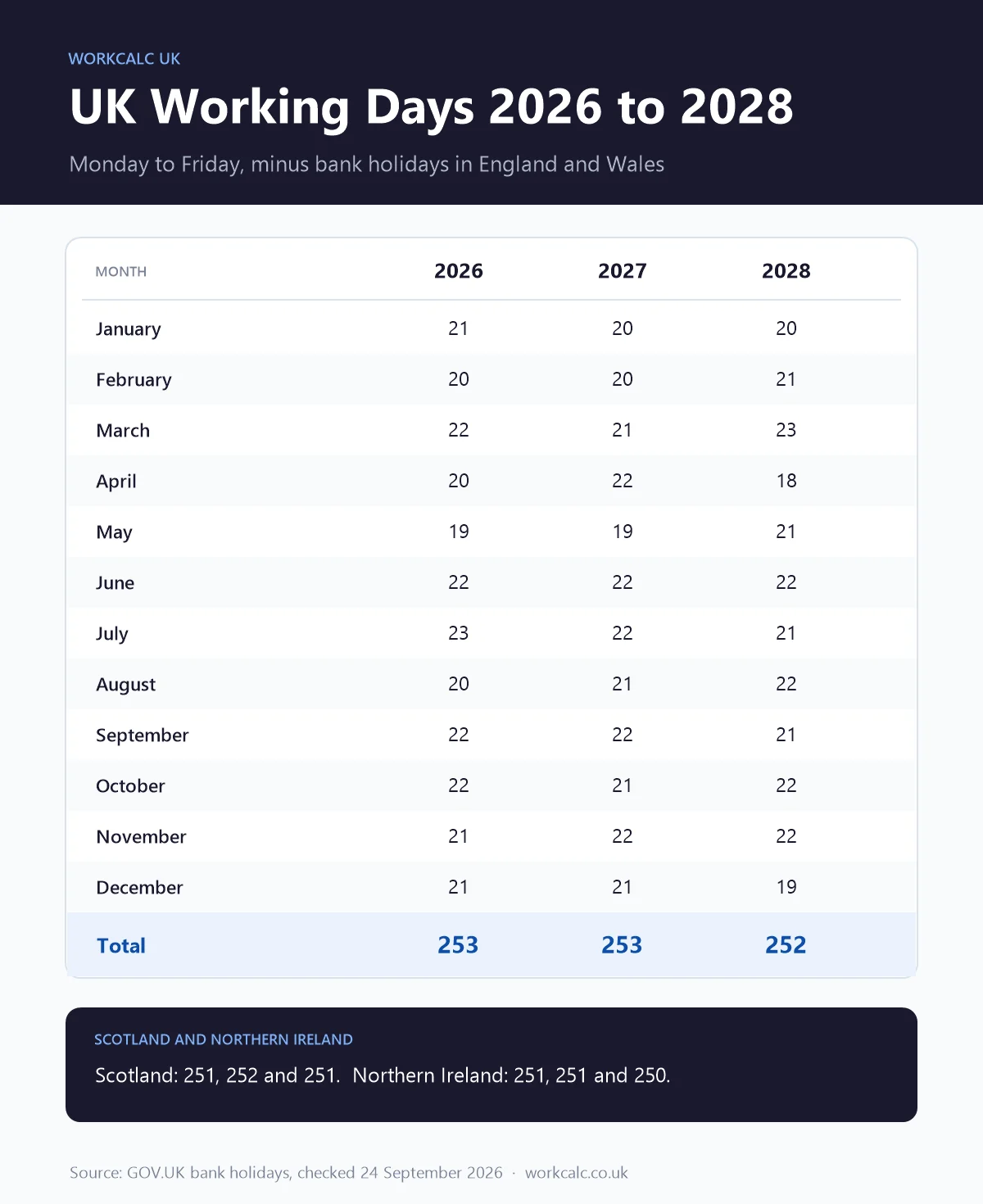
A working day in the UK normally means Monday to Friday, excluding bank holidays. 2027 has 253 working days in England and Wales, 252 in Scotland and 251 in Northern Ireland. 2026 has 253 in England and Wales and 251 in Scotland and Northern Ireland, and 2028 has 252, 251 and 250.
How to calculate working days between two dates
The calculator does this for you, but the method is simple:
- Count the calendar days from the start date to the end date, including both if you want them counted.
- Take off the weekends, or any other days you do not work.
- Take off bank holidays that fall on a working day, using the dates for the nation you work in.
Worked example: 21 December 2026 to 8 January 2027
In Scotland the answer is 11, because Monday 4 January 2027 is also a bank holiday there.
Working days per month, 2026 to 2028
For a Monday to Friday worker in England and Wales:
| Month | 2026 | 2027 | 2028 |
|---|---|---|---|
| January | 21 | 20 | 20 |
| February | 20 | 20 | 21 |
| March | 22 | 21 | 23 |
| April | 20 | 22 | 18 |
| May | 19 | 19 | 21 |
| June | 22 | 22 | 22 |
| July | 23 | 22 | 21 |
| August | 20 | 21 | 22 |
| September | 22 | 22 | 21 |
| October | 22 | 21 | 22 |
| November | 21 | 22 | 22 |
| December | 21 | 21 | 19 |
| Total | 253 | 253 | 252 |
Working days a year by nation
| Year | Weekdays | England and Wales | Scotland | N Ireland |
|---|---|---|---|---|
| 2025 | 261 | 253 | 252 | 251 |
| 2026 | 261 | 253 | 251 | 251 |
| 2027 | 261 | 253 | 252 | 251 |
| 2028 | 260 | 252 | 251 | 250 |
Scotland has 251 working days in 2026 rather than 252 because of the one-off World Cup bank holiday on 15 June. See every date on our UK bank holidays page.
Working days for part-time and shift workers
If you do not work Monday to Friday, tick the days you do work. The calculator then counts only those days and only leaves out bank holidays that fall on them. For example, someone who works Monday to Wednesday has 150 working days in 2027 in England and Wales, because five of the eight bank holidays fall on a Monday and one on a Tuesday.
This matters for holiday. Part-time staff are entitled to 5.6 weeks of their own working pattern, and a Monday worker can lose out on bank holidays unless the employer pro-rates them. The Part-Time Holiday Calculator works out a fair share.
Working days and your pay
Daily pay is often worked out from working days. There are three common methods, and they give different answers. On a £35,000 salary:
| Method | Divide by | Daily rate |
|---|---|---|
| Actual working days in 2027 (England and Wales) | 253 | £138.34 |
| All weekdays in the year | 261 | £134.10 |
| 52 weeks of 5 days | 260 | £134.62 |
Your contract or staff handbook should say which one your employer uses, for example when paying for unpaid leave or a part month. To turn a salary into take-home pay per day or hour, use the salary calculator, and for part-time salaries the Pro Rata Salary Calculator.
Working days in Excel and Google Sheets
Both Excel and Google Sheets have built-in functions that do the same job, as long as you give them a list of bank holidays:
- =NETWORKDAYS(start, end, holidays) counts working days between two dates, Monday to Friday, counting both the start and end dates.
- =NETWORKDAYS.INTL(start, end, "0001111", holidays) uses your own working week. The seven digits run Monday to Sunday, with 1 meaning a day off, so "0001111" is Monday to Wednesday.
- =WORKDAY(start, days, holidays) gives the date a number of working days after the start. Use a negative number to count backwards.
The "holidays" argument is a range of cells holding the bank holiday dates for your nation, which you can copy from our bank holidays tables.
What counts as a working day?
There is no single legal definition. In most contracts and everyday use, a working day or business day is Monday to Friday, excluding bank holidays. Some laws and contracts define it differently, for example by including Saturdays, or by using the bank holidays of a particular part of the UK, so check the wording if a deadline matters. Statutory notice periods, for instance, are set in weeks rather than working days; the Notice Period Calculator handles those.
Sources
- GOV.UK, UK bank holidays data for England and Wales, Scotland and Northern Ireland, 2019 to 2028
- Microsoft Support, NETWORKDAYS, NETWORKDAYS.INTL and WORKDAY functions
- GOV.UK, Holiday entitlement for part-time workers
Working days: frequently asked questions
Quick answers about UK working days.
How many working days are there in 2027 in the UK?
For a Monday to Friday worker, 2027 has 253 working days in England and Wales, 252 in Scotland and 251 in Northern Ireland. That is 261 weekdays minus each nation's bank holidays.
How many working days are there in 2026?
2026 has 253 working days in England and Wales, and 251 in both Scotland and Northern Ireland. Scotland has one fewer than usual because of the World Cup bank holiday on 15 June 2026.
How many working days are there in a year in the UK?
Usually between 250 and 253 for someone working Monday to Friday in England and Wales. A year has 260 or 261 weekdays, and 8 bank holidays come off that. Scotland and Northern Ireland have one or two fewer working days because they have more bank holidays.
How many working days are there in a month?
Between 18 and 23, and about 21 on average. It depends on how many weekends and bank holidays fall in the month. For example, April 2028 has only 18 working days in England and Wales because of Easter, while July 2026 has 23.
Are bank holidays counted as working days?
Usually not. Most people treat a working day as a weekday that is not a bank holiday, and this calculator excludes bank holidays by default. If your contract or a particular rule counts them, choose not to exclude bank holidays.
Do working days include Saturdays?
Not normally. In the UK a working day or business day usually means Monday to Friday, excluding bank holidays. If you work weekends or a shift pattern, tick the days you work in the calculator and it will count those instead.
How do I calculate working days between two dates?
Count the calendar days between the dates, subtract the weekends, then subtract any bank holidays that fall on a weekday. From 21 December 2026 to 8 January 2027 there are 19 calendar days, 4 weekend days and 3 bank holidays, which leaves 12 working days in England and Wales.
How do I add working days to a date?
Count forward one day at a time, skipping weekends and bank holidays, until you have counted the number of working days. The start date itself is not counted. For example, 10 working days after Friday 18 December 2026 is Wednesday 6 January 2027 in England and Wales.