
UK Salary Calculator 2026/27
See what your salary leaves you after income tax, National Insurance, pension and student loan. Enter a yearly, monthly, weekly or hourly figure, or work backwards from the take-home pay you need.
| Year | Month | Week | Day | Hour |
|---|
Income tax by band
What you cost your employer
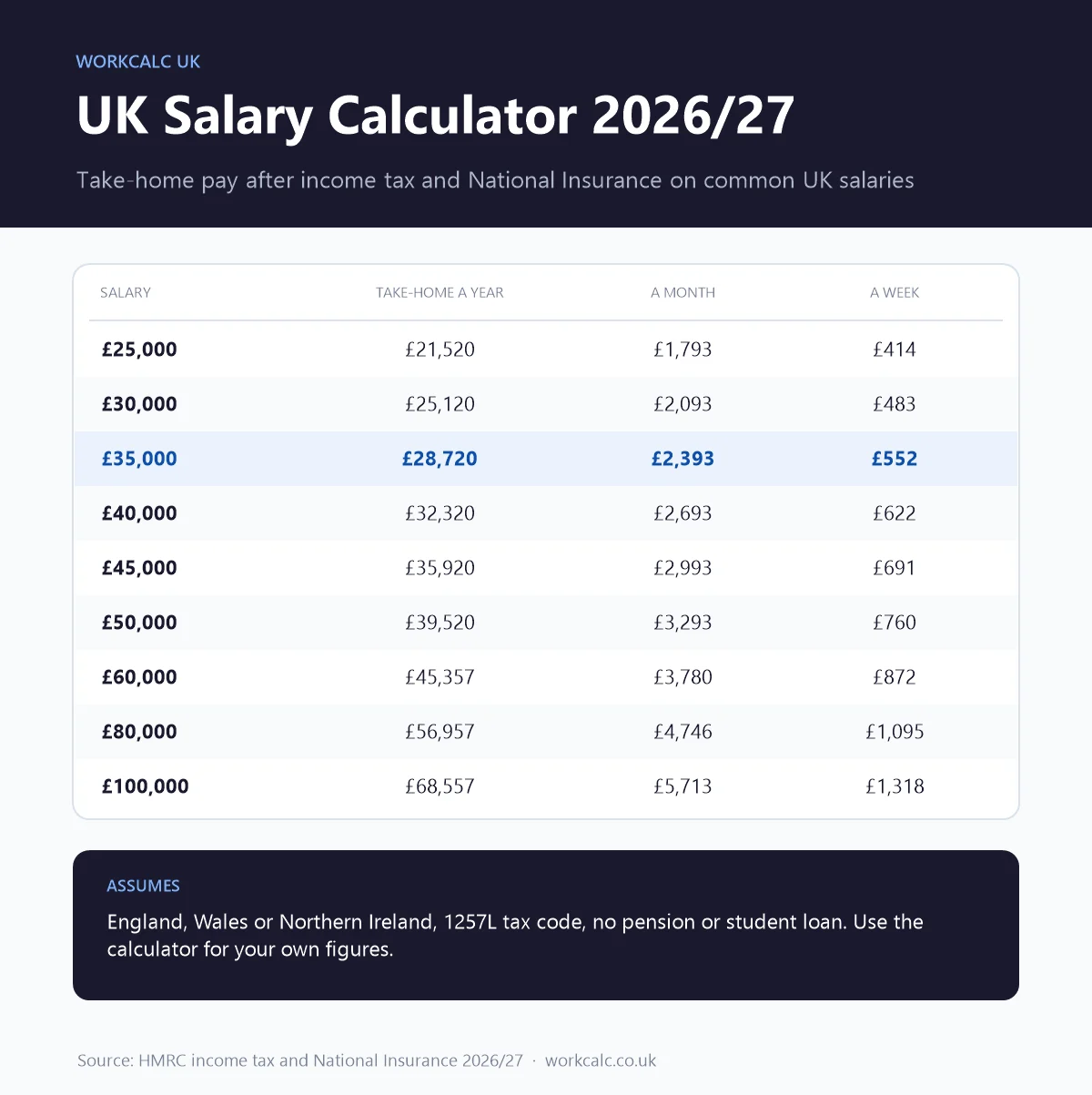
Take-home pay on popular UK salaries, 2026/27
England, Wales and Northern Ireland, 1257L tax code, no pension or student loan. Select a salary for its full breakdown.
| Salary | Income tax | National Insurance | Take-home a year | A month | A week | Deducted |
|---|---|---|---|---|---|---|
| £25,000 | £2,486.00 | £994.40 | £21,519.60 | £1,793.30 | £413.84 | 13.9% |
| £30,000 | £3,486.00 | £1,394.40 | £25,119.60 | £2,093.30 | £483.07 | 16.3% |
| £35,000 | £4,486.00 | £1,794.40 | £28,719.60 | £2,393.30 | £552.30 | 17.9% |
| £38,000 | £5,086.00 | £2,034.40 | £30,879.60 | £2,573.30 | £593.84 | 18.7% |
| £40,000 | £5,486.00 | £2,194.40 | £32,319.60 | £2,693.30 | £621.53 | 19.2% |
| £45,000 | £6,486.00 | £2,594.40 | £35,919.60 | £2,993.30 | £690.76 | 20.2% |
| £50,000 | £7,486.00 | £2,994.40 | £39,519.60 | £3,293.30 | £759.99 | 21.0% |
| £55,000 | £9,432.00 | £3,110.60 | £42,457.40 | £3,538.12 | £816.49 | 22.8% |
| £60,000 | £11,432.00 | £3,210.60 | £45,357.40 | £3,779.78 | £872.26 | 24.4% |
| £75,000 | £17,432.00 | £3,510.60 | £54,057.40 | £4,504.78 | £1,039.57 | 27.9% |
| £80,000 | £19,432.00 | £3,610.60 | £56,957.40 | £4,746.45 | £1,095.33 | 28.8% |
| £100,000 | £27,432.00 | £4,010.60 | £68,557.40 | £5,713.12 | £1,318.41 | 31.4% |
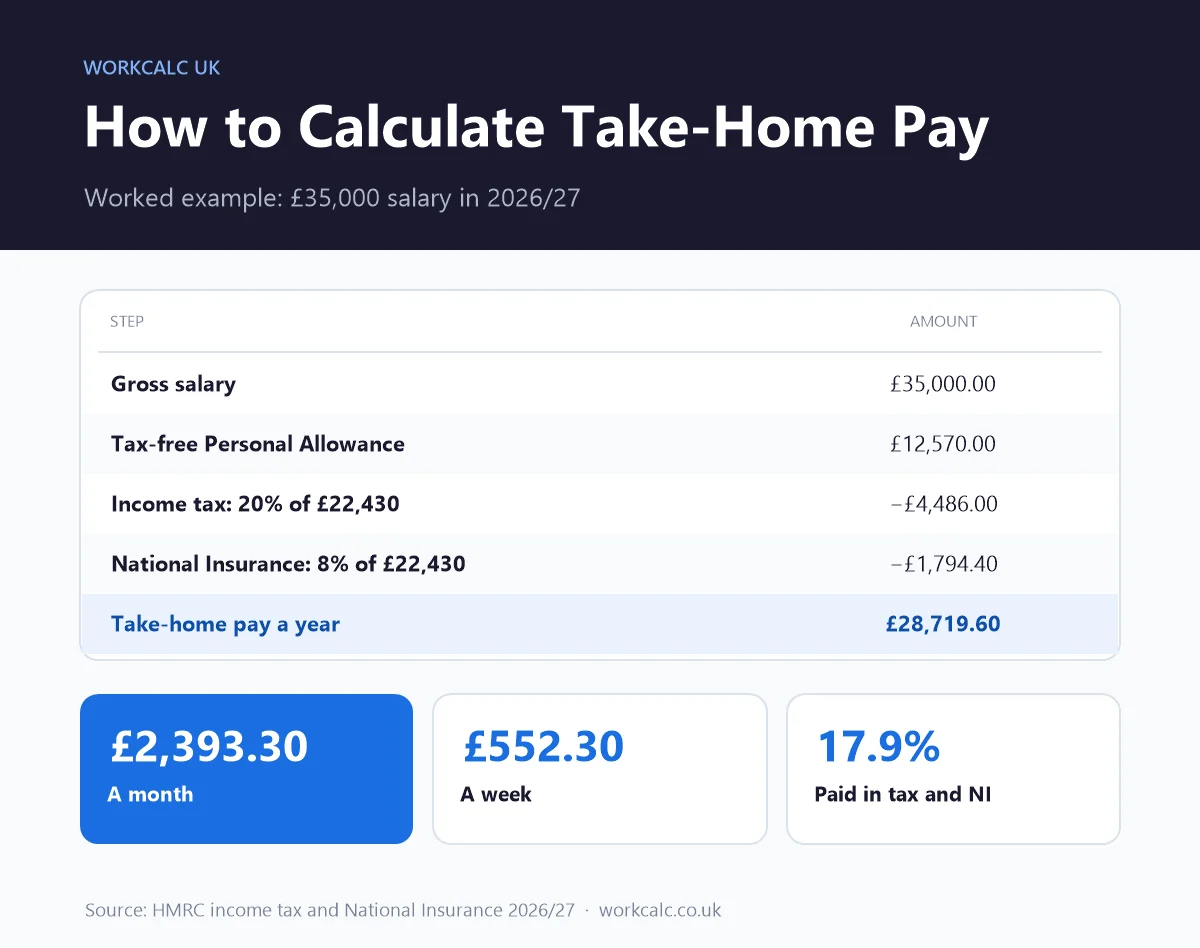
In 2026/27 the first £12,570 of your salary is tax-free. You pay 20% income tax on the next £37,700 and 8% National Insurance on earnings from £12,570 to £50,270. So a £35,000 salary leaves £28,719.60 a year, or £2,393.30 a month, before any pension or student loan.
How to calculate take-home pay from your salary
Every UK payslip follows the same order. You can work it out by hand in five steps:
- Start with gross pay. This is your salary plus any bonus, overtime or commission in the year.
- Take off pension contributions made before tax. Workplace schemes, salary sacrifice, the Teachers' Pension and the NHS Pension all reduce the income you pay tax on.
- Work out income tax. Subtract your £12,570 Personal Allowance, then apply 20% on the next £37,700, 40% up to £125,140 and 45% above that. Scotland uses six bands instead.
- Work out National Insurance. Employees pay 8% on earnings between £12,570 and £50,270 and 2% on anything above. Pension contributions only reduce this if they are made by salary sacrifice.
- Take off student loan repayments. These are 9% of earnings above your plan's threshold, plus 6% above £21,000 for a Postgraduate Loan.
Worked example: £40,000 salary take-home pay
Without the pension, the same £40,000 salary takes home £32,319.60, or £2,693.30 a month. The pension costs £1,600 of take-home pay but puts £2,000 into your pot, because the contribution is taken before income tax.
Which pension type do you have?
Your payslip depends on how your pension is taken, not just how much you pay in. These are the three types, shown for a 5% contribution on £35,000:
| Pension type | How it is taken | Take-home on £35,000 |
|---|---|---|
| Workplace (net pay) | From gross pay before income tax. National Insurance is still charged on the full salary. | £27,319.60 |
| Relief at source | 80% of the contribution comes from your net pay and the provider claims 20% from HMRC. Higher-rate taxpayers claim the rest through Self Assessment. | £27,319.60 |
| Salary sacrifice | Your salary is reduced, so you save income tax and National Insurance. | £27,459.60 |
Salary sacrifice leaves you £140 a year better off here because it also saves 8% National Insurance. Your payslip or pension provider will say which type you have. For more detail, see the Salary Sacrifice Calculator and the Pension Contribution Calculator.
Teacher take-home pay
Teachers in England and Wales pay into the Teachers' Pension Scheme (TPS) at a rate set by their salary. The contribution is taken before income tax, like a workplace pension. From 1 April 2026 the tiers are:
| Annual salary | You pay |
|---|---|
| Up to £36,198.99 | 7.4% |
| £36,199 to £48,727.99 | 8.9% |
| £48,728 to £57,776.99 | 9.9% |
| £57,777 to £76,572.99 | 10.5% |
| £76,573 to £104,413.99 | 11.6% |
| £104,414 and above | 12% |
A teacher on £40,000 pays 8.9%, which is £3,560 a year. After £4,774 income tax and £2,194.40 National Insurance, take-home pay is £29,471.60 a year, or £2,455.97 a month. Choose "Teachers' Pension" in the calculator and it picks the right tier for you. Part-time teachers are placed in a tier by their actual salary, not the full-time equivalent.
NHS staff
The NHS Pension works the same way, with tiers from 5.2% to 12.5% of pensionable pay. On £40,000 the rate is 9.8%, which leaves £29,183.60 a year. For Agenda for Change bands, unsocial hours and part-time hours, use the NHS Pay Calculator.
Working out your salary from your take-home pay
If you know what you need to live on, switch the calculator to Take-home to salary. It finds the gross salary that gives exactly that take-home pay, using the pension, student loan and tax code you set. With no pension or loan in 2026/27, you need:
| Take-home a month | Salary needed |
|---|---|
| £1,500 | £20,112 |
| £2,000 | £28,445 |
| £2,500 | £36,778 |
| £3,000 | £45,112 |
| £3,500 | £54,211 |
| £4,000 | £64,556 |
| £5,000 | £85,246 |
Each extra £500 a month costs about £8,333 of salary below £50,270. Above that line it costs over £9,000, because more of each pound goes in tax.
Monthly, weekly and hourly take-home pay
The calculator works out a full year and then divides it. Monthly pay is the year divided by 12 and weekly pay is divided by 52. Daily and hourly figures use the days and hours you enter, 5 days and 37.5 hours by default. On £40,000 that is £16.57 an hour after tax and National Insurance. If you are paid by the hour and want the annual figure first, the Hourly to Annual Salary Calculator shows the conversion step by step.
Income tax, National Insurance and student loan rates for 2026/27
Income tax in England, Wales and Northern Ireland
| Band | Taxable income | Rate |
|---|---|---|
| Personal Allowance | Up to £12,570 | 0% |
| Basic rate | £12,571 to £50,270 | 20% |
| Higher rate | £50,271 to £125,140 | 40% |
| Additional rate | Over £125,140 | 45% |
Income tax in Scotland
| Band | Taxable income | Rate |
|---|---|---|
| Personal Allowance | Up to £12,570 | 0% |
| Starter | £12,571 to £16,537 | 19% |
| Basic | £16,538 to £29,526 | 20% |
| Intermediate | £29,527 to £43,662 | 21% |
| Higher | £43,663 to £75,000 | 42% |
| Advanced | £75,001 to £125,140 | 45% |
| Top | Over £125,140 | 48% |
National Insurance and student loans
| Deduction | Threshold | Rate |
|---|---|---|
| Employee National Insurance | £12,570 to £50,270 | 8% |
| Employee National Insurance | Over £50,270 | 2% |
| Student loan Plan 1 | Over £26,900 | 9% |
| Student loan Plan 2 | Over £29,385 | 9% |
| Student loan Plan 4 (Scotland) | Over £33,795 | 9% |
| Student loan Plan 5 | Over £25,000 | 9% |
| Postgraduate Loan | Over £21,000 | 6% |
The Personal Allowance and the £50,270 higher-rate threshold are frozen until April 2031. The 2025/26 option in the calculator uses that year's Scottish bands and student loan thresholds.
Pay levels where your take-home pay changes sharply
- £50,270: 40% income tax starts, and National Insurance drops to 2%. Each extra £100 now leaves you £58 instead of £72.
- £60,000: if you or your partner claim Child Benefit, the High Income Child Benefit Charge takes back 1% of it for every £200 of adjusted net income, until it is all repaid at £80,000. Set the number of children under More options to see the charge.
- £100,000: your Personal Allowance shrinks by £1 for every £2 above this, so you keep just 38p of each pound up to £125,140. On £110,000, a £10,000 salary sacrifice pension contribution reduces take-home pay by only £3,800.
- £125,140: the 45% additional rate starts, and the Personal Allowance is gone.
The calculator warns you when you are close to one of these levels. The Pay Rise Calculator shows how much of a rise you would actually keep.
Why your payslip might not match
- Tax code. An emergency code such as 1257L W1 or M1, or a code adjusted for benefits or underpaid tax, changes your tax. Enter the code from your payslip under More options.
- Cumulative tax. PAYE spreads tax across the year, so your first payslip after a pay change or new job can be higher or lower than a twelfth of the annual figure.
- Bonus months. National Insurance is worked out on each pay period, so a large bonus month pays less NI than the same money spread over the year. The calculator handles this for you.
- Other deductions. Cycle to work, season ticket loans, union fees and payroll giving are not included.
How we check these figures
The calculator uses HMRC's 2026/27 and 2025/26 rates and thresholds, the Scottish Government's income tax bands and the published Teachers' Pension and NHS Pension tiers. Before every update we check it against hand-worked cases like these:
| Test case, 2026/27 | Tax | NI | Other | Take-home |
|---|---|---|---|---|
| £30,000, Plan 2 loan | £3,486.00 | £1,394.40 | £55.35 loan | £25,064.25 |
| £55,000, 5% salary sacrifice | £8,332.00 | £3,055.60 | £2,750 pension | £40,862.40 |
| £110,000, Scotland | £37,482.05 | £4,210.60 | £7,570 allowance | £68,307.35 |
Figures are written and checked by Nathan Rowe. If you spot a difference from your payslip that you cannot explain, let us know.
Sources
- HMRC, Rates and thresholds for employers 2026 to 2027
- Scottish Government, Scottish income tax rates and bands 2026 to 2027
- Student Loans Company, repayment thresholds from 6 April 2026
- Teachers' Pensions, member contribution rates from 1 April 2026
- NHS Business Services Authority, member contribution tiers 2026/27
- Office for National Statistics, Employee earnings in the UK: 2025
Frequently asked questions
Salary, tax and take-home pay in 2026/27.
How do I calculate my take-home pay from my salary?
Take off your pension contribution if it comes out before tax, then subtract the £12,570 Personal Allowance to find taxable income. Charge 20% income tax on the next £37,700, 40% up to £125,140 and 45% above. Add National Insurance at 8% on earnings between £12,570 and £50,270 and 2% above, plus any student loan repayment. What is left is your take-home pay.
What is the take-home pay on a £35,000 salary?
In 2026/27 a £35,000 salary leaves £28,719.60 a year after £4,486 income tax and £1,794.40 National Insurance. That is £2,393.30 a month or £552.30 a week, assuming a 1257L tax code, no pension and no student loan, in England, Wales or Northern Ireland.
What is the take-home pay on a £40,000 salary?
£32,319.60 a year, or £2,693.30 a month, in 2026/27 with no pension or student loan. With a 5% workplace pension taken before tax it is £30,719.60 a year, or £2,559.97 a month.
What is the average take-home salary in the UK?
The ONS put median pay for full-time employees at £39,039 in April 2025. After 2026/27 income tax and National Insurance that leaves £31,627.68 a year, about £2,636 a month, before any pension or student loan.
How do I work out my salary from my take-home pay?
Switch the calculator to "Take-home to salary" and enter the monthly or yearly amount you want to keep. It searches for the gross salary that produces exactly that figure with your pension, student loan and tax code. For example, taking home £2,500 a month needs a salary of about £36,778 in 2026/27.
How much does a teacher take home?
A teacher on £40,000 in England pays 8.9% into the Teachers' Pension Scheme in 2026/27, which is £3,560 taken before tax. After £4,774 income tax and £2,194.40 National Insurance, take-home pay is £29,471.60 a year, or £2,455.97 a month. Choose "Teachers' Pension" in the calculator to apply the right tier automatically.
Does this salary calculator work for Scotland?
Yes. Choose Scotland, or enter a tax code starting with S, and the calculator uses the six Scottish income tax bands for the year you pick. National Insurance and student loans are the same across the UK. On £50,000 a Scottish taxpayer takes home £38,023.55 in 2026/27, against £39,519.60 elsewhere.
What is the 60% tax trap?
Between £100,000 and £125,140 of adjusted net income you lose £1 of Personal Allowance for every £2 you earn, so each extra pound costs 40% tax plus 20% from the lost allowance, plus 2% National Insurance. A rise from £100,000 to £125,140 adds only £9,553.20 to take-home pay. Salary sacrifice pension contributions can bring your income back below £100,000.
Why is my payslip different from the calculator?
The most common reasons are an emergency or wrong tax code, a pension or student loan you have not entered, taxable benefits such as a company car, or a bonus paid in one month. PAYE also works out tax cumulatively through the year, so a single payslip can differ from one twelfth of the annual figure.