
Salary Sacrifice Calculator
A salary sacrifice pension calculator for 2026/27. See what pension salary sacrifice actually costs your take-home pay — plus the National Insurance you save, what your employer saves, and whether it pulls you back under £100,000.
Your sacrifice
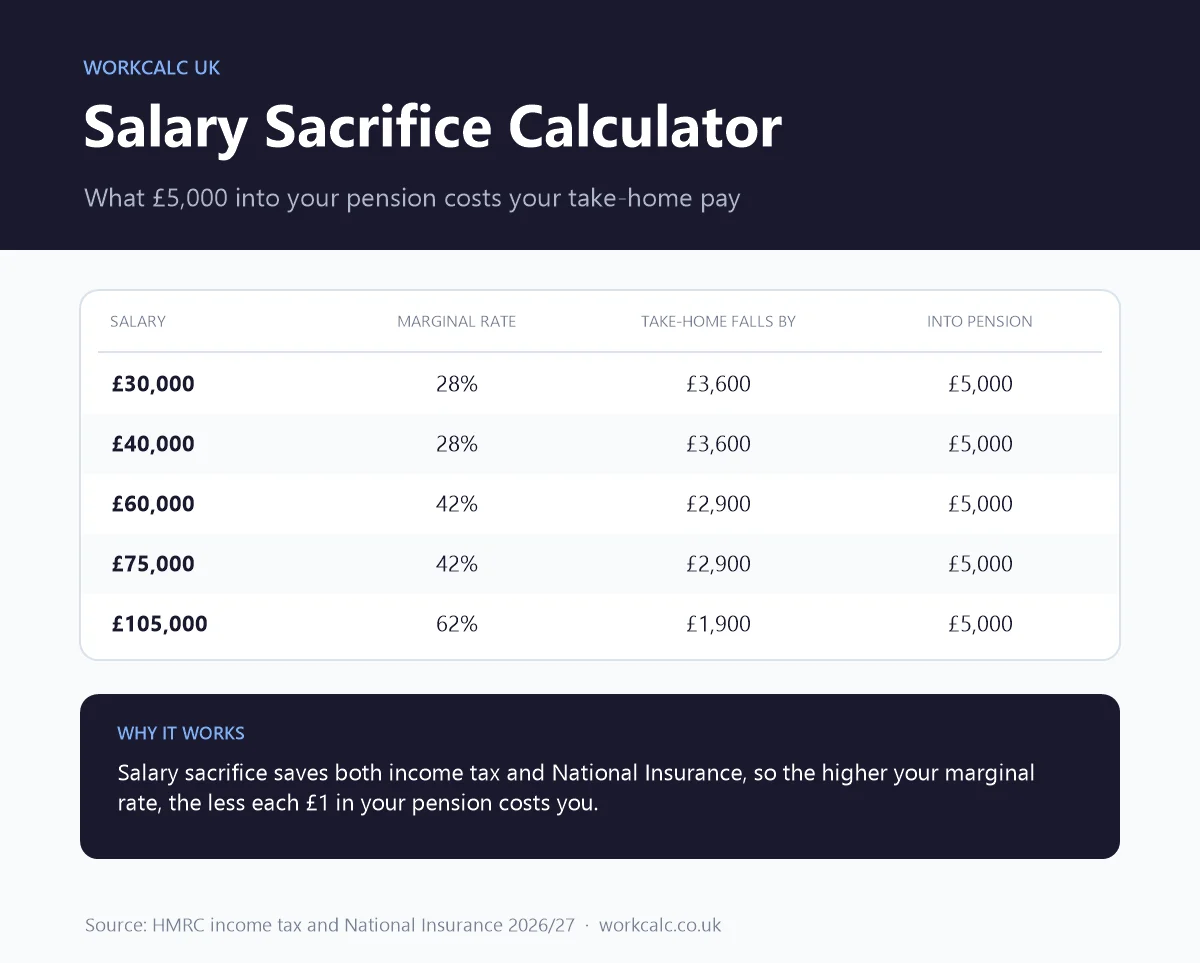
Salary sacrifice calculator UK — relief by salary
England, Wales and Northern Ireland, 2026/27. The higher your marginal rate, the less it costs.
| Salary | Marginal rate | Take-home falls by | Into pension | Effective relief |
|---|---|---|---|---|
| £30,000 | 28% | £3,600 | £5,000 | 28% |
| £40,000 | 28% | £3,600 | £5,000 | 28% |
| £50,000 | 28% | £3,600 | £5,000 | 28% |
| £60,000 | 42% | £2,900 | £5,000 | 42% |
| £75,000 | 42% | £2,900 | £5,000 | 42% |
| £105,000 | 62% | £1,900 | £5,000 | 62% |
| £130,000 | 47% | £2,629 | £5,000 | 47% |
How a salary sacrifice pension scheme works
Under a salary sacrifice pension scheme you agree with your employer to give up part of your gross salary. They pay that amount into your pension instead. Your contract is formally varied, so this is a genuine reduction in pay rather than a deduction from it — and that distinction is what makes it work.
That last point is what separates salary sacrifice from an ordinary pension contribution. Both save income tax. Only sacrifice saves National Insurance.
£5,000 sacrificed on a £60,000 salary
£5,000 into the pension for £2,900 out of your pocket. That is 42% effective relief, and your employer saves a further £750 of their own National Insurance on the same slice.
Related tool Pension Contribution Calculator: compare net pay, relief at source and salary sacrifice →Salary sacrifice pension contributions versus an ordinary contribution
Most workplace pensions do not use pension salary sacrifice. If yours deducts the contribution from your pay rather than reducing your salary, you save income tax but still pay National Insurance on the full amount.
| Salary | Ordinary contribution costs | Sacrifice costs | You save |
|---|---|---|---|
| £30,000 | £4,000 | £3,600 | £400 |
| £60,000 | £3,000 | £2,900 | £100 |
| £105,000 | £2,000 | £1,900 | £100 |
The saving is largest for basic-rate taxpayers, because employee National Insurance is 8% below £50,270 and only 2% above it. A basic-rate earner saves four times as much National Insurance per pound sacrificed as a higher-rate earner does.
Related tool Take-Home Pay Calculator — compare all three pension scheme types →The £100,000 sweet spot
This is where salary sacrifice stops being a modest saving and becomes the single most efficient financial move available to a UK employee.
Between £100,000 and £125,140 the personal allowance is withdrawn at £1 for every £2 earned. That makes the effective marginal rate 62% including National Insurance — higher than the 47% paid above £125,140.
Related tool Pay Rise Calculator: see how little of a rise above £100,000 you keep →£110,000 salary, sacrificing back to £100,000
62% effective relief. And that is before counting Tax-Free Childcare and the 30 funded hours, both withdrawn outright above £100,000 rather than tapered — worth more than £10,000 a year to a parent of two pre-school children.
What your employer saves — and why you should ask
Employer National Insurance is 15% on earnings above £5,000, and it is not charged on sacrificed pay. A £5,000 sacrifice saves your employer £750 a year.
Many employers keep that. Some pass half of it into your pension. A few pass all of it. It costs them nothing either way — they were paying it before the sacrifice existed — so it is worth asking directly. If your employer passes on the full saving, a £5,000 sacrifice puts £5,750 into your pension for £2,900 of take-home pay at higher rate.
Related guide Is salary sacrifice worth it? The savings, the catches and who gains most →The downsides, honestly
Salary sacrifice reduces your gross salary, and gross salary is used for more than tax.
- Statutory maternity, paternity and sick pay are based on average earnings in a reference period. A sacrifice running through that window reduces them.
- Redundancy pay is usually calculated on post-sacrifice salary unless your contract says otherwise.
- Life cover set as a multiple of salary falls with the salary, unless the scheme uses a notional pre-sacrifice figure.
- The minimum wage floor. Your pay cannot be sacrificed below £12.71 an hour for those aged 21 and over. This caps what lower earners can do.
- Reversing it normally needs a qualifying life event — marriage, a birth, a partner losing their job — rather than simply changing your mind.
Limits on salary sacrifice pension contributions
Two ceilings apply. The National Minimum Wage is an absolute floor your post-sacrifice pay cannot go below. And the pension annual allowance of £60,000 caps total contributions — yours plus your employer's — before a tax charge applies.
Very high earners face a tapered annual allowance: above £200,000 of threshold income and £260,000 of adjusted income it reduces by £1 for every £2, down to a floor of £10,000. Unused allowance from the previous three tax years can usually be carried forward, which is worth checking before a one-off large contribution.
Salary sacrifice in Scotland
The mechanism is identical, but the relief differs because Scottish income tax bands do. A Scottish taxpayer between £43,662 and £75,000 is on the 42% Higher rate, so sacrificing there gives 44% relief once the 2% National Insurance is added — slightly more than the equivalent English band.
Below £43,662 the Scottish Intermediate rate of 21% gives 29% relief against 28% in the rest of the UK. National Insurance is identical UK-wide, so all the divergence comes from income tax.
What this calculator does not cover
- Cars, cycles and childcare vouchers — see the Salary Sacrifice Car Calculator for the electric vehicle version
- Existing pension contributions — enter only the additional amount you are considering sacrificing
- Annual allowance carry-forward — depends on your contribution history for the last three years
- Defined benefit schemes — the value of accrual is calculated differently from a money purchase pot
- Investment growth — this shows the cost today, not what the pension will be worth
Every figure in this pension salary sacrifice calculator uses HMRC thresholds for 2026/27. Salary sacrifice is a contractual change and needs your employer's agreement — it is not something you can apply unilaterally. For large sacrifices, or if you are near the annual allowance, take regulated advice first.
Frequently asked questions
Common questions about salary sacrifice pensions.
How does salary sacrifice work for a pension?
You give up an agreed amount of gross salary and your employer pays it into your pension instead. Because the money never counts as salary, you pay no income tax and no National Insurance on it, and your employer saves their 15% National Insurance too. Your contract is formally varied, so it is a real reduction in pay rather than a deduction from it.
How much does salary sacrifice save me?
It depends on your marginal rate. A basic-rate taxpayer sacrificing £5,000 sees take-home pay fall by £3,600, so £5,000 goes into the pension for £3,600 of net pay — 28% relief. A higher-rate taxpayer pays £2,900 for the same £5,000, and someone in the £100,000 taper pays just £1,900, which is 62% relief.
Is salary sacrifice better than a normal pension contribution?
Usually yes, because it saves National Insurance as well as income tax. On £30,000 a £5,000 ordinary contribution costs £4,000 of take-home; the same amount sacrificed costs £3,600. The £400 difference is the employee National Insurance you no longer pay on that slice of salary.
Does my employer save money on salary sacrifice?
Yes. Employer National Insurance is 15% and is not charged on sacrificed pay, so a £5,000 sacrifice saves them £750. Some employers pass part or all of that saving into your pension, which costs them nothing and is worth asking about — it is one of the few genuinely free upgrades available.
Can salary sacrifice reduce my personal allowance taper?
Yes, and it is the most valuable use of it. The personal allowance is withdrawn between £100,000 and £125,140, creating a 62% effective marginal rate. Someone on £110,000 who sacrifices £10,000 brings adjusted net income back to £100,000, restores the full allowance and keeps Tax-Free Childcare — for a net cost of £3,800.
Does salary sacrifice affect my mortgage application?
It can. Your gross salary is genuinely lower after a sacrifice, and most lenders assess affordability on gross pay. Some will add the pension contribution back if you explain it, but many will not. If you are applying for a mortgage in the next year, check with the lender before increasing a sacrifice.
What are the downsides of salary sacrifice?
Your reduced salary is used for statutory maternity, paternity and sick pay, and for redundancy pay in most schemes. It can lower life cover if that is set as a multiple of salary, and it cannot take your pay below the National Minimum Wage. Reversing a sacrifice usually requires a qualifying life event rather than simply changing your mind.
Is there a limit on how much I can sacrifice?
Two limits apply. Your pay cannot fall below the National Minimum Wage of £12.71 an hour for those aged 21 and over. And pension contributions above the annual allowance of £60,000 — reduced for very high earners — trigger a tax charge. Unused allowance from the previous three tax years can often be carried forward.