
Tax Code Calculator
Enter the tax code on your payslip to see what it means, how much tax it takes from your pay, and whether it matches the code you should probably have for 2026/27.
Your tax code
Adjustments HMRC may have made (optional)
| A year | Your code | Expected | Difference |
|---|---|---|---|
| Income tax | |||
| National Insurance | £0.00 | ||
| Take-home a year | |||
| Take-home a month |
What a wrong tax code costs, 2026/27
Income tax a year on a single job in England, Wales or Northern Ireland, compared with the standard 1257L code.
| Tax code | Tax on £35,000 | Extra vs 1257L | Tax on £60,000 | Extra vs 1257L |
|---|---|---|---|---|
| 1257L (standard) | £4,486 | None | £11,432 | None |
| 1097L (£40,000 electric company car) | £4,806 | £320 | £12,072 | £640 |
| BR (all at 20%) | £7,000 | £2,514 | £12,000 | £568 |
| 0T (no allowance) | £7,000 | £2,514 | £16,460 | £5,028 |
| D0 (all at 40%) | £14,000 | £9,514 | £24,000 | £12,568 |
Your tax code tells your employer how much you can earn tax-free. Multiply the number by 10 to get your allowance: 1257L means £12,570, the standard Personal Allowance for 2026/27. The letter says why: L is standard, M and N mean Marriage Allowance, K means an amount is added to your pay, and BR, D0 and 0T mean no allowance at all. A code ending in W1, M1 or X is an emergency code.
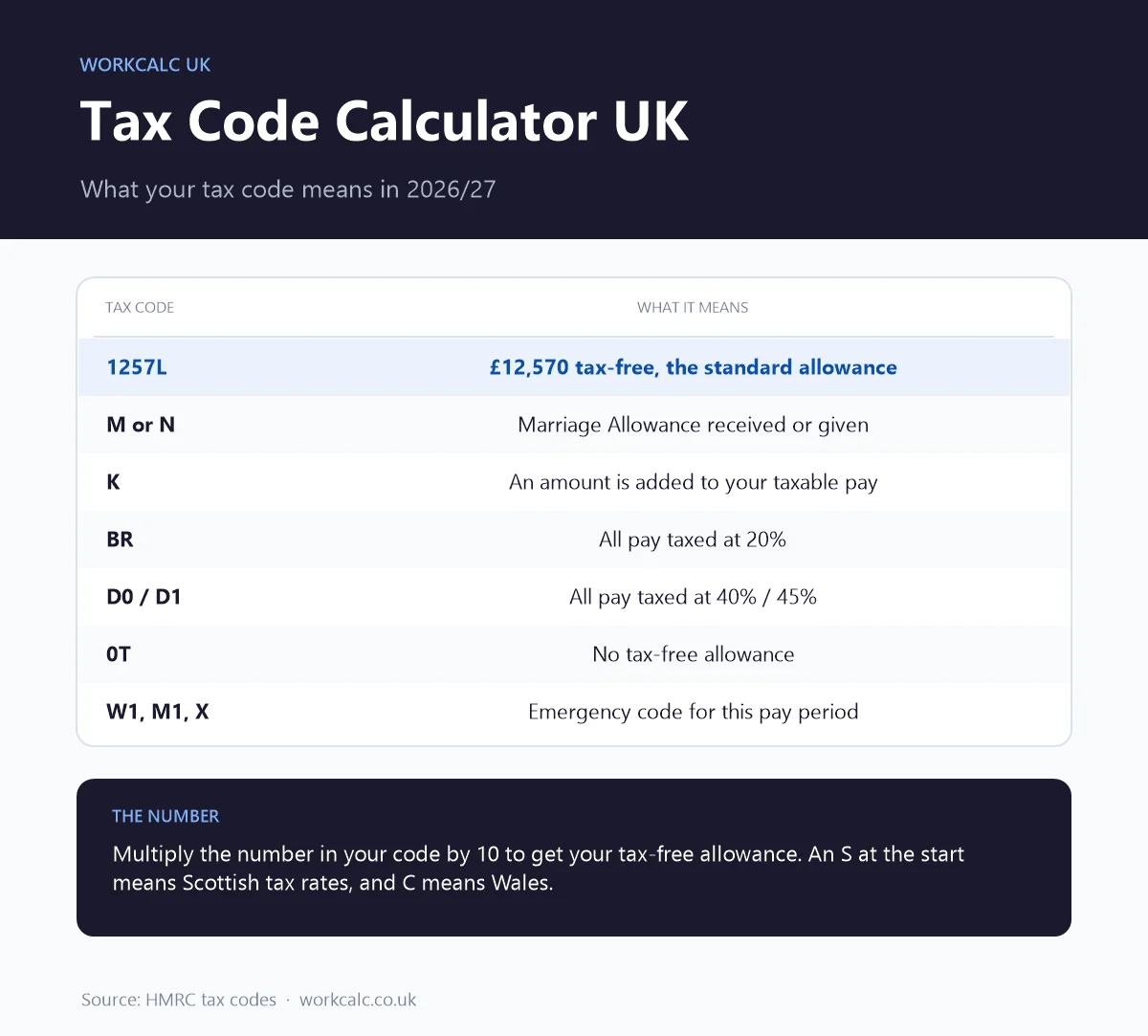
How to read your tax code
Most codes have up to four parts. Take S1097L M1:
- S is the prefix: you pay Scottish income tax. C means Welsh rates, and no prefix means England or Northern Ireland.
- 1097 is the number: your tax-free amount divided by 10, so £10,970 a year.
- L is the letter: you get the standard allowance, reduced here by a benefit such as a company car.
- M1 is the basis: an emergency code, so each month is taxed on its own.
The allowance is shared across the year. On 1257L and monthly pay, £1,047.50 of each month's pay is tax-free.
What the letters in a tax code mean
| Code | Meaning |
|---|---|
| L | The standard tax-free Personal Allowance, with any adjustments shown in the number |
| M | Marriage Allowance: you receive 10% of your partner's allowance (usually 1383M) |
| N | Marriage Allowance: you transfer 10% of your allowance to your partner (usually 1131N) |
| T | Your code includes other calculations that HMRC needs to review, such as the £100,000 taper |
| K | Untaxed income or benefits are larger than your allowance, so the amount is added to your taxable pay |
| 0T | No tax-free allowance, but tax is charged through the normal bands |
| BR | All pay taxed at the 20% basic rate, usually a second job or pension |
| D0 | All pay taxed at the 40% higher rate, usually a second job |
| D1 | All pay taxed at the 45% additional rate |
| NT | No tax taken from this income |
| S / C | Prefix for Scottish or Welsh income tax rates |
| W1 / M1 / X | Emergency code: weekly, monthly or irregular pay taxed on each period alone |
Scottish flat-rate codes
Scotland has more bands, so it has more flat-rate codes: SBR taxes everything at 20%, SD0 at the 21% intermediate rate, SD1 at the 42% higher rate, SD2 at the 45% advanced rate and SD3 at the 48% top rate. If you live in Scotland and your code has no S, you are being taxed at the wrong rates, and HMRC will usually collect or refund the difference later.
Emergency tax codes
An emergency code ends in W1, M1 or X, for example 1257L M1. It means your tax is worked out on each week's or month's pay in isolation, instead of cumulatively across the tax year. You are most likely to get one when you start a new job without a P45, or when your employer does not have your details.
If you start work in April, an emergency code usually makes little difference. Start later in the year after a gap without work and it can mean overpaying, because the tax-free allowance for the months you were not working is not given back. Handing your new employer a P45, or completing HMRC's starter checklist, gets you off it faster. HMRC normally issues the correct code within about 35 days.
Why your tax code changes
HMRC changes your code when it learns about a change in your income or circumstances. The most common reasons are:
- Company benefits such as a car, fuel or private medical insurance
- Marriage Allowance claimed by you or your partner
- Job expenses you claim tax relief on, such as uniform or professional fees
- Underpaid tax from an earlier year being collected through your pay
- A second job or pension, or a change in your State Pension
- Savings interest above your Personal Savings Allowance
- The High Income Child Benefit Charge, if you pay it through your wages
- Income over £100,000, which reduces your allowance
How common changes show up in your code
K codes and the 50% limit
If your untaxed income or benefits are worth more than your allowance, the number in a K code is added to your pay instead. K475 adds £4,750 to your taxable pay for the year. So that a large K code cannot leave you with almost nothing, your employer cannot deduct more than 50% of your pay in tax in any pay period. Anything held back is carried forward.
The £100,000 taper and your code
Above £100,000 you lose £1 of Personal Allowance for every £2 earned. HMRC reflects this in your code using an estimate of your income, for example 757L on £110,000. If you stay on 1257L with pay that high, your employer under-collects: £2,000 a year at £110,000, which HMRC will ask for later. Pension contributions through salary sacrifice reduce the income used for the taper.
Related page £110,000 After Tax: how much personal allowance you lose →What to do if your tax code looks wrong
- Check the code and the income HMRC has for you in your personal tax account or the HMRC app. Wrong estimated income or an old benefit are the usual causes.
- Update the details there, or contact HMRC. Your employer cannot change your code; only HMRC can.
- Once HMRC corrects the code, overpaid tax for the current year is normally refunded through your next payslip.
- For earlier years, HMRC usually sends a P800 tax calculation after the tax year ends, and you can claim a refund from it.
To see your full payslip under any code, including pension and student loan, use the Take-Home Pay Calculator.
What this calculator does not cover
- Several jobs or pensions at once. Enter each job separately, with the code it uses.
- Starting part way through the year. Results show a full year on one code.
- Pension contributions and student loans, which do not change your code but do change take-home pay.
- The exact HMRC coding rules for complex cases. The expected code is an estimate from the details you enter.
Sources
- GOV.UK, Tax codes: what your tax code means, emergency tax codes and why your tax code might change
- HMRC PAYE Manual, K codes and the 50% overriding limit
- HMRC income tax rates and thresholds for 2026/27, including Scottish rates
Frequently asked questions
Tax codes, emergency codes and refunds.
What does the tax code 1257L mean?
1257L is the standard tax code for 2026/27. The number means you can earn £12,570 tax-free from that job, which is the full Personal Allowance, and the L means you get the standard allowance with no adjustments.
Why is my tax code BR?
BR means all your pay from that job is taxed at the 20% basic rate, with no tax-free allowance. It is normally used for a second job or pension, because your allowance is already used by your main job. If BR is on your only or main job, you are probably overpaying: on £35,000 it costs £2,514 a year more than 1257L.
What is an emergency tax code?
An emergency code ends in W1, M1 or X, for example 1257L M1. Your tax is worked out on each week's or month's pay on its own, without taking account of earlier pay in the tax year. It is often used when you start a new job without a P45, and HMRC usually updates it within about 35 days.
What does the tax code 0T mean?
0T means you get no tax-free allowance from that job, but tax is still charged through the normal bands. It is used when your allowance has been used up, for example above £125,140, or when a new employer does not have the details it needs. On £60,000 it costs £5,028 a year more than 1257L.
What is a K tax code?
A K code means you have income or benefits worth more than your allowance, so an amount is added to your taxable pay instead of taken off. K475 adds £4,750. By law your employer cannot deduct more than 50% of your pay in tax in any pay period, however large the K code.
Why has my tax code changed?
HMRC changes your code when your income or circumstances change, for example if you start getting a company car or medical insurance, claim Marriage Allowance or job expenses, have underpaid tax from an earlier year, start a second job or pension, or earn over £100,000.
What tax code do I get with Marriage Allowance?
The partner receiving the allowance usually gets 1383M, because £1,260 is added to their £12,570 allowance. The partner transferring it usually gets 1131N. The transfer is worth up to £252 a year.
How do I get a refund if my tax code was wrong?
Once HMRC corrects your code, any overpaid tax for the current year is normally refunded through your next payslip. For earlier years HMRC usually sends a P800 calculation after the tax year ends. You can check your code and income in your HMRC personal tax account or the HMRC app.