
Does 28 Days Holiday Include Bank Holidays?
The short answer is that it can, and it often does. What decides it is the exact wording in your contract, and in some leave years the difference is worth two or more days off.
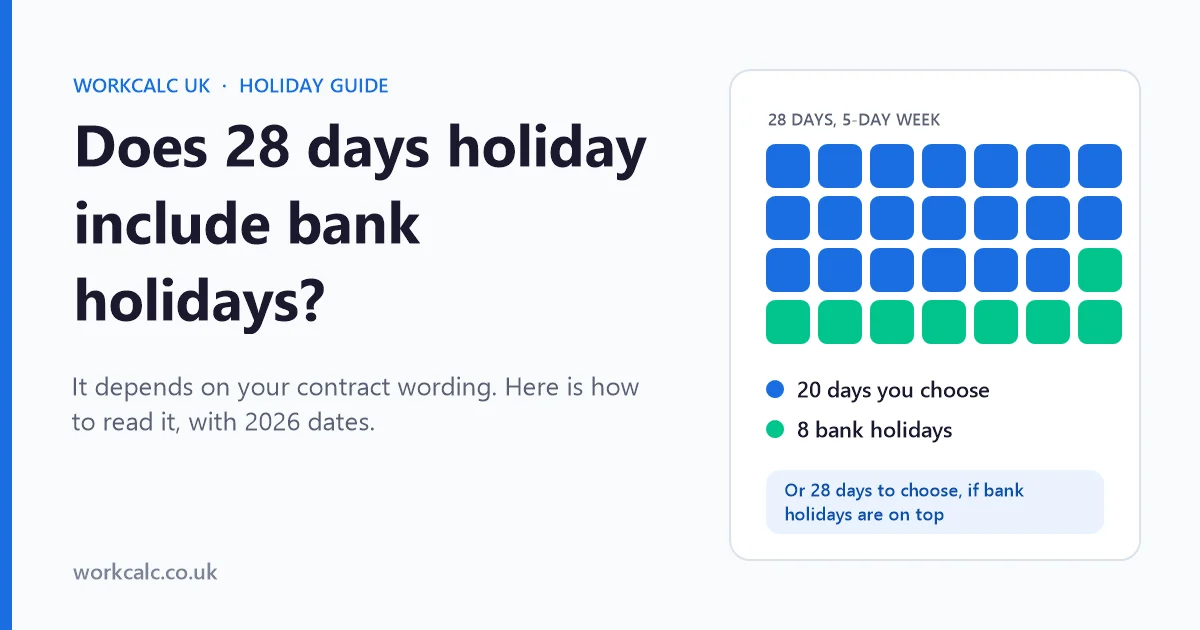
Yes, 28 days can include bank holidays. The legal minimum is 5.6 weeks of paid holiday, which is 28 days for a 5-day week, and employers are allowed to count bank holidays towards it. So "28 days including bank holidays" means 20 days you choose plus 8 bank holidays in England and Wales. Only if your contract says "plus bank holidays" do you get them on top.
Key points
- The law gives 5.6 weeks of paid holiday, capped at 28 days, and bank holidays can be part of it.
- There is no legal right to have bank holidays off, or to extra pay for working one.
- An April 2026 to March 2027 leave year has 10 bank holidays in England and Wales, so "28 days including bank holidays" leaves just 18 to choose.
- Part-time workers should get a pro rata share of bank holidays, whichever days they work.
- One-off bank holidays, like Scotland's on 15 June 2026, depend on how your contract is worded.
What the law says
Under the Working Time Regulations, almost every worker is entitled to 5.6 weeks of paid holiday a year. For someone working five days a week, that is 28 days. The statutory entitlement is capped at 28 days, so working six days a week does not increase it. For where the 5.6 weeks comes from, see 5.6 weeks holiday explained.
GOV.UK is clear that employers can choose to treat bank holidays as part of this statutory leave. Nothing in the law requires bank holidays to be given as extra days, or even as days off at all. Many employers give more than the minimum, but that is a contractual benefit, and the contract decides how it works.
Your written statement of employment particulars, which employers must give from day one, has to set out your holiday entitlement, including public holidays. That is the document to check.
What your contract wording means
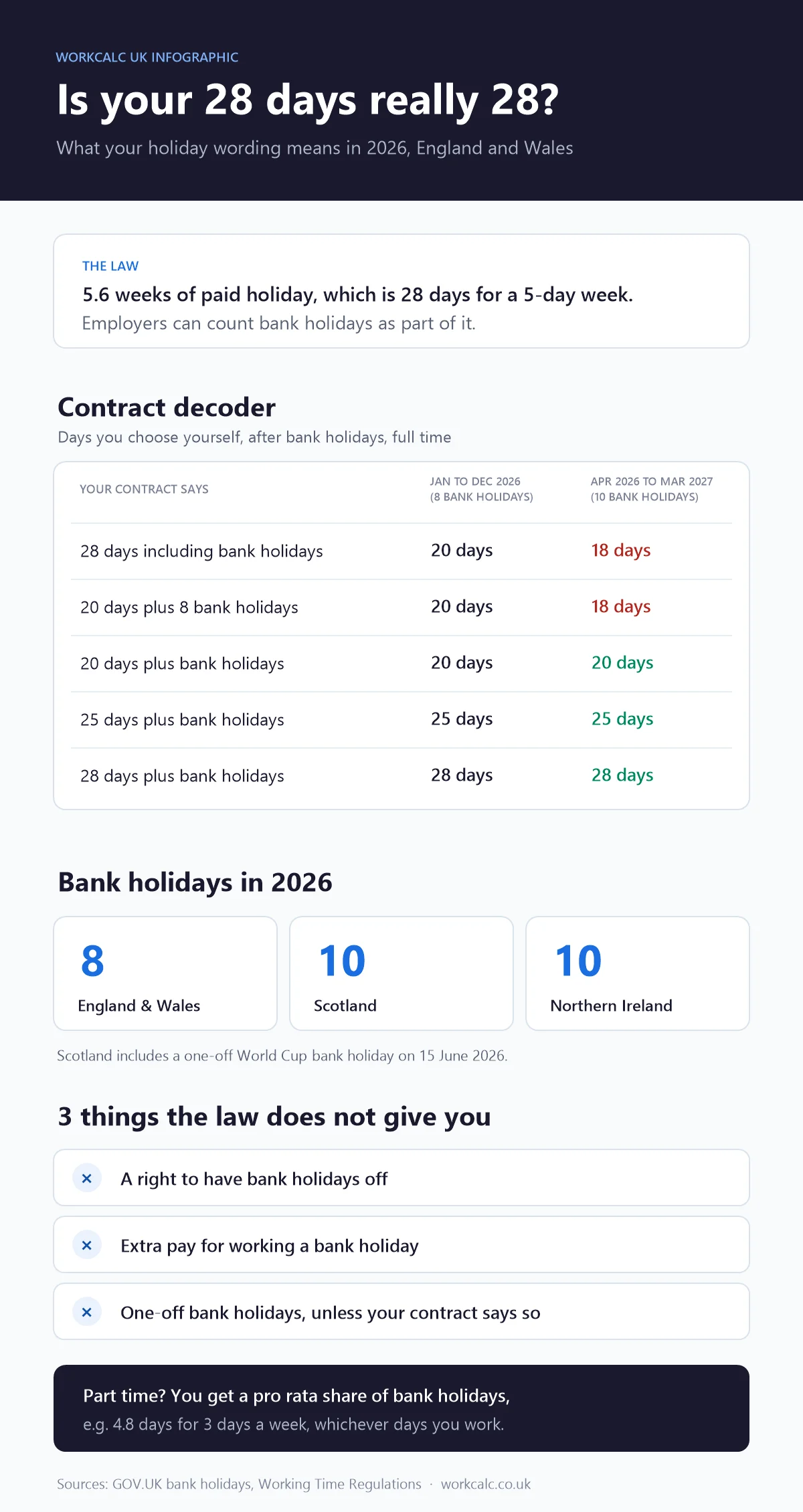
Small differences in wording change how many days you can choose yourself. These are the common versions for a full-time, 5-day worker in England and Wales:
| Contract says | What it means | Days you choose, 2026 |
|---|---|---|
| 28 days holiday | Usually read as including bank holidays, the legal minimum | 20 |
| 28 days including bank holidays | The legal minimum, with bank holidays taken from it | 20 |
| 20 days plus 8 bank holidays | 28 days, with the bank holidays fixed at 8 | 20 |
| 20 days plus bank holidays | 20 days plus however many bank holidays fall in the year | 20 |
| 25 days plus bank holidays | A common enhanced contract: 33 days in an 8-bank-holiday year | 25 |
If your contract only says "28 days" and your workplace has always closed on bank holidays without taking them from your allowance, that custom and practice may count too. If in doubt, ask HR to confirm in writing.
Why some leave years have 10 bank holidays
England and Wales usually have 8 bank holidays in a calendar year. But many employers run their leave year from April to March, and the April 2026 to March 2027 leave year contains two Easters: 3 and 6 April 2026, then 26 and 29 March 2027. That gives 10 bank holidays in one leave year.
- "28 days including bank holidays": 10 are bank holidays, so you choose only 18.
- "20 days plus 8 bank holidays": the 2 extra bank holidays usually come out of your 20 days or have to be worked, again leaving 18.
- "20 days plus bank holidays": you get all 10 on top, 30 days in total.
It evens out the following year, which has only 6, but it is worth knowing when you plan leave.
Related tool Part-Time Holiday Calculator: bank holidays in your leave year and on your working days →Bank holidays in 2026 and 2027
| England and Wales | 2026 | 2027 |
|---|---|---|
| New Year's Day | Thu 1 January | Fri 1 January |
| Good Friday | Fri 3 April | Fri 26 March |
| Easter Monday | Mon 6 April | Mon 29 March |
| Early May bank holiday | Mon 4 May | Mon 3 May |
| Spring bank holiday | Mon 25 May | Mon 31 May |
| Summer bank holiday | Mon 31 August | Mon 30 August |
| Christmas Day | Fri 25 December | Mon 27 December (substitute) |
| Boxing Day | Mon 28 December (substitute) | Tue 28 December (substitute) |
Scotland has 10 in 2026: it adds 2 January, St Andrew's Day on 30 November and the one-off World Cup holiday on 15 June, has its summer bank holiday on 3 August, and does not have Easter Monday. Northern Ireland has 10: the England and Wales dates plus St Patrick's Day on 17 March and the Battle of the Boyne on 13 July.
Working on a bank holiday
Many people work bank holidays, especially in retail, hospitality, care and the NHS. The law does not require:
- A day off: your employer can ask you to work if your contract allows it.
- Extra pay: there is no legal right to time and a half or double time. Any premium comes from your contract or policy.
What the law does protect is your total leave. If bank holidays count towards your 28 days and you work one, you still need to be able to take 28 days of paid holiday in the year, so you should get the day back to use at another time.
Part-time workers and bank holidays
Part-time staff are entitled to 5.6 of their own working weeks. Someone working 3 days a week gets at least 16.8 days, and that includes a pro rata share of bank holidays worth 4.8 days (60% of 8).
Because most bank holidays in England and Wales fall on Mondays, a part-timer who never works Mondays can miss out if they only get the bank holidays that land on their working days. Under the Part-time Workers Regulations they should not be treated less favourably, so the fair approach is to give everyone the pro rata share and let them book it on days they do work. Working it out in hours makes this simple. Read more in what pro rata means.
One-off bank holidays
Extra bank holidays are added from time to time: for the late Queen's funeral in September 2022, the King's Coronation in May 2023, and in Scotland for the World Cup on 15 June 2026. Whether you get them depends on your contract:
- "Plus bank holidays" or "plus public holidays": you are usually entitled to the extra day.
- A fixed number or a list of named days: the one-off holiday is not included, although many employers give it anyway.
How to check your own entitlement
- Find the holiday clause in your contract or written statement of particulars.
- Look for "including" or "plus", and whether the bank holidays are a fixed number.
- Check when your leave year starts, because it changes how many bank holidays fall in it.
- Put your working pattern into the Holiday Entitlement Calculator or, if you work part time, the Part-Time Holiday Calculator.
NHS staff on Agenda for Change get bank holidays on top of their annual leave. See the NHS Annual Leave Calculator for the 27, 29 and 33-day entitlements.
Planning next year?All UK bank holidays 2027, with long weekends and the Christmas three-day week →Sources
- GOV.UK, Holiday entitlement: entitlement
- GOV.UK, UK bank holidays for England and Wales, Scotland and Northern Ireland
- The Working Time Regulations 1998, regulations 13 and 13A
- Scottish Government, World Cup bank holiday confirmed
Frequently asked questions
Bank holidays, the 28-day minimum and your contract.
Does 28 days holiday include bank holidays?
It can. The legal minimum is 5.6 weeks, which is 28 days for a 5-day week, and employers are allowed to count bank holidays as part of it. If your contract says 28 days including bank holidays, you choose 20 days in a year with 8 bank holidays. If it says 28 days plus bank holidays, you get 36.
Is 20 days plus bank holidays the same as 28 days?
In most years, yes: 20 days plus 8 bank holidays is 28. The difference shows when a year has more bank holidays. An April 2026 to March 2027 leave year has 10 in England and Wales, so 20 days plus bank holidays gives 30, while 28 days including bank holidays leaves only 18 days to choose.
Do I get paid extra for working a bank holiday?
Not by law. There is no legal right to extra pay for working on a bank holiday. Many employers pay time and a half or double time, or give a day off in lieu, but only if your contract or workplace policy says so.
Can my employer make me work on a bank holiday?
Yes, if your contract allows it. There is no legal right to have bank holidays off. If your bank holidays are counted as part of your annual leave and you work one, you should get the day back to take at another time.
Do part-time workers get bank holidays?
They should get a pro rata share. Someone working 3 days a week gets at least 16.8 days of holiday a year, including a share of bank holidays worth 4.8 days, whichever days of the week they work.
How many bank holidays are there in 2026?
England and Wales have 8 bank holidays in 2026. Scotland has 10, including a one-off World Cup bank holiday on 15 June, and Northern Ireland has 10, including St Patrick's Day and the Battle of the Boyne.
Do I get the World Cup bank holiday in Scotland?
Only if your contract gives it. Employers do not have to give the extra day off. If your contract says your holiday is plus bank holidays, you should get it; if it lists specific days, the one-off holiday is usually not included.
What if a bank holiday falls on my day off?
If you are part time, you should still get your pro rata share of bank holiday leave to take on another day. Working out your holiday in hours, then taking off the hours of any bank holidays that fall on your working days, handles this fairly.