
What Does Pro Rata Mean? A Plain-English UK Guide
Pro rata turns up in job adverts, contracts and payslips. Here is what it means, how to work it out for pay and holiday, and the one thing it does not apply to: your take-home pay.
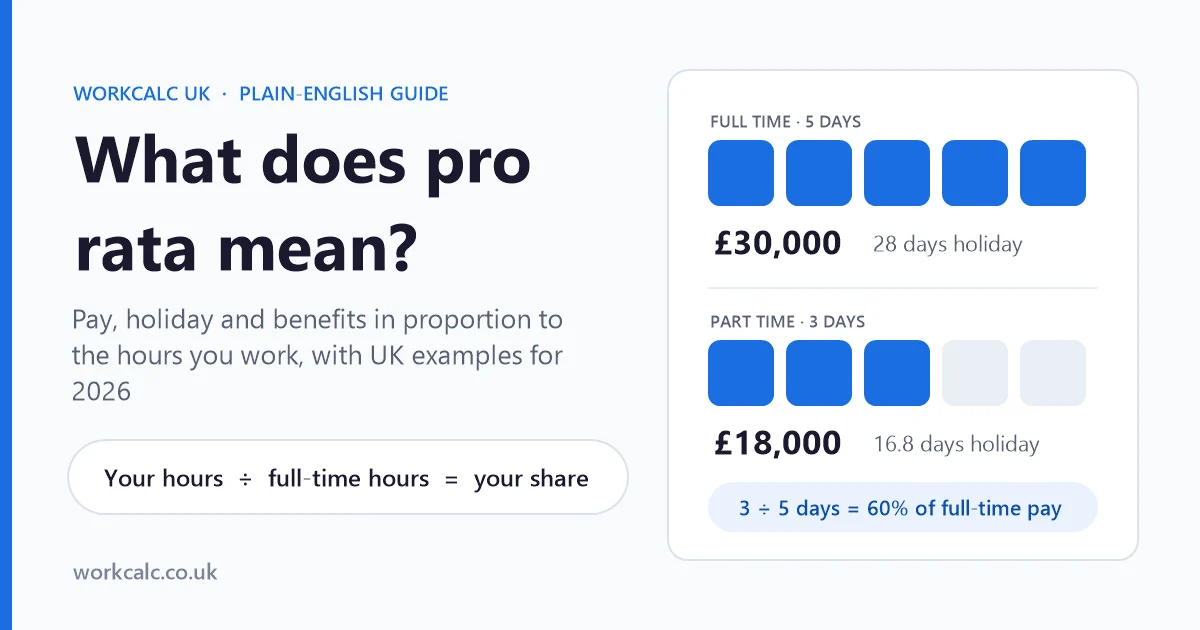
Pro rata is Latin for "in proportion". In a job, it means you get pay, holiday and benefits in the same proportion as the hours you work compared with a full-time colleague. A salary of £30,000 pro rata for someone working 3 days of a 5-day week is £18,000, because 3 ÷ 5 = 60%.
Key points
- A pro rata salary in a job advert is the full-time figure, not what you will be paid.
- Your share = your hours ÷ full-time hours. Multiply the full-time salary and holiday by it.
- Holiday, bank holidays, bonuses, pension contributions and allowances are pro-rated too.
- Take-home pay is not pro rata: 60% of the hours leaves about 65.6% of the take-home.
- Pro rata never overrides the minimum wage, which applies to every hour.
Pro rata meaning in plain English
Pro rata comes from the Latin pro rata parte, "according to the calculated share". Whenever something is split pro rata, each person or period gets a share that matches their part of the whole. You will see it written as pro rata, pro-rata or as a verb, pro-rated.
At work, the "whole" is a full-time job for a full year. If you work fewer hours, or only part of the year, your pay and benefits are scaled down in the same proportion. UK law backs this up: the Part-time Workers (Prevention of Less Favourable Treatment) Regulations 2000 say part-time staff must not be treated less favourably than comparable full-time staff, and Acas guidance says pay and leave should be given in proportion to hours worked.
What "£30,000 pro rata" means in a job advert
When a part-time job advert shows a salary followed by "pro rata", the salary is what the role would pay if you worked full time. Your actual pay is a share of it.
| Advert says | What it means |
|---|---|
| £30,000 per annum | £30,000 a year for the role as advertised |
| £30,000 pro rata, 22.5 hours | Full-time rate is £30,000; you get 60%, or £18,000 |
| £30,000 FTE, 0.6 FTE | Same thing: full-time equivalent £30,000, you work 60% |
| £30,000 pro rata, fixed term 6 months | Full-year rate; you are paid for 6 months, £15,000 |
If the advert does not say how many hours count as full time, ask. The same pro rata salary pays different amounts on a 35, 37.5 or 40-hour full-time week.
How to calculate pro rata
Every pro rata calculation follows the same three steps.
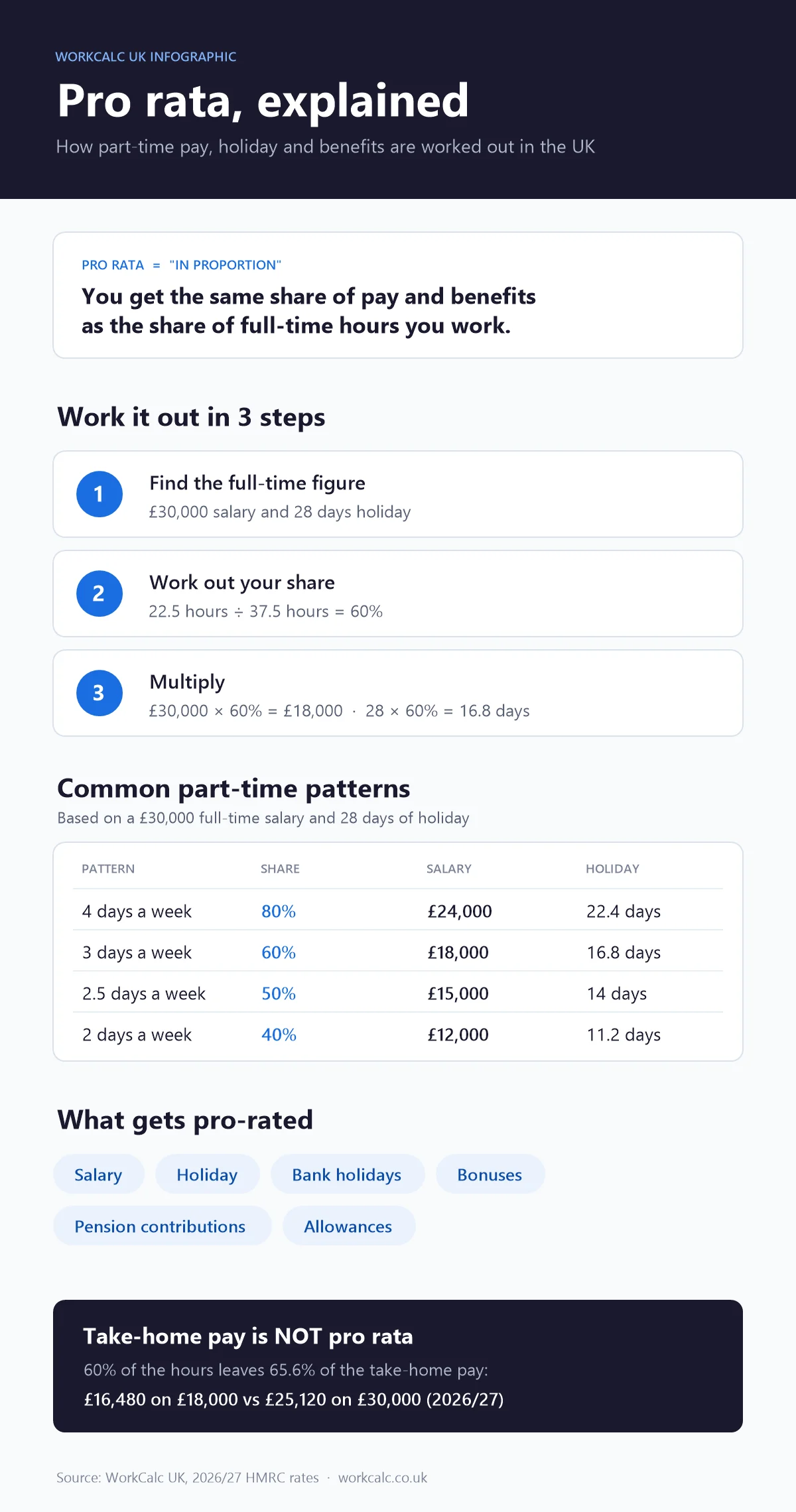
- Find the full-time figure, for example a £30,000 salary and 28 days of holiday.
- Work out your share: your hours ÷ full-time hours. 22.5 ÷ 37.5 = 0.6, or 60%.
- Multiply: £30,000 × 60% = £18,000, and 28 days × 60% = 16.8 days.
By days a week
If every working day is the same length, you can use days instead of hours: 4 days out of 5 is 80%, 3 days is 60%, 2.5 days is 50%. On a £30,000 full-time salary that gives £24,000, £18,000 and £15,000.
For part of a year
If you join or leave part way through the year, or work a fixed-term contract, the share is the time worked out of a full year. Six months at £30,000 pro rata is £15,000. For an exact figure, use days: £30,000 × 91 ÷ 365 = £7,479.45 for 91 days.
Related tool Pro Rata Salary Calculator: your pro rata pay by hours, days or percentage →Pro rata holiday
Almost every worker gets 5.6 weeks of paid holiday a year. For a 5-day week that is 28 days; for a part-time worker it is 5.6 of their own working weeks. Someone working 3 days a week gets at least 16.8 days, and someone working 20 hours a week gets at least 112 hours.
Bank holidays are part of this. If full-time staff get 8 bank holidays, a 3-day-a-week worker should get a pro rata share of 4.8 days, whichever days of the week they work. Working it out in hours is the fairest way when your days are different lengths. For how bank holidays count towards the 28-day minimum, see does 28 days holiday include bank holidays.
Related tool Part-Time Holiday Calculator: your leave in hours, with 2026 bank holidays on your days →What else is pro-rated, and what is not
Under the Part-time Workers Regulations, most contractual pay and benefits should be pro-rated unless there is an objective reason not to:
- Salary and overtime rates, once you work beyond full-time hours
- Holiday and bank holidays
- Bonuses and profit share, by hours and often by time in the year
- Pension contributions, which follow your lower pay
- Allowances such as London weighting or shift allowances
- Enhanced sick pay and family leave pay, in line with your pay
Some things are not pro-rated:
- The minimum wage applies to every hour you work. A job paying £22,000 pro rata on a 37.5-hour full-time week works out at £11.28 an hour, below the £12.71 National Living Wage for workers aged 21 and over.
- Tax allowances. Part-time workers get the full £12,570 Personal Allowance.
- Length of service, which counts in full for part-timers, so statutory notice and redundancy entitlement are based on years worked.
- Benefits that cannot be split, such as a staff discount or a company phone, are usually given in full or not at all.
Why take-home pay is not pro rata
Your gross salary is pro-rated, but your tax is not, because the £12,570 Personal Allowance and National Insurance threshold stay the same whatever your hours. More of a part-time salary falls in the tax-free band, so take-home pay drops by less than your hours.
£30,000 full time vs 60% pro rata, 2026/27
This is why dropping a day a week often costs less than people expect. See your own figures with the Take-Home Pay Calculator.
Pro rata outside work
The same idea turns up in everyday money:
- Rent: moving in on 10 June at £900 a month, you might pay for 21 of June's 30 days: £900 × 21 ÷ 30 = £630.
- Bills and subscriptions: switching part way through a billing period usually means a pro rata charge or refund.
- Council tax: charged pro rata by the day when you move home.
- Shares and dividends: paid pro rata to the number of shares you own.
- Insurance: cancelling mid-term can bring a pro rata refund, less any fees.
Common pro rata mistakes
- Reading the advertised figure as your pay. A pro rata salary is always the full-time rate.
- Not checking the full-time hours. 20 hours is 57% of a 35-hour week but 50% of a 40-hour week.
- Using days when your days vary. If you work 8, 8 and 4 hours, use hours, or a short day costs you a full day of holiday.
- Forgetting bank holidays. Part-timers should get a pro rata share, not just the ones that land on their working days.
- Expecting take-home to scale. It falls by less than your hours.
- Missing a minimum wage breach. Divide any pro rata salary by the full-time hours to check the hourly rate.
Pro rata is simple once you know the full-time figure and your share of it. For quick answers on your own hours, use the Pro Rata Salary Calculator for pay and the Holiday Entitlement Calculator for leave.
Sources
- The Part-time Workers (Prevention of Less Favourable Treatment) Regulations 2000
- Acas, Part-time workers' rights
- GOV.UK, Holiday entitlement and National Minimum Wage rates from April 2026
- HMRC income tax and National Insurance rates for 2026/27
Frequently asked questions
Pro rata pay, holiday and job adverts.
What does pro rata mean in a salary?
It means the salary shown is the full-time figure, and you will be paid a share of it in proportion to your hours. £30,000 pro rata for 22.5 hours a week, where full time is 37.5 hours, is £18,000 a year.
Is pro rata the same as per annum?
No. Per annum means a year's pay for the job as described. Pro rata means the figure is a full-time equivalent, and your actual yearly pay will be lower if you work fewer hours or only part of the year.
How do I calculate pro rata pay?
Divide your hours by the full-time hours to find your share, then multiply the full-time salary by it. 22.5 hours out of 37.5 is 60%, so £30,000 pro rata is £18,000. For part of a year, multiply by the months or days worked out of 12 months or 365 days.
What is £30,000 pro rata for 3 days a week?
£18,000 a year, because 3 days out of a 5-day full-time week is 60%. That is £1,500 a month before tax and about £1,373 a month after 2026/27 income tax and National Insurance.
What is pro rata holiday?
Holiday in proportion to the time you work. Full-time workers get at least 28 days a year on a 5-day week; someone working 3 days a week gets at least 16.8 days, including a proportional share of bank holidays.
Does pro rata mean part time?
Not always. Pro rata is most common in part-time jobs, but it also applies to people who join or leave part way through a year, fixed-term contracts, job shares and term-time roles.
What does FTE mean in a job advert?
FTE stands for full-time equivalent. A salary of £30,000 FTE means the same as £30,000 pro rata: the full-time rate. A 0.6 FTE role works 60% of full-time hours and pays 60% of the salary.
Is my take-home pay pro rata too?
No. The tax-free Personal Allowance is not reduced for part-time workers, so take-home pay falls by less than your hours. In 2026/27, working 60% of the hours of a £30,000 job leaves 65.6% of the take-home pay: £16,479.60 against £25,119.60.