
Notice Period Calculator
Find out how much notice you are owed or must give, the exact date your job ends, and what your notice pay is worth before and after tax, whether you are resigning or your employer is ending your employment.
Your notice
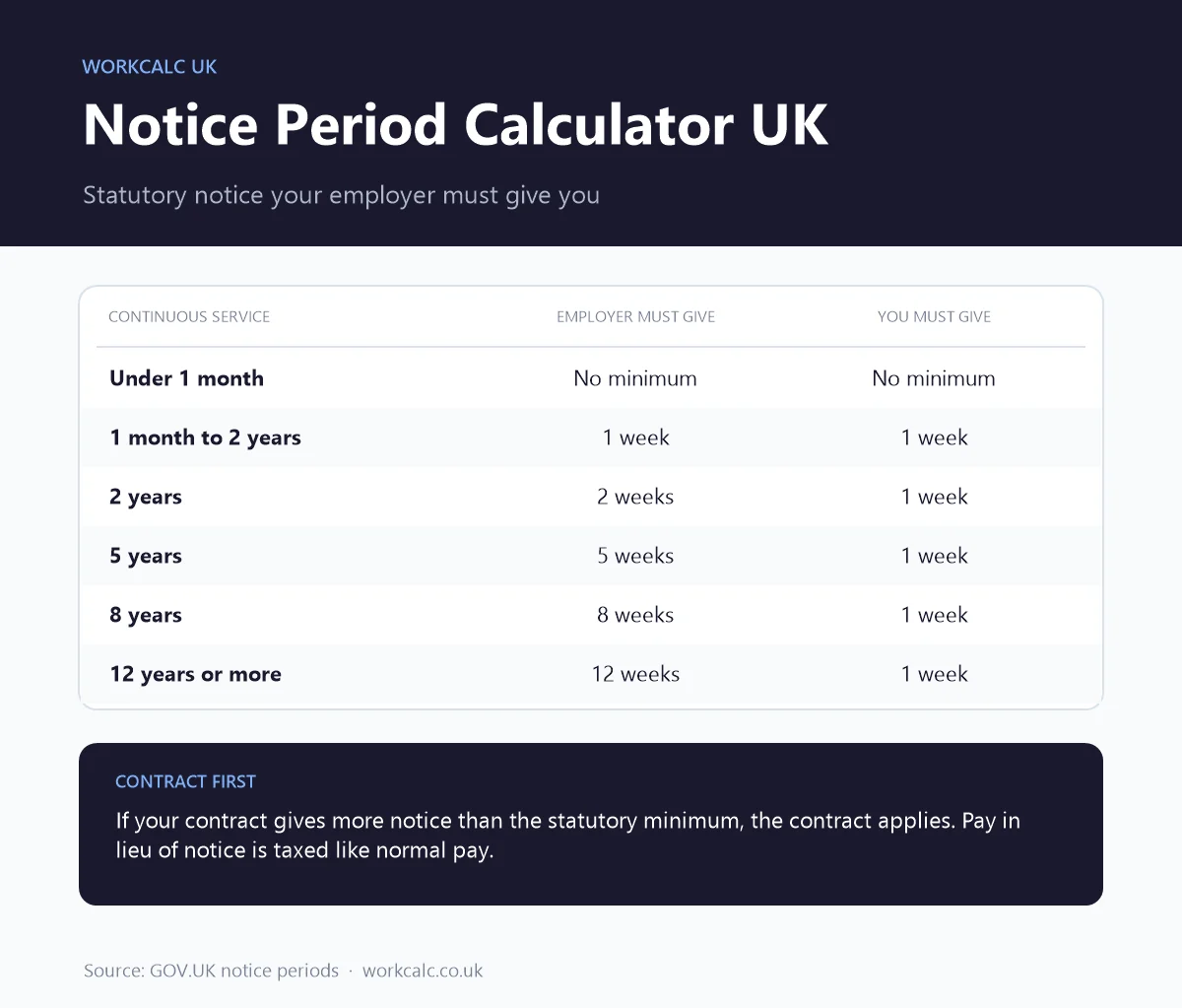
Statutory notice periods by length of service
The minimum your employer must give. Notice pay assumes a £30,000 salary, which is £576.92 a week.
| Continuous service | Employer must give | Notice pay at £30,000 | You must give |
|---|---|---|---|
| Under 1 month | No statutory minimum | n/a | No statutory minimum |
| 1 month to under 2 years | 1 week | £576.92 | 1 week |
| 2 years | 2 weeks | £1,153.85 | 1 week |
| 3 years | 3 weeks | £1,730.77 | 1 week |
| 5 years | 5 weeks | £2,884.62 | 1 week |
| 8 years | 8 weeks | £4,615.38 | 1 week |
| 10 years | 10 weeks | £5,769.23 | 1 week |
| 12 years or more | 12 weeks | £6,923.08 | 1 week |
If your employer ends your job, you are owed at least 1 week's notice for each complete year of service, with a minimum of 1 week after one month and a maximum of 12 weeks. If your contract gives more, the contract applies. If you resign, you must give at least 1 week, or the notice in your contract. You are paid normally throughout, and pay in lieu of notice is taxed like normal pay.
Statutory notice: the legal minimum
Section 86 of the Employment Rights Act 1996 sets the minimum notice an employer must give once you have worked for them for a month:
- 1 month to under 2 years' service: 1 week
- 2 to 12 years: 1 week for each complete year
- 12 years or more: 12 weeks
Only complete years count. Someone with 5 years and 11 months' service is owed 5 weeks. Service is continuous employment with the same employer, or an associated employer, up to the date notice is given.
Contractual notice: why the longer one wins
Your contract can give more notice than the law, and many do, especially for senior roles, where one or three months is common. It cannot give less. If your contract says 1 month but you have 6 years' service, you are owed the statutory 6 weeks.
Started 2 March 2020, notice given 18 September 2026
Resigning: how much notice you must give
The legal minimum when you resign is 1 week, once you have worked for your employer for a month, however long you have been there. In practice your contract usually sets a longer period, and that is what you must give. Put your resignation in writing and keep a copy, so the date notice was given is clear.
If you want to leave sooner, ask. Employers often agree a shorter period, or let you use remaining holiday to bring your last day forward. Leaving early without agreement is a breach of contract.
Working out your last day
Notice normally starts the day after it is given. Count forward from there:
- Weeks: 4 weeks' notice given on Friday 18 September 2026 ends on Friday 16 October 2026.
- Months: 1 month's notice given on 18 September 2026 ends on 18 October 2026.
Your contract may say something different, for example that notice must end on the last day of a calendar month, or on a Friday. If so, that rule applies.
Last day for common notice periods
Notice given on Friday 30 October 2026, counting from the next day:
| Notice period | Last day | Length |
|---|---|---|
| 1 week | Fri 6 Nov 2026 | 7 days |
| 2 weeks | Fri 13 Nov 2026 | 14 days |
| 4 weeks | Fri 27 Nov 2026 | 28 days |
| 1 month | Mon 30 Nov 2026 | 31 days |
| 2 months | Wed 30 Dec 2026 | 61 days |
| 12 weeks (statutory maximum) | Fri 22 Jan 2027 | 84 days |
| 3 months | Sat 30 Jan 2027 | 92 days |
A last day can fall on a weekend. Unless your contract says otherwise, your employment still ends on that date, and you are paid up to it.
1 month's notice or 4 weeks: which is longer?
They are not the same. 4 weeks is always exactly 28 days. A month runs to the same date in the next month, so its length depends on the month: 28 to 31 days. That makes 1 month's notice up to 3 days longer than 4 weeks:
| Notice given | 4 weeks ends | 1 month ends | 1 month is |
|---|---|---|---|
| Fri 16 Oct 2026 | Fri 13 Nov 2026 | Mon 16 Nov 2026 | +3 days |
| Mon 30 Nov 2026 | Mon 28 Dec 2026 | Wed 30 Dec 2026 | +2 days |
| Thu 31 Dec 2026 | Thu 28 Jan 2027 | Sun 31 Jan 2027 | +3 days |
| Fri 29 Jan 2027 | Fri 26 Feb 2027 | Sun 28 Feb 2027 | +2 days |
| Sun 31 Jan 2027 | Sun 28 Feb 2027 | Sun 28 Feb 2027 | Same day |
| Fri 12 Feb 2027 | Fri 12 Mar 2027 | Fri 12 Mar 2027 | Same day |
When there is no matching date, such as 31 January to February, a month ends on the last day of the shorter month, so 1 month from 31 January 2027 ends on 28 February. The two only match when the month being counted is a 28-day February, as in the last two rows. If your contract says "one month", use the calendar month, and if it says "four weeks", count 28 days.
When written notice takes effect
Notice counts from when the other side receives it, not from when you write or post it. For a letter, unless the contract says otherwise, that is when it is actually read or the person has had a reasonable chance to read it. The Supreme Court confirmed this for a dismissal letter in Newcastle upon Tyne Hospitals v Haywood (2018). Handing notice over in person, or emailing it and getting a reply, removes any doubt about the start date.
Notice pay and pay in lieu of notice
You are paid your normal salary and benefits throughout your notice, including employer pension contributions. Your employer can ask you to work your notice, put you on garden leave (paid but not working), or pay you in lieu of notice and end your job straight away.
If your pay varies, statutory notice pay is based on your average weekly earnings over the 12 weeks before notice starts. Accrued, untaken holiday is paid on top, separately.
Notice pay examples
Notice pay is your normal pay for the notice period. These are the amounts before and after income tax and National Insurance in 2026/27, for someone paid through PAYE with a 1257L tax code and no pension or student loan:
| Salary | 4 weeks (gross / take-home) | 1 month (gross / take-home) | 3 months (gross / take-home) |
|---|---|---|---|
| £25,000 | £1,923 / £1,655 | £2,083 / £1,793 | £6,250 / £5,380 |
| £30,000 | £2,308 / £1,932 | £2,500 / £2,093 | £7,500 / £6,280 |
| £35,000 | £2,692 / £2,209 | £2,917 / £2,393 | £8,750 / £7,180 |
| £40,000 | £3,077 / £2,486 | £3,333 / £2,693 | £10,000 / £8,080 |
| £50,000 | £3,846 / £3,040 | £4,167 / £3,293 | £12,500 / £9,880 |
| £60,000 | £4,615 / £3,489 | £5,000 / £3,780 | £15,000 / £11,339 |
For example, on £35,000 one month's notice is worth £2,917 before tax and £2,393 after it. Accrued holiday you have not taken is paid on top. The Holiday Pay Calculator works out that part.
Timing can change the tax. If notice pay or pay in lieu is paid after your P45 has been issued, your employer must use the 0T tax code, which gives no personal allowance on that payment, so more tax is taken. Any overpayment is refunded through your next employer or by claiming from HMRC.
Sick or on holiday during your notice
Sections 87 to 91 of the Employment Rights Act protect your pay during statutory notice. If you are off sick, on holiday or on family leave during the notice, your employer must still pay your normal pay for the statutory notice period, with sick pay or holiday pay counting towards it.
The protection only applies if your contractual notice is less than one week longer than your statutory notice. If your contract gives at least a week more, your contractual sick pay rules apply instead. The calculator tells you which side of the line you are on.
Redundancy, probation and gross misconduct
- Redundancy: you are owed notice as well as any redundancy pay. NHS staff can check their package with the NHS Redundancy Calculator.
- Probation: contracts often set shorter notice during probation, such as 1 week, but statutory notice still applies once you pass one month's service.
- Gross misconduct: an employer can dismiss without notice for serious misconduct, such as theft or violence. Dismissal without notice for any other reason may be wrongful dismissal.
Holiday when you leave
You keep building up holiday during your notice period. Any statutory holiday you have not taken by your last day must be paid, and your employer can ask you to take some of it during your notice instead. Work out how much you have built up with the Holiday Accrual Calculator, and what it is worth with the Holiday Pay Calculator. Salary for your final part month is covered by the Part-Month Salary Calculator.
What this calculator does not cover
- Northern Ireland, which has its own employment law with similar notice rules.
- Unusual contract rules, such as notice ending on a set day, or different notice for each side.
- Breaks in continuous service, TUPE transfers and employment with associated employers.
- Unfair or wrongful dismissal claims. For advice, contact Acas.
Sources
- Employment Rights Act 1996, sections 86 to 91
- GOV.UK, Redundancy: your rights, notice periods
- HMRC, Termination payments and post-employment notice pay
Frequently asked questions
Notice periods, notice pay and leaving a job.
What is the statutory notice period in the UK?
If your employer ends your job, you are entitled to at least 1 week's notice after one month's service, 1 week for each complete year of service between 2 and 12 years, and 12 weeks after 12 years. If you resign, you must give at least 1 week's notice once you have worked there for a month, unless your contract says more.
Which applies, my contract or statutory notice?
Whichever is longer. Your employer must give at least the statutory minimum even if your contract says less. If your contract gives more, you get the contractual period. When you resign, you normally have to give the notice in your contract.
When does my notice period start?
Notice usually starts the day after it is given. One month's notice given on 18 September 2026 ends on 18 October 2026, and 6 weeks' notice ends on 30 October 2026. Your contract can set different rules, for example notice to end on the last day of a month.
Do I get paid during my notice period?
Yes. You are paid your normal pay for the notice period, whether you work it, are put on garden leave or are paid in lieu. If your pay varies, statutory notice pay is based on your average weekly pay over the 12 weeks before notice starts.
Is pay in lieu of notice taxed?
Yes, in full. Since April 2018, pay in lieu of notice and post-employment notice pay are subject to income tax and National Insurance like normal pay, even where the contract has no PILON clause. They do not qualify for the £30,000 tax-free allowance for termination payments.
What happens if I am off sick during my notice period?
If your contractual notice is less than one week longer than your statutory notice, your employer must pay your normal pay during the statutory notice period even while you are off sick or on holiday. If your contract gives at least a week more than the statutory minimum, you get your normal contractual sick pay instead.
Can I leave before my notice period ends?
Only if your employer agrees. Leaving early without agreement is a breach of contract, and your employer could in theory claim for losses it causes, although this is rare. Many employers agree a shorter period or use annual leave to bring the last day forward.
Can I be dismissed without notice?
Only for gross misconduct, such as theft or violence, or if your contract has a pay in lieu of notice clause and your employer pays you instead. If you are dismissed without notice or pay in lieu and it was not gross misconduct, you may have a wrongful dismissal claim.