
Holiday Accrual Calculator
See how much holiday you have built up so far this leave year, what is left after leave taken and carried over, how much you can take in your first year, and what untaken holiday pays if you leave.
Your leave
| By the end of | Accrued | Share of year |
|---|
Holiday accrued each month
Statutory minimum of 5.6 weeks. Each month adds one-twelfth of the annual figure.
| Months into the leave year | 5 days a week (28 days) | 3 days a week (16.8 days) | 37.5 hours a week (210 hours) |
|---|---|---|---|
| 1 month | 2.33 days | 1.4 days | 17.5 hours |
| 3 months | 7 days | 4.2 days | 52.5 hours |
| 6 months | 14 days | 8.4 days | 105 hours |
| 9 months | 21 days | 12.6 days | 157.5 hours |
| 12 months | 28 days | 16.8 days | 210 hours |
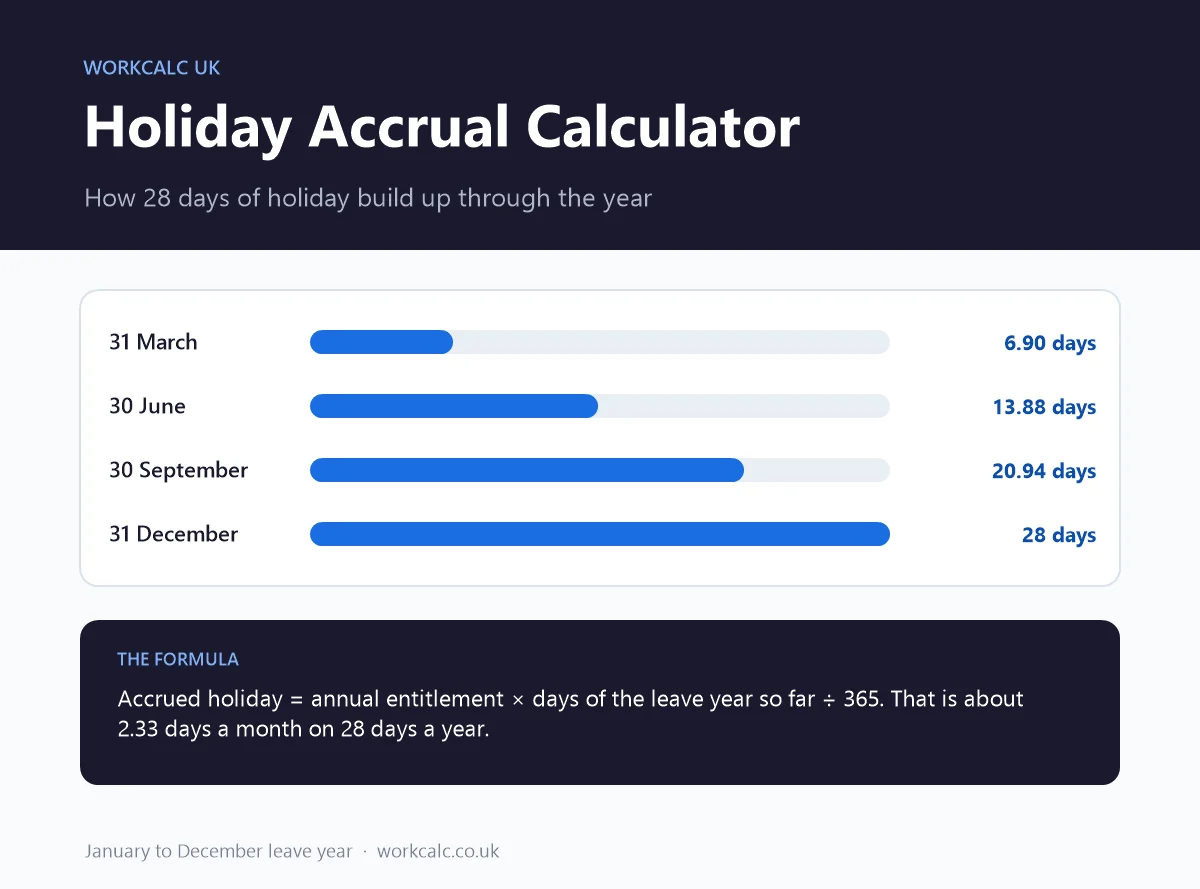
Holiday builds up evenly through the leave year. To find how much you have accrued, multiply your annual entitlement by the share of the leave year that has passed: 28 days × 261 ÷ 365 = 20.02 days by 18 September in a January to December year. Take off leave you have taken, add anything carried over, and the result is your balance. When you leave, any positive balance of statutory leave must be paid.
How holiday accrual works
Almost every worker gets 5.6 weeks of paid holiday a year, and it builds up, or accrues, as the year goes on. There are two common ways to measure it:
- By days elapsed: annual entitlement × days of the leave year passed ÷ days in the leave year. This is the method the law uses when you leave.
- By months: one-twelfth of the annual entitlement for each month. On 28 days that is 2.33 days a month. This is how most HR systems show it, and how the law treats your first year.
The two give almost the same answer at month ends. The calculator uses days elapsed for your balance and shows the monthly schedule alongside.
28 days a year, January to December 2026, checked on 18 September
Your first year: the monthly rule
In the first year of a new job, the Working Time Regulations limit the leave you can take to what has built up so far. Leave accrues at one-twelfth of the annual amount on the first day of each month of employment, and part days are rounded up to the nearest half day.
Someone who started on 16 March 2026 on a 28-day entitlement has begun 7 months of employment by 18 September: 7 × 2.33 = 16.33 days, rounded up to 16.5 days they can have taken by then. Their full entitlement for the rest of the leave year to December is 28 × 291 ÷ 365 = 22.32 days. Many employers let new starters take leave in advance of accrual; the rule is a limit employers can apply, not a requirement.
Related tool Holiday Entitlement Calculator: your full-year and part-year entitlement →Holiday when you leave a job
When your job ends, you must be paid for any statutory leave you have accrued but not taken. Unless your contract sets its own method, regulation 14 of the Working Time Regulations gives the formula:
Leaving on 18 September 2026 in the example above, with 10 days taken, gives 10.02 days. At £115.38 a day on a £30,000 salary, that is £1,156.33 before tax, paid with your final salary and taxed through PAYE in the normal way.
Your employer can also ask you to use some of your remaining holiday during your notice period instead of paying it. The Notice Period Calculator shows your last day.
If you have taken too much
New starters in particular can leave having taken more holiday than they built up. Your employer can only recover the overpaid days from your final pay if your contract or another written agreement allows it. Otherwise they cannot make the deduction.
Accrual in hours
If your days vary in length, track holiday in hours. A 37.5-hour week gives 210 hours a year, or 17.5 hours a month. A 20-hour week gives 112 hours a year, or 9.33 hours a month. Switch the calculator to hours to see your balance that way.
Related tool Part-Time Holiday Calculator: your entitlement in hours and bank holidays on your days →Does holiday accrue during sick leave or family leave?
Yes. Statutory holiday keeps building up while you are off sick or on maternity, paternity, adoption or shared parental leave. If you could not take your holiday because of sickness or family leave, you can carry it into the next leave year: up to 4 weeks for sickness, to be used within 18 months of the end of the year it was earned in, and all of it for family leave.
Carrying over unused holiday
The 5.6 weeks of statutory leave are made up of 4 weeks and 1.6 weeks. Up to 1.6 weeks can be carried into the next year if your contract allows. The 4 weeks must normally be used in the year, unless you were unable to take it because of sickness or family leave, or your employer did not give you a reasonable chance to take it or tell you it would be lost. Enter carried-over days in the calculator to include them in your balance.
Irregular hours and zero-hours contracts
If you work irregular hours or only part of the year, and your leave year started on or after 1 April 2024, holiday accrues at 12.07% of the hours you work in each pay period rather than monthly. Use the Zero Hours Holiday Pay Calculator for that pattern.
Related guide 5.6 weeks holiday explained: where it comes from and the 4-week and 1.6-week rules →What this calculator does not cover
- Contract rules that set a different accrual or payout formula, or round differently.
- Changes in working pattern part way through the year; work out each period separately.
- Irregular-hours and part-year workers using the 12.07% method.
- Northern Ireland, which has its own working time regulations with similar rules.
Sources
- The Working Time Regulations 1998, regulations 13, 13A, 14 and 15A, as amended
- GOV.UK, Holiday entitlement
- Acas, Holiday entitlement and holiday pay
Frequently asked questions
Holiday accrual, first-year leave and leaving pay.
How is holiday accrual calculated?
Multiply your annual entitlement by the share of the leave year that has passed. On 28 days a year, by 18 September 2026 in a January to December leave year, 261 of 365 days have passed, so you have accrued 20.02 days. Take off any leave already taken and add any carried over.
How much holiday do I accrue each month?
One-twelfth of your annual entitlement. On the 28-day statutory minimum for a 5-day week that is 2.33 days a month; on 16.8 days for a 3-day week it is 1.4 days; in hours, 210 hours a year is 17.5 hours a month.
How much holiday can I take in my first year?
In your first year, you can only take the leave you have built up so far. It accrues at one-twelfth of the annual amount on the first day of each month of employment, and part days are rounded up to the nearest half day. Seven months into a 28-day year, you can have taken up to 16.5 days.
Do I get paid for accrued holiday when I leave?
Yes. Any statutory holiday you have accrued but not taken by your last day must be paid. The legal formula is your annual entitlement multiplied by the proportion of the leave year that has passed, minus leave taken. On £30,000 and 28 days, leaving on 18 September 2026 having taken 10 days, that is 10.02 days, worth £1,156.33 before tax.
What if I have taken more holiday than I have accrued?
If you leave having taken more leave than you built up, your employer can only deduct the overpaid days from your final pay if your contract or a written agreement allows it. Without that, they cannot make the deduction.
Does holiday accrue during sick leave or maternity leave?
Yes. Statutory holiday continues to build up while you are off sick or on maternity, paternity, adoption or shared parental leave. If sickness stops you taking it, you can carry up to 4 weeks forward, to be used within 18 months of the end of the leave year it was earned in.
Can I carry over unused holiday?
Up to 1.6 weeks of statutory leave can be carried over if your contract allows. The other 4 weeks must normally be taken in the year, unless you could not take it because of sickness, family leave, or because your employer did not give you a proper chance to take it.
How does holiday accrue on a zero-hours contract?
For irregular-hours and part-year workers, in leave years starting on or after 1 April 2024, holiday accrues at 12.07% of the hours worked in each pay period rather than monthly. Use a 12.07% calculator for that pattern.