
Part-Time Holiday Calculator
Enter the hours you work each day to see your holiday entitlement in hours and days, which bank holidays land on your working days, and how much leave is left for you to book.
Your working pattern
You work 22.5 hours over 3 days a week.
Assumes your workplace closes on bank holidays and that any bank holiday on a working day is taken from your entitlement. Part days are shown to two decimal places; employers can round up but should not round statutory leave down.
Part-time holiday entitlement by days worked
Statutory minimum of 5.6 weeks, which can include bank holidays. Hours assume a 7.5-hour working day.
| Days a week | Hours a week | Holiday in days | Holiday in hours | Bank holiday share (of 8) |
|---|---|---|---|---|
| 1 day | 7.5 | 5.6 | 42 | 1.6 days |
| 2 days | 15 | 11.2 | 84 | 3.2 days |
| 2.5 days | 18.75 | 14 | 105 | 4 days |
| 3 days | 22.5 | 16.8 | 126 | 4.8 days |
| 3.5 days | 26.25 | 19.6 | 147 | 5.6 days |
| 4 days | 30 | 22.4 | 168 | 6.4 days |
| 4.5 days | 33.75 | 25.2 | 189 | 7.2 days |
| 5 days (full time) | 37.5 | 28 | 210 | 8 days |
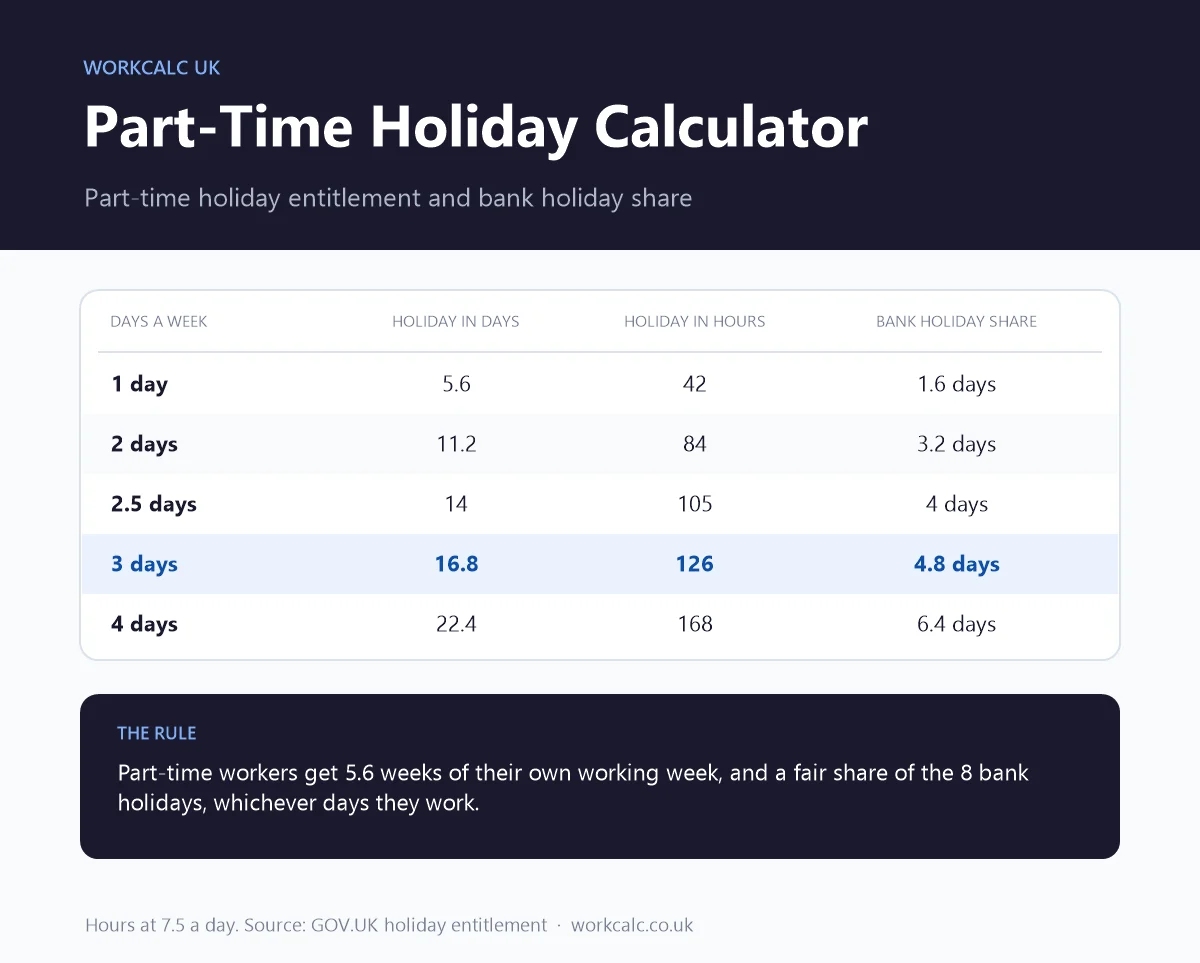
Part-time workers get the same 5.6 weeks of paid holiday as full-time staff, measured in their own working weeks. Multiply the days you work by 5.6 (3 days gives 16.8 days) or, if your days vary in length, multiply your weekly hours by 5.6 (20 hours gives 112 hours). If full-time colleagues get bank holidays, you should get a pro-rata share of them, whichever days of the week you work.
How part-time holiday entitlement works
Almost every worker in the UK is entitled to 5.6 weeks of paid holiday a year under the Working Time Regulations. For someone working five days a week that is 28 days. For a part-time worker it is the same 5.6 weeks, but each week is shorter, so the number of days is smaller.
Statutory leave is capped at 28 days, so working six days a week does not take you above it. Many employers give more than the minimum, in which case part-time staff should get the enhanced figure pro rata too. The Part-time Workers Regulations 2000 protect part-timers from being treated less favourably than a comparable full-time colleague, and Acas guidance says leave should be given in proportion to hours worked.
This calculator starts from the allowance a full-time colleague gets, scales it to your hours, then checks the result never falls below the legal 5.6 weeks.
Why hours are fairer when your days vary
The days formula assumes every working day is the same length. If yours are not, it gives odd results. Take someone who works 8 hours on Monday and Tuesday and 4 hours on Thursday, 20 hours a week:
- In days: 3 days × 5.6 = 16.8 days. A 4-hour Thursday off uses a full day, the same as an 8-hour Monday.
- In hours: 20 hours × 5.6 = 112 hours. A Monday off uses 8 hours and a Thursday uses 4.
The hours method gives exactly 5.6 weeks of time off whichever days you book, which is why most payroll systems record part-time leave in hours. The calculator shows both, using your average working day to convert hours into days.
Compressed hours and 4-day weeks
If you work full-time hours in fewer days, for example 37.5 hours over four 9.375-hour days, you are not part time. You are entitled to the same 210 hours as a colleague on five 7.5-hour days. That is 22.4 of your longer days, not 28. Each bank holiday on a working day uses 9.375 hours.
Related tool Holiday Entitlement Calculator: starting or leaving part way through the leave year →Part-time bank holidays: the fair way to work them out
The law does not give anyone the right to bank holidays off. Employers can count them towards the 5.6 weeks or give them on top. The problem for part-time staff is where bank holidays fall. In England and Wales most of them are Mondays, so someone who never works a Monday can miss out on most of them, while a Monday worker gets them all.
The fair method, and the one this calculator uses, is:
- Work out the full-time entitlement, including bank holidays, in hours.
- Give the part-time worker the same proportion of it as their share of full-time hours.
- Take off the hours of any bank holidays that fall on their working days.
- The rest is theirs to book whenever they like.
Two 3-day workers, Jan to Dec 2026, England
Both end up with 126 hours of time off. Compare the unfair method of giving 60% of the 20 days plus only the bank holidays that land on each person's days: the Monday worker gets 17 days, but the Tuesday to Thursday worker gets just 13, which is below the 16.8-day legal minimum.
\n Related guide\n Does 28 days holiday include bank holidays? What your contract wording means →\n \n\nThe 2026/27 leave year has 10 bank holidays
If your leave year runs from April to March, 2026/27 contains two Easters in England and Wales: 3 and 6 April 2026, then 26 and 29 March 2027. That gives 10 bank holidays instead of 8, and 6 of them are Mondays. If your contract says "20 days plus bank holidays", full-time colleagues get 30 days that year, and your pro-rata share should rise with it. Scotland has 11 bank holidays in the same period and Northern Ireland 12.
| Bank holidays | Jan to Dec 2026 | Apr 2026 to Mar 2027 | Jan to Dec 2027 |
|---|---|---|---|
| England and Wales | 8 (5 on Mondays) | 10 (6 on Mondays) | 8 (5 on Mondays) |
| Scotland | 10 (6 on Mondays) | 11 (7 on Mondays) | 9 (5 on Mondays) |
| Northern Ireland | 10 (6 on Mondays) | 12 (7 on Mondays) | 10 (6 on Mondays) |
Scotland's 2026 total includes a one-off bank holiday on 15 June 2026. All dates come from GOV.UK, and the calculator lists each one for your leave year and region.
When bank holidays outnumber your share
A Monday-only worker can have more bank holidays on working days than their pro-rata share covers. In that case the employer may ask them to work some bank holidays, swap to another day, or use more of their remaining leave. The calculator flags this if bank holidays would use up more than your whole entitlement.
Holiday pay for part-time workers
You are paid your normal pay for the hours you would have worked on each day of leave. If you work regular hours, that is simply your usual pay for that day. If your hours or pay vary, holiday pay is based on an average of the previous 52 paid weeks. For irregular-hours and part-year workers there are different rules, where leave builds up at 12.07% of hours worked.
Related tool Zero Hours Holiday Pay Calculator: the 12.07% rule for irregular hours → Related tool Holiday Pay Calculator: what each day of leave pays, including overtime →If your hours change during the year
Work out each period separately. Leave you built up on your old pattern should keep its value, and the rest of the year is calculated on your new hours. For example, moving from 5 days to 3 days halfway through a 28-day year gives 14 days for the first half and 8.4 days for the second, 22.4 days in total, less any leave already taken. If a move to part-time hours also changes your salary, the Pro Rata Salary Calculator shows the new figure.
Rounding and part days
Part-time entitlement often comes out as a fraction, such as 16.8 days. Employers can round it up or let you take part days, but statutory leave should not be rounded down. Recording leave in hours avoids the problem entirely.
What this calculator does not cover
- Starting or leaving mid-year: leave builds up month by month. Use the Holiday Entitlement Calculator.
- Irregular hours, zero-hours and term-time contracts, which use the 12.07% accrual method.
- NHS Agenda for Change staff, whose leave rises with service. Use the NHS Annual Leave Calculator.
- Carry-over, sickness and family leave, which can change how much leave you can take in a year.
- Local or company holidays that are not official bank holidays.
Sources
- GOV.UK, Holiday entitlement: entitlement, and part-time and irregular hours
- GOV.UK, UK bank holidays data for England and Wales, Scotland and Northern Ireland
- Acas, Part-time workers' rights
- The Part-time Workers (Prevention of Less Favourable Treatment) Regulations 2000
Frequently asked questions
Part-time leave, bank holidays and working patterns.
How much holiday do I get working 3 days a week?
At least 16.8 days a year, which is 5.6 weeks multiplied by 3 days. On 7.5-hour days that is 126 hours. The statutory minimum can include bank holidays, so if your employer gives bank holidays on top of the minimum you will get more.
How much holiday do I get working 4 days a week?
At least 22.4 days a year, or 5.6 weeks multiplied by 4 days. On 7.5-hour days that is 168 hours. If you work a compressed full-time week of 37.5 hours over 4 days, you are entitled to the same 210 hours as a full-time colleague, which is 22.4 of your longer days.
Do part-time workers get bank holidays?
There is no legal right to have bank holidays off, but part-time workers must not be treated less favourably than comparable full-time staff. If full-time colleagues get bank holidays, the fair approach is a pro-rata share: someone working 3 of 5 days gets 60% of the bank holiday allowance, for example 4.8 days out of 8, whichever days they work.
What if a bank holiday falls on my day off?
You should still receive your pro-rata share of bank holiday leave to take on another day. Working out your whole entitlement in hours, then deducting the hours of any bank holidays that land on your working days, handles this automatically.
Should part-time holiday be calculated in hours or days?
Either works if you work the same hours every day. If your days are different lengths, hours are fairer: a 20-hour week gives 112 hours of statutory leave, and a 4-hour Thursday then uses 4 hours rather than a whole day.
How many bank holidays are there in 2026?
England and Wales have 8 bank holidays in 2026. Scotland has 10, including a one-off bank holiday on 15 June 2026, and Northern Ireland has 10, including St Patrick's Day and the Battle of the Boyne.
Why are there 10 bank holidays in my 2026/27 leave year?
An April 2026 to March 2027 leave year contains two Easters in England and Wales: Good Friday and Easter Monday on 3 and 6 April 2026, and again on 26 and 29 March 2027. That gives 10 bank holidays instead of the usual 8, and 6 of them are Mondays.
Can my employer make me use holiday for bank holidays?
Yes, if your contract includes bank holidays in your allowance. When the workplace closes, the hours for bank holidays on your working days are taken from your total, and whatever remains is yours to book on other days.