
Holiday Pay Calculator
Work out what each day of holiday should pay, whether your pay is a fixed salary or varies with overtime and commission, and what any untaken leave is worth when you leave a job.
Your pay
| Holiday pay | Rate | Basic only |
|---|---|---|
| A day | ||
| A week | ||
| An hour |
Holiday pay by salary, 2026
Fixed salary, 5-day week. A day's pay is the annual salary divided by 260, and 28 days is the statutory minimum for a 5-day week.
Holiday pay is a normal week's pay for each week of leave. On a fixed salary, a day's holiday pay is your salary divided by 52 and then by the days you work each week: £30,000 on a 5-day week pays £115.38 a day. If your pay varies, average your last 52 paid weeks. For at least 4 weeks of leave that average must include regular overtime, commission and allowances; the other 1.6 weeks can be paid at your basic rate.
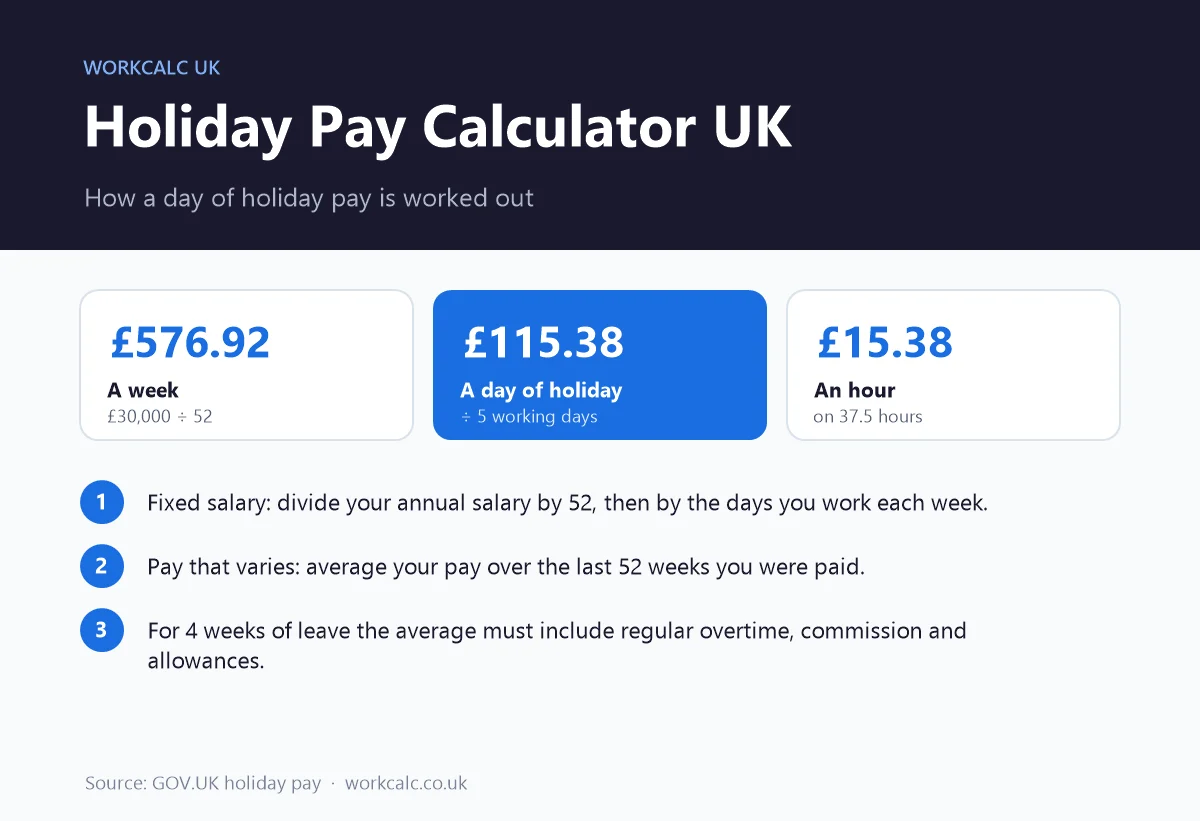
How holiday pay is calculated
Almost every worker in the UK gets 5.6 weeks of paid holiday a year, and the Working Time Regulations say each week of leave is paid at a week's pay. How that week's pay is worked out depends on whether your pay is fixed.
If your hours and pay are fixed
You get exactly what you would have earned if you had worked. Someone paid £500 for a fixed 37-hour week gets £500 for a week's holiday. To turn that into a daily rate, divide by the days you work:
For a 5-day week that is the same as dividing by 260. On the £12.71 National Living Wage and a 37.5-hour week, a day's holiday pays £95.33.
If your pay varies
If you earn overtime, commission, shift allowances or bonuses, or your hours change, your employer works out an average week's pay:
Only weeks in which you were paid count. If some weeks had no pay, for example unpaid leave, your employer goes further back to find 52 paid weeks, up to a maximum of 104 weeks. If you have not worked 52 weeks yet, the average uses the weeks you have. Holiday pay received during the period is left out, so it does not drag the average down.
What must be included: the 4 weeks and the 1.6 weeks
Your 5.6 weeks of statutory leave are made up of two parts that can be paid differently. For leave years starting on or after 1 April 2024 in England, Scotland and Wales, the law says the first 4 weeks must be paid at your normal remuneration, which includes:
- payments linked to tasks in your contract, such as commission
- payments for length of service, seniority or professional qualifications
- overtime you have regularly been paid over the last year
The remaining 1.6 weeks, and any contractual leave above 5.6 weeks, can be paid at your basic rate unless your contract says otherwise. Many employers simply pay everything at the higher rate, which is simpler to run. Read more in 5.6 weeks holiday explained.
£12.71 an hour with regular overtime and a shift allowance
If the employer paid all 5.6 weeks at the normal rate, the year's holiday pay would be £3,145.10, or £136 more. These are the default figures in the calculator's variable-pay option, so you can see the split for yourself.
Related tool Part-Time Holiday Calculator: how many hours of leave you get and which bank holidays fall on your days →260 or 365? Getting the daily rate right
A common mistake is dividing an annual salary by 365 to get a day's pay. That spreads the salary across weekends and days you do not work, and underpays each day of leave by almost 30% for a 5-day worker. The correct day's pay is a week's pay divided by the days you work in a week, which is salary ÷ 260 for a standard 5-day week.
Part-time workers use their own days. Someone on £18,000 working 3 days a week gets £18,000 ÷ 52 ÷ 3 = £115.38 per day of holiday, the same daily rate as a full-time colleague on £30,000.
Holiday pay when you leave a job
When you leave, you must be paid for any statutory leave you have built up in the current leave year but not taken. The Holiday Accrual Calculator works out how many days that is. Leave above the statutory minimum is paid if your contract says so. The payment is:
On a £35,000 salary and a 5-day week, 6 untaken days are worth £807.69 before tax. The payment goes through your final payslip and is taxed at your marginal rate, so a basic rate taxpayer in England keeps about £581.54 after income tax and National Insurance. To work out your last day, use the Notice Period Calculator. If you have taken more leave than you have built up, your contract may allow your employer to deduct the overpaid days from your final pay.
Irregular hours and rolled-up holiday pay
If you work irregular hours, such as a zero-hours contract, or only for part of the year, different rules apply for leave years starting on or after 1 April 2024. Your leave builds up at 12.07% of the hours you work, and your employer can choose to pay holiday pay as you go, adding 12.07% to every payslip. This rolled-up holiday pay must be shown separately on your payslip, and it is not allowed for workers on regular hours. Northern Ireland has its own regulations, and rolled-up holiday pay is not lawful there.
Related tool Zero Hours Holiday Pay Calculator: the 12.07% rule and rolled-up holiday pay →If you think your holiday pay is wrong
- Check your payslips for the reference period and add up everything that counts as normal pay.
- Ask your employer, in writing, how they worked out your holiday pay.
- If the problem is not fixed, raise a formal grievance.
- Acas offers free advice, and early conciliation is required before an employment tribunal claim. Time limits are short, usually 3 months less a day from the underpayment.
What this calculator does not cover
- Irregular-hours and part-year workers, who use the 12.07% method.
- Sickness, maternity and other family leave in the reference period, which have their own rules.
- Bonuses paid annually, which may need to be spread across the year depending on how they are earned.
- Pension and student loan deductions on a leaving payment. The after-tax figure is an estimate for England, Wales and Northern Ireland with a 1257L tax code.
Sources
- GOV.UK, Holiday entitlement: holiday pay
- Acas, Calculating holiday pay
- Department for Business and Trade, Calculating holiday pay for workers without fixed hours or pay
- The Working Time Regulations 1998, as amended from 1 January 2024
Frequently asked questions
Holiday pay rates, overtime and leaving pay.
How is holiday pay calculated in the UK?
You are paid a normal week's pay for each week of holiday. If your hours and pay are fixed, that is simply your usual pay. If your pay varies, your employer averages what you earned over your last 52 paid weeks, ignoring weeks with no pay, and for at least 4 weeks of leave that average must include regular overtime, commission and similar payments.
How much is a day's holiday pay on a salary?
Divide your annual salary by 52 to get a week's pay, then by the number of days you work each week. On a 5-day week that is salary divided by 260, so £30,000 gives £115.38 for each day of holiday.
Does holiday pay include overtime?
Yes, if you work overtime regularly. Regular overtime, commission, and payments linked to seniority or qualifications must be included in holiday pay for at least 4 weeks of your statutory leave. The remaining 1.6 weeks can legally be paid at your basic rate, although many employers use the higher rate for all of it.
What is the 52-week reference period for holiday pay?
It is the period used to average holiday pay for workers whose pay varies. Your employer looks back over the last 52 weeks in which you were paid, skipping any week with no pay, and can go back up to 104 weeks to find them. If you have worked fewer than 52 weeks, it uses the weeks you have.
Is holiday pay taxed?
Yes. Holiday pay is taxed through PAYE in exactly the same way as normal pay, with income tax, National Insurance, pension and any student loan deducted. A payment for untaken leave when you leave is added to your final pay and taxed at your marginal rate.
Do I get paid for unused holiday when I leave a job?
Yes, for any statutory leave you have built up but not taken by your last day. Contractual leave above the statutory minimum is paid according to your contract. On a £35,000 salary and a 5-day week, 6 untaken days are worth £807.69 before tax.
Should a day's holiday pay be based on 260 or 365 days?
On working days. A day's holiday pay is a week's pay divided by the days you work in a week, which for a 5-day week is the same as dividing your salary by 260. Dividing by 365 calendar days would underpay, because it spreads your salary across weekends and days you do not work.
Can my employer include holiday pay in my hourly rate?
Only for irregular-hours and part-year workers in England, Scotland and Wales, for leave years starting on or after 1 April 2024. This rolled-up holiday pay must be 12.07% of pay and shown separately on the payslip. For regular-hours workers, holiday pay must be paid when the leave is taken.