
Gross vs Net Pay: What's the Difference? (UK 2026/27)
Gross pay is what you earn before anything is taken off. Net pay is what reaches your bank account. Here is what comes off in between, how much of a UK salary you actually take home in 2026/27, and how to work from one to the other.
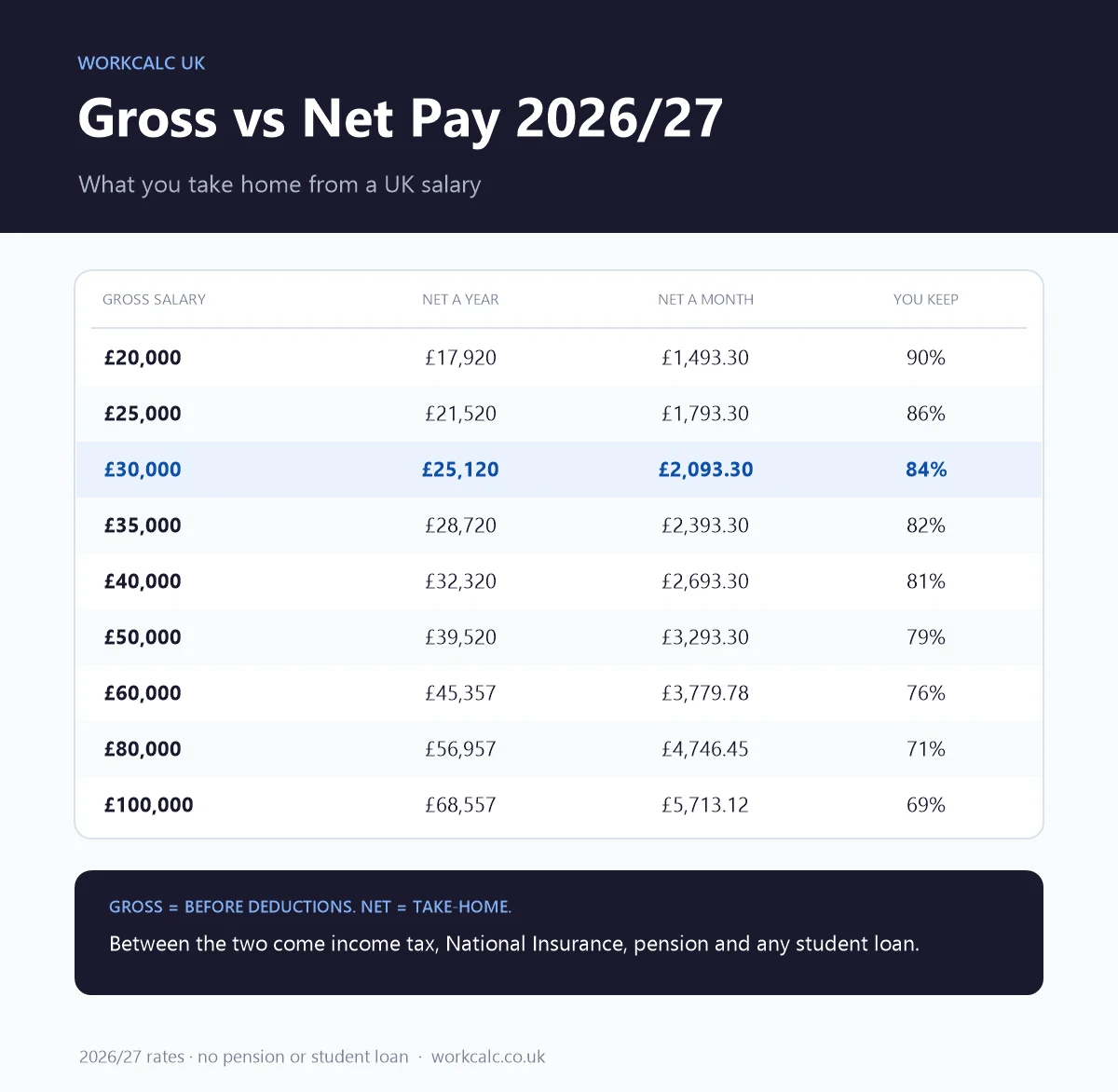
Gross pay is your pay before deductions, the figure in your contract or a job advert. Net pay is your take-home pay after income tax, National Insurance, pension and any student loan. On a £30,000 gross salary in 2026/27 you take home £25,120 net a year, £2,093.30 a month, with no pension or student loan, or £2,014.10 a month with a 5% workplace pension.
Key points
- Gross means before tax and deductions; net means after.
- Salaries in job adverts and contracts are gross.
- The main deductions are income tax, National Insurance, pension and student loan.
- On £30,000 you keep 84% of your gross pay; on £100,000 you keep 69%.
- Taxable pay can be lower than gross pay if you pay into a pension before tax or use salary sacrifice.
Gross and net: the definitions
- Gross pay: everything you earn before deductions, including basic salary or wages, overtime, bonuses, commission and holiday pay. Job adverts, offer letters and contracts quote gross figures.
- Net pay: what you receive after all deductions. It is the figure at the bottom of your payslip and the amount paid into your account, which is why it is also called take-home pay.
- Gross income: the same idea applied to all your income, not just one job. Mortgage lenders and benefit forms usually ask for gross income.
- Net income: income after tax and deductions. In some benefit and childcare rules, adjusted net income has its own meaning: total taxable income minus things like pension contributions and Gift Aid.
Gross to net on a payslip
Here is how £30,000 gross becomes net pay in 2026/27, for someone in England, Wales or Northern Ireland paying 5% of qualifying earnings into a workplace pension before tax:
| Line | A month | A year |
|---|---|---|
| Gross pay | £2,500.00 | £30,000 |
| Pension (5% of qualifying earnings) | −£99.00 | −£1,188 |
| Taxable pay | £2,401.00 | £28,812 |
| Income tax | −£270.70 | −£3,248 |
| National Insurance | −£116.20 | −£1,394 |
| Net pay | £2,014.10 | £24,169 |
The pension comes off before tax, so income tax is worked out on £28,812, not £30,000. National Insurance is still worked out on the full gross pay under this kind of scheme. With salary sacrifice instead, both tax and National Insurance would be worked out on the lower figure. The Salary Sacrifice Calculator shows the difference.
What comes off between gross and net
- Income tax: nothing on the first £12,570, your personal allowance, then 20% up to £50,270, 40% up to £125,140 and 45% above that. Scotland has its own rates: on £45,000 a Scottish taxpayer pays £6,882 income tax, against £6,486 elsewhere in the UK. See wrong tax code if your tax looks too high.
- National Insurance: 8% of earnings between £12,570 and £50,270 a year, and 2% above that.
- Pension: under auto-enrolment you pay at least 5% of qualifying earnings, the slice of pay between £6,240 and £50,270, and your employer adds at least 3%. Use the Pension Contribution Calculator to see your figures.
- Student loan: 9% of earnings above your plan's threshold, which in 2026/27 is £26,900 for Plan 1, £29,385 for Plan 2, £33,795 for Plan 4 and £25,000 for Plan 5, plus 6% above £21,000 for a postgraduate loan.
- Other deductions: salary sacrifice for a car, bike or childcare, union fees, payroll giving and court orders such as an attachment of earnings.
Gross to net pay table 2026/27
Take-home pay for common gross salaries, with income tax and National Insurance only, no pension or student loan, outside Scotland:
| Gross salary | Net a year | Net a month | You keep |
|---|---|---|---|
| £20,000 | £17,920 | £1,493.30 | 90% |
| £25,000 | £21,520 | £1,793.30 | 86% |
| £30,000 | £25,120 | £2,093.30 | 84% |
| £35,000 | £28,720 | £2,393.30 | 82% |
| £40,000 | £32,320 | £2,693.30 | 81% |
| £50,000 | £39,520 | £3,293.30 | 79% |
| £60,000 | £45,357 | £3,779.78 | 76% |
| £80,000 | £56,957 | £4,746.45 | 71% |
| £100,000 | £68,557 | £5,713.12 | 69% |
The share you keep falls as pay rises because more of it is taxed at 40%. Between £100,000 and £125,140 it falls faster still, because your personal allowance is withdrawn. For any other salary, or to add pension and student loan, use the salary calculator. For hourly pay, the Hourly Wage Calculator converts gross hourly rates into net pay.
Working out gross from net
If you know what you want to take home, you can work back to the gross salary you need. Below £50,270, income tax and National Insurance together take 28p of every pound above £12,570, so:
Gross salary ≈ (net annual pay − £3,519.60) ÷ 0.72
To take home £2,000 a month, or £24,000 a year, with no pension or student loan, you need about £28,445 gross. A pension or student loan pushes the figure up, so check the result in the salary calculator. When comparing job offers, always compare gross with gross, or net with net.
Gross income, taxable pay and the self-employed
- Taxable pay: your payslip and P60 may show a taxable pay figure lower than your gross pay, because pension contributions and salary sacrifice come off first. Income tax is worked out on taxable pay.
- Gross pay for National Insurance: National Insurance is worked out on each pay period separately, not over the year, so a large one-off bonus can mean less of it is charged at 8% than you might expect.
- Self-employed: your gross income is your turnover. Take off allowable expenses to get your profit, then income tax and Class 4 National Insurance to get your net income. The Self-Employed Tax Calculator works this out.
- Contractors: a day rate is a gross figure for the client, not your salary. Inside IR35, employer costs come out before your own gross pay, as the Inside IR35 Calculator shows.
Sources
- GOV.UK, Income Tax rates and Personal Allowances 2026/27
- GOV.UK, Rates and thresholds for employers 2026 to 2027
- The Pensions Regulator, Automatic enrolment earnings thresholds
- gov.scot, Scottish Income Tax rates and bands 2026 to 2027
Frequently asked questions
Gross and net pay, quickly answered.
What is net pay?
Net pay is what you actually receive after deductions: income tax, National Insurance, pension contributions, student loan repayments and anything else taken from your pay. It is the amount that lands in your bank account, often called take-home pay. On a £30,000 salary with no pension or student loan, net pay in 2026/27 is £25,120 a year, or £2,093.30 a month.
What is gross income?
Gross income is your income before any tax or deductions. For an employee it is your salary or wages plus things like overtime, bonuses and commission. Forms for mortgages, loans and benefits usually ask for gross income, and HMRC adds other income such as self-employed profit, rent and savings interest to work out your total income for tax.
Is my salary gross or net?
Salaries in job adverts and contracts are almost always gross: the figure before tax and other deductions. A job advertised at £30,000 a year means £30,000 gross, which is £2,500 a month before deductions and about £2,093 a month net if you have no pension or student loan.
How do I work out net pay from gross?
Take your gross pay and subtract income tax (20% on income between £12,570 and £50,270, 40% above that), employee National Insurance (8% between £12,570 and £50,270, 2% above), and any pension, student loan or other deductions. The salary calculator does this for any salary.
How do I work out gross pay from net?
Work backwards: below £50,270, tax and National Insurance together take 28p of each pound above £12,570, so gross pay is roughly (net pay minus £3,519.60) divided by 0.72. To take home £2,000 a month, or £24,000 a year, with no pension or student loan, you need a gross salary of about £28,445.
Is gross income before or after tax?
Before. Gross always means before tax and deductions, and net always means after. Gross profit for a business is slightly different: it is sales minus the direct cost of those sales, before overheads and tax.
Is gross pay the same as taxable pay?
Not always. If you pay into a pension through a net pay arrangement or salary sacrifice, or sacrifice salary for a car or bike, your taxable pay is lower than your gross pay. Your payslip and P60 show taxable pay, which is the figure income tax is worked out on.