
Wrong Tax Code? How to Check and Fix It (2026/27)
A wrong tax code can take hundreds of pounds too much from your pay, or leave you with a tax bill later. Here is how to spot one, what it is costing you, and the steps to get HMRC to fix it and pay you back.
Most people with one job should be on 1257L in 2026/27 (S1257L in Scotland, C1257L in Wales). If your main job shows BR, 0T or D0, or an emergency code ending in W1, M1 or X that has not changed for months, it is probably wrong. Check how HMRC worked it out in the HMRC app or your Personal Tax Account, update the details there or call HMRC on 0300 200 3300, and any tax you have overpaid normally comes back in your next pay.
Key points
- Only HMRC can change your tax code. Your employer just applies it.
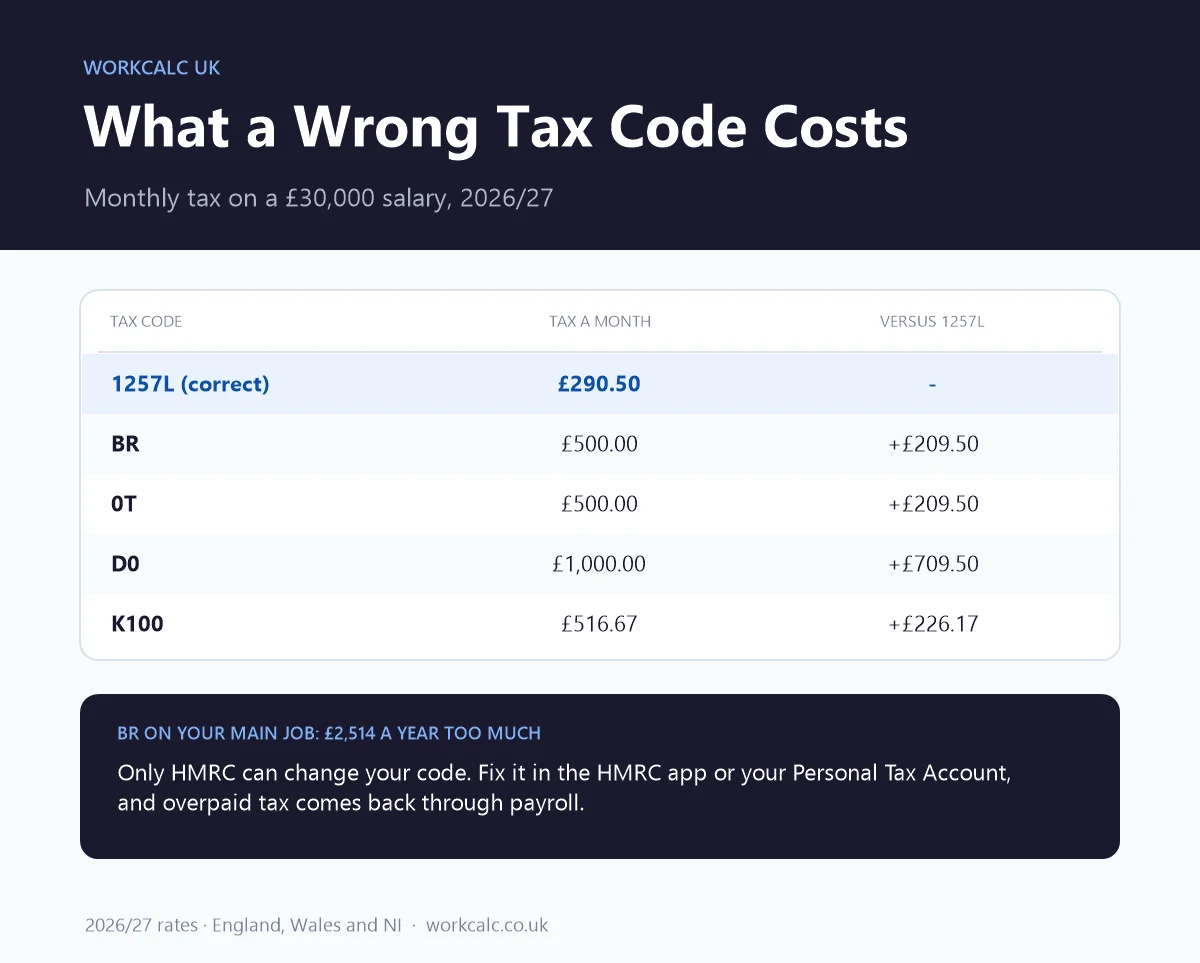
- BR instead of 1257L on a £30,000 salary takes £209.50 a month too much, £2,514 a year.
- Emergency codes often overpay after a gap in work, because they do not give back unused allowance.
- Overpaid tax is refunded through payroll once the code is fixed, or by HMRC after the year ends.
- You can claim back overpaid tax for up to four tax years.
Signs your tax code is wrong
Your tax code is on every payslip, your P60 and any P45. Compare it with these warning signs:
| What you see | What it means | Usual effect |
|---|---|---|
| BR, 0T or D0 on your only or main job | You are getting no tax-free allowance | Overpaying |
| W1, M1 or X at the end, for more than two months | Emergency code, not catching up | Often overpaying |
| A K code you cannot explain | HMRC thinks you have untaxed income or benefits | Overpaying if wrong |
| No S prefix, but you live in Scotland | Taxed at English rates | Under or overpaying |
| 1257L on a second job as well | Allowance used twice | Underpaying |
| A number lower than 1257 with no reason you know of | A benefit or deduction you do not have | Overpaying if wrong |
Some of these are right in the correct situation. BR is normal on a second job or a workplace pension, and a lower number is correct if you have a company car or HMRC is collecting an old underpayment. To decode any code, use the Tax Code Calculator.
What a wrong tax code costs
On a £30,000 salary paid monthly in 2026/27, outside Scotland:
| Code | What it does | Tax a month | Versus 1257L |
|---|---|---|---|
| 1257L (correct) | Standard allowance | £290.50 | - |
| BR | All pay taxed at 20% | £500.00 | £209.50 more |
| 0T | No allowance | £500.00 | £209.50 more |
| D0 | All pay taxed at 40% | £1,000.00 | £709.50 more |
| K100 | £1,000 added to taxable pay | £516.67 | £226.17 more |
Emergency codes are more subtle. With a code ending in W1 or M1, each payday is taxed on its own, with just one month's share of your allowance. If you work all year, that makes no difference. But if you start a job in October after six months off, a cumulative 1257L code would give you the allowance for the months you were not earning, so you would pay £486 in tax by April. On an emergency M1 code you would pay £1,743, which is £1,257 too much until HMRC puts you on a normal code.
Why tax codes go wrong
- Starting a job without a P45: your employer uses HMRC's starter checklist. If it is your first job since 6 April, you should get 1257L. If you had another job since April, you usually get 1257L on an emergency basis, and if you have another job or pension now, BR. Ticking the wrong statement is one of the most common causes.
- Two jobs or a job and a pension: your allowance should go on the main one. If it is on the wrong job, or used on both, your code is wrong on at least one.
- Out-of-date information: HMRC may still think you have a company car you handed back, a job you have left, or a higher income estimate from last year.
- Untaxed income and old debts: savings interest, rent or an earlier underpayment can be collected by reducing your code. If the amount is wrong, the code is too.
- Moving to or from Scotland: your code should start with S if you live in Scotland. Without it you are taxed at English rates, which HMRC corrects later.
- Marriage Allowance: the partner receiving it should have an M code, such as 1383M, and the partner giving it an N code, such as 1131N.
How to fix a wrong tax code
- Find your code: it is on your latest payslip. If you have more than one job or pension, check each.
- See how HMRC worked it out: the HMRC app and your Personal Tax Account show your code for each employer, the allowances and deductions behind it, and HMRC's estimate of your income.
- Correct the details: you can update your estimated income, tell HMRC a job or benefit has ended, or ask for your allowance to be moved between jobs, online.
- Or call HMRC: the Income Tax helpline is 0300 200 3300. Have your National Insurance number and your employer's PAYE reference, which is on your payslip or P60.
- Wait for the new code: HMRC sends it to your employer, who uses it from the next payroll they run. Check your next payslip to make sure it has changed.
Your employer cannot change the code for you, but payroll can confirm which code they are using and when a new one arrived. If you have just started a job on an emergency code, handing in your P45 or completing the starter checklist correctly usually fixes it without contacting HMRC.
Getting your money back
Once a cumulative code such as 1257L is in place, payroll works out the tax due for the year so far and refunds any overpayment in your next pay. That is why a corrected code can give you a much bigger payslip one month.
- Emergency codes: with W1, M1 or X, the overpaid tax is not refunded until HMRC replaces the code with a cumulative one, or after the tax year ends.
- After the year ends: HMRC checks PAYE records and sends a P800 calculation between June and March if you paid too much.
- Earlier years: you can claim overpaid tax back for up to four tax years. For 2022/23 the deadline is 5 April 2027. Estimate what you are owed with the Tax Rebate Calculator.
If you have paid too little
A wrong code can also mean too little tax. The most common case is two jobs both on 1257L: if the second job pays £10,000 a year, about £2,000 of tax is missed. HMRC usually collects an underpayment by reducing your tax code the following year, spreading it over your pay, rather than asking for a lump sum. Larger amounts can be collected through a Simple Assessment bill. Fixing the code as soon as you notice keeps the bill small.
To see what your pay should look like on the right code, use the salary calculator.
Sources
- GOV.UK, Tax codes: what your tax code means and how to update it
- GOV.UK, Income Tax rates and Personal Allowances 2026/27
- GOV.UK, Starter checklist for PAYE
- GOV.UK, Tax overpayments and underpayments
Frequently asked questions
Wrong tax codes, quickly answered.
How do I know if my tax code is wrong?
Check the code on your latest payslip against what you expect. For most people with one job and no benefits it should be 1257L in 2026/27, or S1257L in Scotland and C1257L in Wales. Warning signs are BR, 0T or D0 on your main job, W1, M1 or X at the end of the code for more than a couple of months, a K code you cannot explain, or a missing S if you live in Scotland. Your HMRC app or Personal Tax Account shows how your code was worked out.
Can my employer change my tax code?
No. Only HMRC sets your tax code. Your employer uses the code HMRC sends them, or an emergency code when you start without a P45, until HMRC issues a new one. If your code is wrong, contact HMRC, not payroll, though payroll can tell you which code they are using.
How do I get my tax code changed?
Update the details HMRC holds about you, such as your estimated income, company benefits or a job you have left, in the HMRC app or your Personal Tax Account, or call the HMRC Income Tax helpline on 0300 200 3300. HMRC then sends the new code to your employer, who applies it from the next payroll they run.
What happens if I have been on the wrong tax code?
If you have paid too much, you usually get it back in your next pay once the new code is in place, as long as it is a cumulative code. If the tax year has ended, HMRC sends a P800 or you can claim a refund for up to four years. If you have paid too little, HMRC normally collects it by lowering your tax code the following year.
What does 1257L mean?
It means you get the standard tax-free Personal Allowance of £12,570 for 2026/27. Multiply the number by 10 to get your allowance, and the L means you have the standard allowance with no adjustments for benefits, Marriage Allowance or other income.
Is a BR tax code wrong?
Not always. BR is correct on a second job or a workplace pension when your personal allowance is used on your main job. It is wrong on your only or main job, because it taxes every pound at 20% with no tax-free amount. On a £30,000 salary that costs £209.50 a month.
Why has my tax code changed?
HMRC changes your code when it learns something new: a company car or medical insurance, Marriage Allowance, job expenses, untaxed income such as rent or savings interest, a State Pension, or tax underpaid in an earlier year that it is collecting through your pay. Your Personal Tax Account shows the reason.