
Personal Savings Allowance 2026/27
How much savings interest you can earn before paying tax: £1,000 for basic rate taxpayers, £500 for higher rate and nothing for additional rate. Work out your allowance, the starting rate for savings and any tax on your interest.
Uses the UK income tax bands, which also apply to savings interest for Scottish taxpayers. Assumes the standard personal allowance and no dividends. 2027/28 uses the announced 22%, 42% and 47% savings rates.
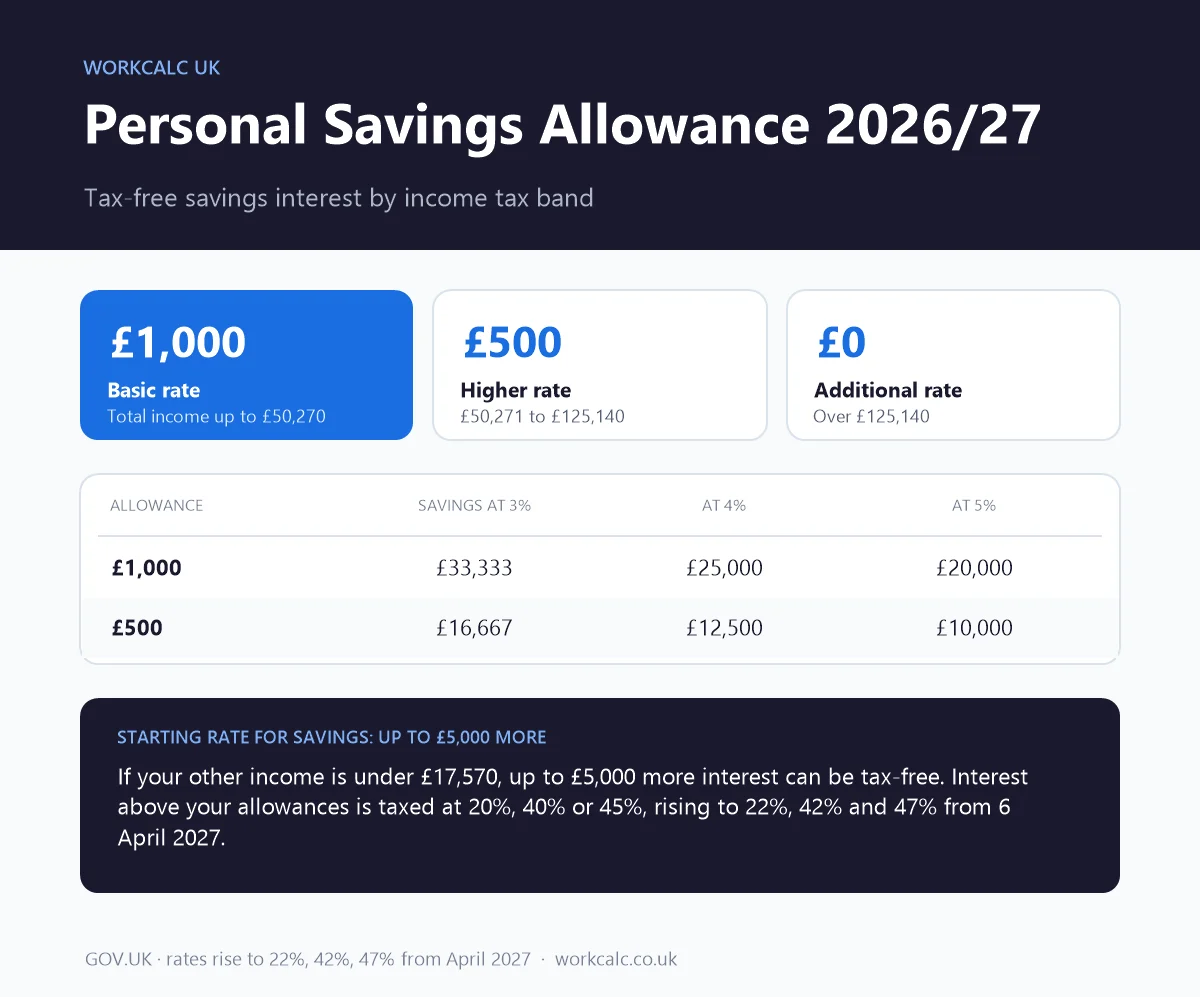
The personal savings allowance lets you earn £1,000 of interest tax-free if you are a basic rate taxpayer, £500 if you are a higher rate taxpayer and £0 if you pay the additional rate. If your other income is under £17,570, the starting rate for savings can make up to another £5,000 of interest tax-free. Interest above your allowances is taxed at 20%, 40% or 45% in 2026/27, rising to 22%, 42% and 47% from 6 April 2027.
How much is the personal savings allowance?
Your allowance depends on the highest income tax band you reach, counting your salary, pension, other income and the interest itself:
| Tax band | Total income | Allowance | Tax on interest above it |
|---|---|---|---|
| Basic rate | £12,571 to £50,270 | £1,000 | 20% (22% from April 2027) |
| Higher rate | £50,271 to £125,140 | £500 | 40% (42% from April 2027) |
| Additional rate | Over £125,140 | £0 | 45% (47% from April 2027) |
Because the interest counts towards your income, it can push you into the next band. Someone earning £49,800 with £1,200 of interest has total income of £51,000, so they are a higher rate taxpayer with a £500 allowance, not £1,000. In that case the tax is £280.00.
The starting rate for savings: up to £5,000 more
If your income other than savings is low, you may get up to £5,000 of interest tax-free on top of the personal savings allowance. The starting rate for savings is reduced by £1 for every £1 of other income above your £12,570 personal allowance, so it disappears once other income reaches £17,570.
| Other income | Starting rate left | Savings allowance | Tax-free interest |
|---|---|---|---|
| £12,570 | £5,000 | £1,000 | £6,000 |
| £15,000 | £2,570 | £1,000 | £3,570 |
| £17,570 | £0 | £1,000 | £1,000 |
| £30,000 | £0 | £1,000 | £1,000 |
| £45,000 | £0 | £1,000 | £1,000 |
| £60,000 | £0 | £500 | £500 |
| £130,000 | £0 | £0 | £0 |
If your other income is below £12,570, any unused personal allowance covers interest too. A retired saver with a £14,000 pension and £3,000 of interest pays no tax, because £3,570 of the starting rate is left plus the £1,000 allowance.
How much savings before you pay tax?
The savings you can hold before interest goes over your allowance depend on the rate you earn. Savings in ISAs do not count:
| Allowance | At 3% | At 4% | At 5% |
|---|---|---|---|
| £1,000 | £33,333 | £25,000 | £20,000 |
| £500 | £16,667 | £12,500 | £10,000 |
Fixed-rate bonds that pay all their interest at the end count it in the tax year it is paid, which can push several years of interest into one year. A bond that pays interest annually spreads it across the years.
What counts as savings interest
- Counts: interest from bank and building society accounts, credit unions, fixed-rate bonds, National Savings & Investments accounts other than Premium Bonds, peer-to-peer lending, government and corporate bonds, and interest paid on PPI refunds.
- Does not count: cash and stocks and shares ISAs, Premium Bond prizes, and dividends, which have their own £500 dividend allowance.
- Joint accounts: HMRC splits the interest equally, so each of you counts half against your own allowance.
- Children's savings: money a parent gives a child under 18 is taxed as the parent's if it earns more than £100 of interest a year. Money from grandparents does not have this rule.
The April 2027 changes
The allowance amounts are not changing, but the tax on interest above them is. From 6 April 2027 savings income will be taxed at 22% basic rate, 42% higher rate and 47% additional rate. A basic rate taxpayer with £1,500 of interest pays £100.00 in 2026/27 and £110.00 in 2027/28. A higher rate taxpayer on £60,000 with £2,000 of interest pays £600.00, then £630.00.
From the same date the cash ISA limit falls to £12,000 a year for under-65s, with the rest of the £20,000 ISA allowance only usable for stocks and shares or other ISA types. People aged 65 and over keep the full £20,000 for cash. Moving savings into a cash ISA before then keeps the interest outside your allowance for good.
How tax on savings is paid
Banks pay interest without taking tax off and report it to HMRC after each tax year. If you owe tax, HMRC usually collects it by changing your tax code or sends you a calculation, and you can check it in your Personal Tax Account. If your savings and investment income is more than £10,000 you need to register for Self Assessment. If you think you have paid too much tax on savings, see the Tax Rebate Calculator.
Paying into a pension can lower your income band and bring back the £1,000 allowance. The Pension Contribution Calculator shows how much that saves.
Sources
- GOV.UK, Tax on savings interest: how much is tax-free
- HMRC, Savings and Investment Manual: personal savings allowance
- HM Treasury, Budget 2025: savings income tax rates and ISA reforms from April 2027
- Chartered Institute of Taxation, Scottish taxpayers and savings income
Personal savings allowance: frequently asked questions
Quick answers about tax on savings interest.
What is the personal savings allowance?
It is the amount of savings interest you can earn each tax year without paying tax on it. Basic rate taxpayers can earn £1,000 of interest tax-free, higher rate taxpayers £500 and additional rate taxpayers nothing. It covers interest from bank and building society accounts, credit unions, bonds and similar savings, but not ISAs, which are tax-free anyway.
What is my personal savings allowance?
It depends on your total taxable income, including the interest. If it is £50,270 or less in 2026/27, your allowance is £1,000. Between £50,271 and £125,140 it is £500, and above £125,140 it is £0. The calculator above works it out from your income and interest.
How much tax do I pay on savings interest in the UK?
Interest above your tax-free allowances is taxed at 20% for basic rate taxpayers, 40% for higher rate and 45% for additional rate in 2026/27. From 6 April 2027 these rise to 22%, 42% and 47%. For example, a basic rate taxpayer earning £1,500 of interest pays £100.00 in 2026/27 and £110.00 in 2027/28.
How does the personal savings allowance work in Scotland?
The same as in the rest of the UK. Savings interest is taxed at the UK rates, not the Scottish ones, and your allowance depends on the UK higher rate threshold of £50,270. So a Scottish taxpayer earning £45,000 pays the Scottish 42% higher rate on their salary but still gets the £1,000 savings allowance.
How does the personal savings allowance work on a joint account?
HMRC splits the interest on a joint account equally between the account holders, so each person counts half against their own allowance. If the money really belongs to one of you in a different share, you can tell HMRC.
Do I need to tell HMRC about my savings interest?
Usually not. Banks and building societies report the interest they pay to HMRC each year. If you owe tax, HMRC normally collects it by changing your tax code or by sending you a calculation. If your savings and investment income is more than £10,000, you need to register for Self Assessment.
Is the personal savings allowance changing?
The allowance itself stays at £1,000, £500 and £0. What changes is the tax on interest above it, which rises by 2 percentage points from 6 April 2027 to 22%, 42% and 47%. From the same date the cash ISA limit falls to £12,000 a year for under-65s, while the overall ISA allowance stays at £20,000.
Can I give my daughter £20,000?
Yes, and there is no tax to pay when you give it. Gifts above your £3,000 annual exemption may count towards inheritance tax if you die within 7 years. If your child is under 18 and the money you gave earns more than £100 of interest a year, all of that interest is taxed as yours, so a Junior ISA is often a better home for it.