
Salary Sacrifice Car Calculator
A car salary sacrifice calculator for 2026/27. Work out what an electric car actually costs you each month — after tax relief, National Insurance and the Benefit-in-Kind charge.
Your car and salary
Salary sacrifice car scheme calculator — BIK rates to 2029/30
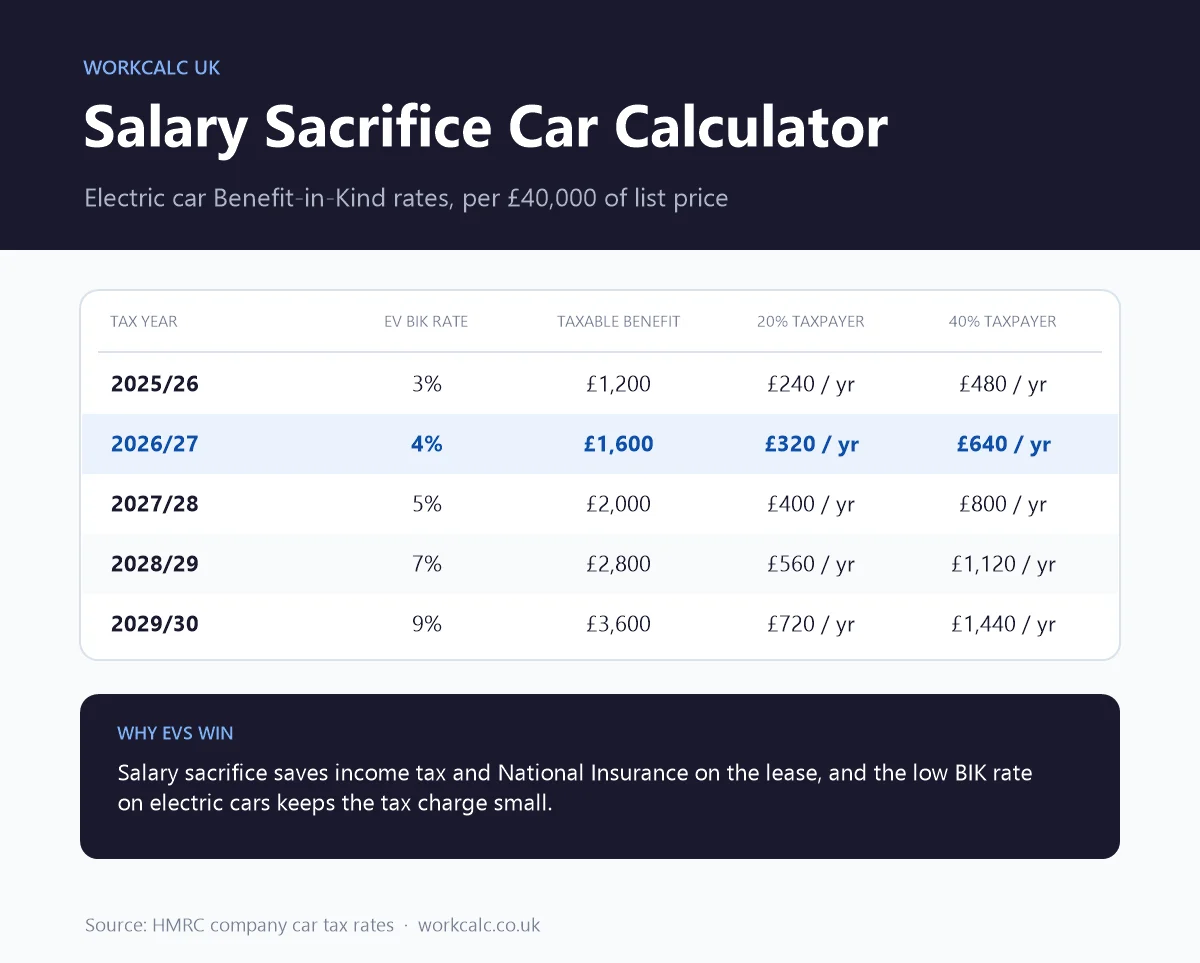
Benefit-in-Kind percentages for zero-emission cars, confirmed by HMRC and protected to 2030 at the November 2025 Budget. Tax shown on a £40,000 car.
| Tax year | EV BIK rate | Taxable benefit | 20% taxpayer | 40% taxpayer |
|---|---|---|---|---|
| 2025/26 | 3% | £1,200 | £240 / yr | £480 / yr |
| 2026/27 (current) | 4% | £1,600 | £320 / yr | £640 / yr |
| 2027/28 | 5% | £2,000 | £400 / yr | £800 / yr |
| 2028/29 | 7% | £2,800 | £560 / yr | £1,120 / yr |
| 2029/30 | 9% | £3,600 | £720 / yr | £1,440 / yr |
How salary sacrifice for a car works
A salary sacrifice car scheme works like this. You agree to give up part of your gross salary, and your employer provides a leased car in return. Because the sacrifice happens before income tax and National Insurance are calculated, you effectively pay for the car out of pre-tax income.
The Benefit-in-Kind charge is what stops this being free money. HMRC treats the car as a taxable benefit, valued at a percentage of its list price. For a fully electric car that percentage is only 4% in 2026/27, which is why the arrangement works so well.
£40,000 electric car, £500 a month sacrifice, £60,000 salary
A £500 headline sacrifice costs £343 in real terms — an effective discount of 31%. On top of that, the employer saves £900 in National Insurance, which many schemes use to fund insurance and maintenance.
Why an EV salary sacrifice calculator gives a very different answer to a petrol one
This is the part most calculators skip, and it explains the entire market. Under the optional remuneration arrangement rules, you are normally taxed on the higher of the salary you gave up or the value of the benefit — which wipes out the saving.
Cars emitting 75g/km of CO2 or less are exempt from those rules. Only the low BIK figure is taxed, and the sacrifice keeps its full relief.
| Electric, 4% BIK | Petrol, 31% BIK | |
|---|---|---|
| BIK on a £40,000 car | £1,600 | £12,400 |
| OpRA rules apply? | No — exempt below 75g/km | Yes |
| Amount actually taxed | £1,600 | £12,400 (the higher figure) |
| Net cost a month | £343 | £703 |
Same car price, same sacrifice, same salary — and the petrol version costs £360 a month more. That gap is the whole reason employers offer EV-only schemes.
The higher your tax rate, the more you save
Relief comes at your marginal rate, so the same car costs different people very different amounts:
| Salary | Marginal rate | Tax and NI saved | Net monthly cost |
|---|---|---|---|
| £35,000 | 28% | £1,680 | £387 |
| £60,000 | 42% | £2,520 | £343 |
| £110,000 | 62% | £3,720 | £270 |
The BIK escalator — budget for it
The 4% rate is not permanent. HMRC has published the path to 2029/30, and the cost on the same £40,000 car for a 40% taxpayer triples over five years:
- 2026/27 — 4%: £53 a month
- 2027/28 — 5%: £67 a month
- 2028/29 — 7%: £93 a month
- 2029/30 — 9%: £120 a month
On a three-year lease starting now you would see 4%, 5% and 7%. That is worth factoring into the comparison rather than assuming today's figure holds. Even at 9%, though, an EV remains far cheaper than a petrol car taxed at 25% to 37%.
What your employer gets from company car salary sacrifice
Employer National Insurance is 15% and is not charged on sacrificed salary. A £6,000 a year sacrifice saves the employer £900. Schemes typically use that to fund insurance, servicing, tyres and breakdown cover, which is why the monthly figure often includes far more than a personal lease would.
Compare like with like: a personal lease quote rarely includes insurance. Add £600 to £1,200 a year for that before deciding the lease is cheaper.
The risks worth understanding first
Three further things to check:
- Your gross salary is genuinely lower. Mortgage lenders may assess you on the reduced figure, and pension contributions based on a percentage of salary will fall unless the scheme is written to prevent it.
- Earnings-related benefits can drop. Statutory maternity pay is based on average earnings in a set reference period, so a sacrifice running through that window reduces it.
- You cannot sacrifice below the minimum wage. Your post-sacrifice pay must still meet the National Living Wage of £12.71 an hour, which caps what lower earners can take.
What this calculator does not cover
- Employer contributions to the scheme — some employers subsidise the monthly figure, which lowers your cost further
- Excess mileage and damage charges — assessed at the end of the lease
- Home charger installation — currently a tax-free benefit when provided by the employer
- Scotland — different income tax bands change the relief, though National Insurance is the same
- Company car fuel benefit — not applicable to electricity for EVs
Every figure in this salary sacrifice car calculator uk uses HMRC published BIK rates for 2026/27 onwards. Income tax and National Insurance use 2026/27 thresholds for England, Wales and Northern Ireland. To model sacrificing into a pension instead, use the Salary Sacrifice Calculator, and see the Employers NI Calculator for the employer side.
Frequently asked questions
Common questions about salary sacrifice car schemes.
How does salary sacrifice work for a car?
You give up an agreed amount of gross salary and your employer provides a leased car in return. Because the sacrifice comes out before income tax and National Insurance, you save tax at your marginal rate on the amount given up. You then pay Benefit-in-Kind tax on the car, which for a fully electric car is only 4% of its list price in 2026/27.
How much does a salary sacrifice car cost per month?
It depends on your tax rate. A £40,000 electric car with a £500 a month gross sacrifice costs a basic-rate taxpayer about £387 a month net, a higher-rate taxpayer about £343, and someone in the £100,000 to £125,140 personal allowance taper about £270. The higher your marginal rate, the more you save.
What is the BIK rate for electric cars in 2026/27?
4% of the car's P11D list price, up from 3% in 2025/26. The rate rises to 5% in 2027/28, 7% in 2028/29 and 9% in 2029/30, and the structure was protected through to 2030 at the November 2025 Budget. Petrol and diesel cars are taxed at 17% to 37% by comparison.
Why does salary sacrifice only work well for electric cars?
Because of the optional remuneration arrangement rules. For most benefits you are taxed on the higher of the salary given up or the benefit value, which cancels out the saving. Cars emitting 75g/km of CO2 or less are exempt from those rules, so only the low BIK figure is taxed. This exemption is the entire reason electric car schemes work.
Is a salary sacrifice car cheaper than a personal lease?
Usually yes for an electric car, because you are paying from gross rather than net income and the employer often passes on their own National Insurance saving. A higher-rate taxpayer effectively gets around 42% off the lease cost, minus the small BIK charge. Compare the net monthly figure against a personal lease quote for the same vehicle.
Does my employer save money on salary sacrifice cars?
Yes. Employer National Insurance is 15% and is not charged on sacrificed salary, so a £6,000 a year sacrifice saves the employer £900. Many employers use part of that saving to cover scheme administration or insurance, and some pass it back to the employee as a lower monthly cost.
What happens to a salary sacrifice car if I leave my job?
The car normally goes back, and most schemes charge an early termination fee that can run to several thousand pounds. Some employers hold insurance covering resignation, redundancy, long-term sickness and maternity, but cover varies enormously between schemes. Check the early exit terms in writing before signing, because this is the single biggest risk.
Does salary sacrifice affect my pension or mortgage?
It can. Your gross salary is genuinely lower, so pension contributions based on a percentage of salary fall, and lenders may assess your borrowing against the reduced figure. Statutory maternity pay and other earnings-related benefits can also be affected, and your salary cannot be reduced below the National Minimum Wage.