
Pro Rata Salary Calculator
A pro rata pay calculator for any working pattern. Find out what a full-time salary actually pays at your hours — with take-home pay, your real hourly rate, and a check that it still meets the minimum wage.
Your working pattern
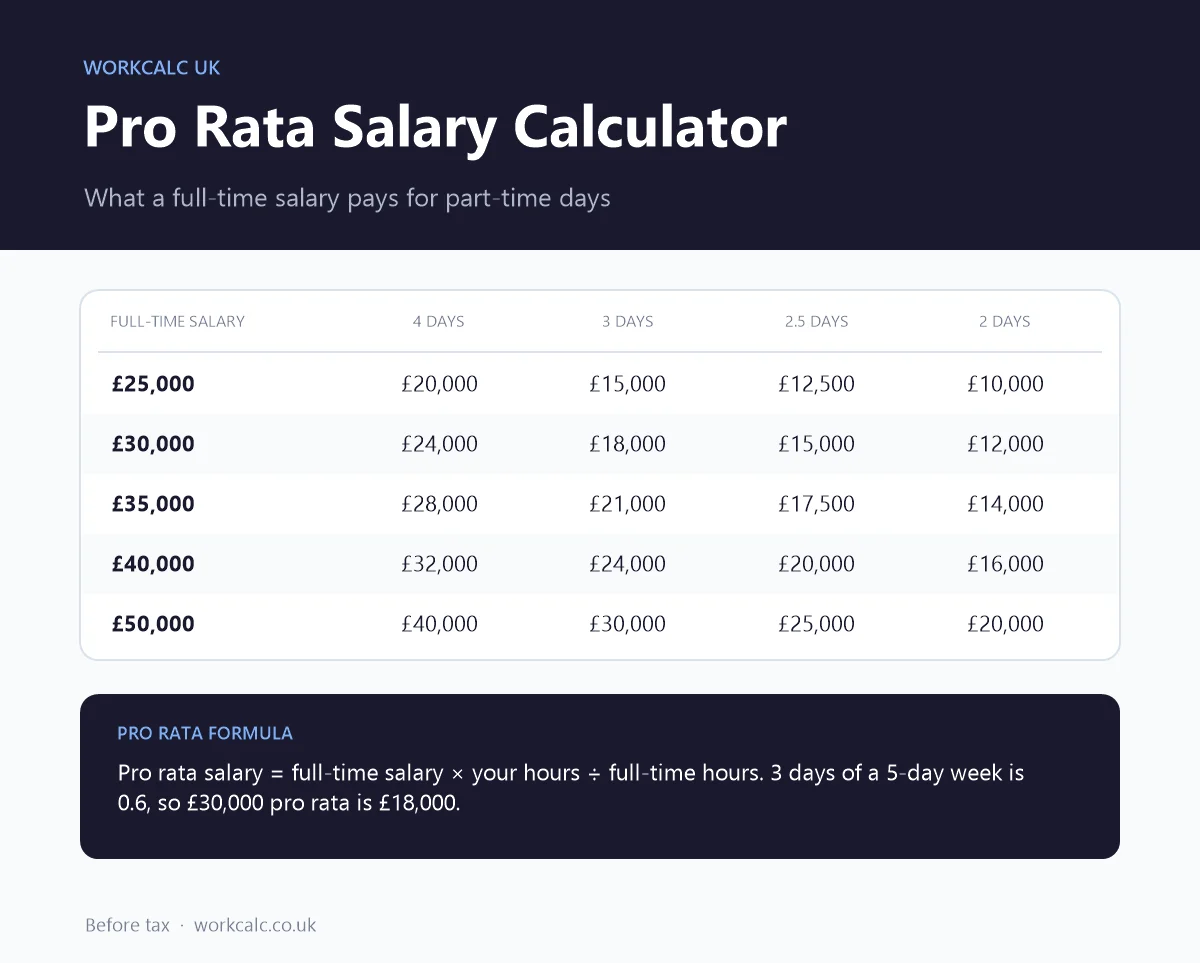
Pro rata salary calculator quick reference
Full-time is 37.5 hours over five days. Take-home assumes a standard tax code and no student loan.
| Full-time salary | 4 days (0.8) | 3 days (0.6) | 2.5 days (0.5) | 2 days (0.4) |
|---|---|---|---|---|
| £25,000 | £20,000 | £15,000 | £12,500 | £10,000 |
| £30,000 | £24,000 | £18,000 | £15,000 | £12,000 |
| £35,000 | £28,000 | £21,000 | £17,500 | £14,000 |
| £40,000 | £32,000 | £24,000 | £20,000 | £16,000 |
| £45,000 | £36,000 | £27,000 | £22,500 | £18,000 |
| £50,000 | £40,000 | £30,000 | £25,000 | £20,000 |
How to work out a pro rata salary
Pro rata means "in proportion". When a job is advertised at £30,000 pro rata, £30,000 is what a full-time person would earn — not what you will be paid. Your actual salary is the share matching your hours.
That fraction is your full-time equivalent, or FTE. Someone on 22.5 hours where full time is 37.5 is 0.6 FTE, so £30,000 becomes £18,000. The same works with days: three days out of five is also 0.6, giving the same answer.
Worked example — £30,000 pro rata, three days a week
Check the minimum wage — pro rata does not override it
This is the single most useful check on this page, and almost nobody does it. Pro-rating reduces your salary but it does not reduce your right to the National Minimum Wage on every hour you work.
Divide the salary by the hours actually worked in the year and compare it to the rate for your age. Some advertised salaries fail this test outright:
| Salary | Hours a week | Effective hourly | vs £12.71 NLW |
|---|---|---|---|
| £20,000 | 37.5 | £10.26 | Below minimum |
| £24,000 | 40 | £11.54 | Below minimum |
| £25,000 | 37.5 | £12.82 | Compliant |
| £18,000 | 22.5 | £15.38 | Compliant |
Using this pro rata calculator for days, hours or percentage
Working out pro rata salary can be done three ways, and all give the same answer when they describe the same pattern. They suit different situations:
- By hours — best when your days vary in length, or you work compressed hours over fewer days
- By days — simplest when every day is the same length and you work whole days
- By percentage (FTE) — how the NHS, universities and most large employers express it in contracts and job adverts
Watch the full-time baseline. A 0.6 FTE role is 22.5 hours where full time is 37.5, but 24 hours where full time is 40. The same FTE fraction means different hours at different employers, so always check what their full-time week actually is.
Part-year and term-time contracts
Some contracts pro-rate by time rather than hours. Term-time-only staff work full days but only during term, so both the hours and the weeks are reduced.
Someone on a £30,000 full-time salary working 30 hours a week for 39 paid weeks is at 0.6 FTE overall — 30 ÷ 37.5 for the hours, then 39 ÷ 52 for the weeks — giving £18,000. That total is usually spread across twelve equal monthly payments, which is why term-time pay can look disconnected from the hours you are actually working.
Starting or leaving part way through a month is pro-rated by days instead of hours. The Part-Month Salary Calculator compares the four methods employers use for that first or last month.
Why your take-home is not pro-rated
Here is something that works in your favour. The £12,570 personal allowance is not pro-rated — everyone gets the full amount regardless of hours. So part-time staff keep proportionally more of their gross pay.
| FTE on £30,000 | Gross | Take-home | Effective rate |
|---|---|---|---|
| 1.0 — full time | £30,000 | £25,120 | 16.3% |
| 0.6 — three days | £18,000 | £16,480 | 8.4% |
| 0.4 — two days | £12,000 | £12,000 | 0.0% |
Dropping from 0.6 to 0.4 cuts gross pay by 33% but take-home by only 27%, because the whole salary now sits inside the personal allowance. Going part time costs less in net terms than the gross figures suggest.
What else gets pro-rated
| Entitlement | Pro-rated? | How it works |
|---|---|---|
| Salary | Yes | In proportion to hours or days |
| Holiday | Yes | 5.6 weeks of your working week — 16.8 days on three days |
| Pension | Automatically | A percentage of actual pay, so it scales itself |
| Bonus | Usually | Should be pro-rated, not withheld |
| Sick pay (SSP) | No | Flat weekly rate if you meet the earnings threshold |
| Personal allowance | No | Full £12,570 regardless of hours |
Under the Part-time Workers Regulations 2000 you cannot be treated less favourably than a comparable full-timer without objective justification. Withholding a bonus entirely, rather than pro-rating it, is the classic breach.
What this calculator does not cover
- Overtime and enhancements — paid on top and not part of the pro rata calculation
- Pension contributions — use the Take-Home Pay Calculator to model these
- Scotland — different income tax bands, so take-home differs
- Second jobs — taxed differently, often at BR on the whole amount
- Salary sacrifice — see the Salary Sacrifice Calculator
Every figure in this pro rata wage calculator uses statutory minimum wage rates from 1 April 2026 and HMRC income tax and National Insurance thresholds for 2026/27. For holiday specifically, the Holiday Entitlement Calculator handles part-time patterns in days or hours.
Frequently asked questions
Common questions about pro rata pay and part-time salaries.
How do you work out a pro rata salary?
Divide your hours by the full-time hours to get your full-time equivalent fraction, then multiply that by the full-time salary. On a £30,000 full-time salary where full time is 37.5 hours, someone working 22.5 hours is 0.6 FTE and earns £18,000. The same method works with days: three days out of five is also 0.6.
What does pro rata mean in wages?
It means the salary is being shared in proportion to the hours or time you actually work. A job advertised at £30,000 pro rata does not pay £30,000 unless you work full time — it pays the share matching your hours. The advertised figure is always the full-time equivalent.
What is £30,000 pro rata for 3 days a week?
£18,000 a year, assuming full time is five days. Three days out of five is 0.6, and 0.6 of £30,000 is £18,000. After tax and National Insurance that leaves £16,480, which is £1,373 a month.
How do I calculate pro rata pay for a mid-year start?
Take the full annual salary and multiply it by the portion of the year you are employed. Starting on 1 July with a leave year running from 6 April leaves 279 of 365 days, so a £30,000 salary becomes £22,932 for that year. Your monthly pay does not change — only the total for the part-year.
Does pro rata pay have to meet minimum wage?
Yes. Pro rata reduces the salary but not your right to the National Minimum Wage on every hour worked. Divide the pro rata salary by the hours you actually work in the year and check it against the rate for your age. A £24,000 salary on a 40-hour week works out at £11.54 an hour, which is below the £12.71 National Living Wage.
Is pro rata take-home pay also proportional?
No, and this surprises people. Because the £12,570 personal allowance is not pro-rated, part-time staff keep proportionally more of their gross pay. Dropping from 0.6 to 0.4 of a £30,000 salary cuts gross pay by 33% but take-home by only 27%, because more of the lower salary falls inside the tax-free allowance.
What is pro rata holiday entitlement?
Holiday is pro-rated the same way as salary. Someone working three days a week gets 16.8 days of statutory leave rather than 28, because the entitlement is 5.6 weeks of their working week. Bank holidays are handled separately and are a common source of disputes for part-time staff.
Do part-time staff get pro rata pension and bonus?
Pension contributions are a percentage of actual pay, so they scale automatically. Bonuses should normally be pro-rated too, and under the Part-time Workers Regulations 2000 you cannot be treated less favourably than a comparable full-timer without objective justification. Benefits with a fixed cash value, like health insurance, are often given in full.