
£80,000 After Tax
A £80,000 salary leaves £56,957 a year after income tax and National Insurance, which is £4,746 a month or £1,095 a week in 2026/27. If you claim Child Benefit, the charge now takes all of it.
Adjust for your situation
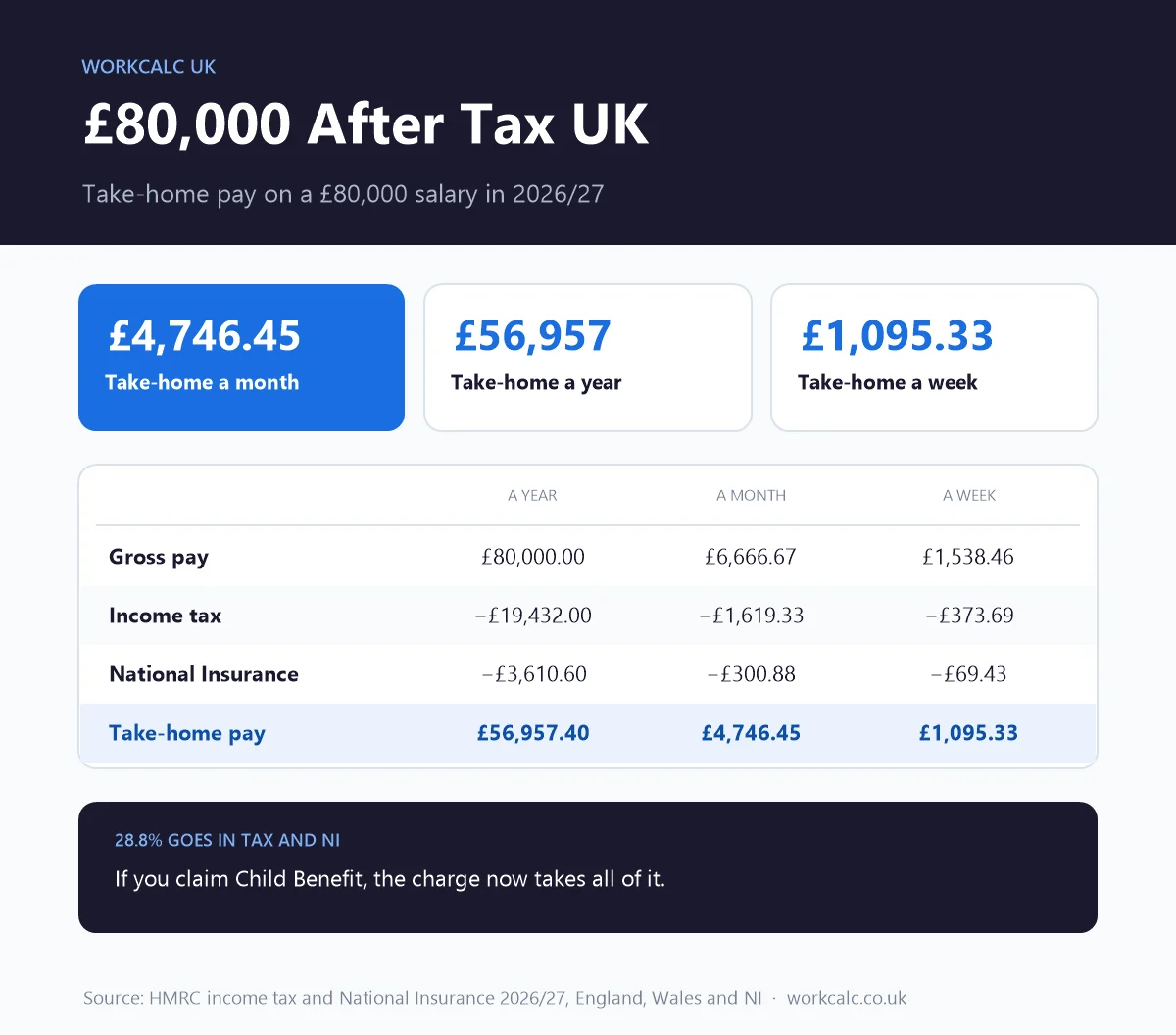
£80,000 after tax: the short answer
A salary of £80,000 leaves £56,957.40 after income tax and National Insurance in 2026/27. Paid monthly that is £4,746.45, and 28.8% of the salary goes on the two deductions.
| Year | Month | Week | |
|---|---|---|---|
| Gross pay | £80,000.00 | £6,666.67 | £1,538.46 |
| Income tax | −£19,432.00 | −£1,619.33 | −£373.69 |
| National Insurance | −£3,610.60 | −£300.88 | −£69.43 |
| Take-home pay | £56,957.40 | £4,746.45 | £1,095.33 |
How the tax on £80,000 is worked out
- Personal allowance: the first £12,570 is tax-free
- Basic rate: 20% on £37,700 = £7,540.00
- Higher rate: 40% on £29,730 = £11,892.00
- National Insurance: 8% on £37,700 = £3,016.00
- National Insurance above £50,270: 2% on £29,730 = £594.60
Your effective rate is 28.8%, but the rate on the next pound you earn is 42%. That second figure is the one to use when you weigh up overtime, a bonus or a pay rise.
£80,000: Child Benefit fully clawed back
At £80,000 of adjusted net income the High Income Child Benefit Charge equals 100% of the Child Benefit paid to your household. It is still usually worth staying registered: claiming protects National Insurance credits towards the State Pension for a parent who is not working, and you can opt out of the payments rather than the claim.
You are £20,000 below the £100,000 point where the personal allowance starts to disappear, so your marginal rate in the rest of the UK is still 42%.
Scotland's advanced rate
In Scotland income between £75,000 and £125,140 is taxed at the 45% advanced rate. On £80,000 the top £5,000 falls in that band, making the marginal rate 47% against 42% elsewhere. Overall a Scottish taxpayer pays £2,300.05 more a year and takes home £54,657.
What salary sacrifice saves
A 5% salary sacrifice contribution of £4,000 costs £2,320 of take-home pay, because it avoids 40% income tax and 2% National Insurance. It also lowers adjusted net income, which reduces the Child Benefit charge.
£80,000 after tax with a student loan
| Plan | Repays above | A year | Take-home |
|---|---|---|---|
| Plan 1 | £26,900 | £4,779.00 | £52,178 |
| Plan 2 | £29,385 | £4,555.35 | £52,402 |
| Plan 4 (Scotland) | £33,795 | £4,158.45 | £52,799 |
| Plan 5 | £25,000 | £4,950.00 | £52,007 |
| Postgraduate Loan | £21,000 | £3,540.00 | £53,417 |
Every plan is in repayment at this salary. Each takes 9% of income above its own threshold, or 6% for a Postgraduate Loan, so two loans stack rather than replace each other.
Pension contributions on £80,000
A 5% contribution puts £4,000 a year into your pension. Through a net pay scheme it reduces take-home pay by £2,400, because the contribution comes off before income tax. Through salary sacrifice, which also saves National Insurance, the cost falls to £2,320. Your employer adds at least 3% on top under auto-enrolment. The Salary Sacrifice Calculator shows other percentages.
What a pay rise is worth on £80,000
| Rise | Gross | Extra take-home a year | A month | You keep |
|---|---|---|---|---|
| 3.3% (NHS and council award) | £2,640 | £1,531 | £128 | 58% |
| 5% | £4,000 | £2,320 | £193 | 58% |
| £1,000 | £1,000 | £580 | £48 | 58% |
| £5,000 | £5,000 | £2,900 | £242 | 58% |
For a rise that includes a pension, student loan or back pay, use the Pay Rise Calculator.
£80,000 after tax in Scotland
| England, Wales and NI | Scotland | |
|---|---|---|
| Income tax | £19,432.00 | £21,732.05 |
| National Insurance | £3,610.60 | £3,610.60 |
| Take-home a year | £56,957.40 | £54,657.35 |
| Take-home a month | £4,746 | £4,555 |
You pay Scottish income tax if your main home is in Scotland, and your tax code starts with S. On £80,000 a Scottish taxpayer keeps £2,300.05 less a year. National Insurance is the same across the UK.
How £80,000 compares
Median pay for full-time employees was £39,039 in April 2025, according to the ONS Annual Survey of Hours and Earnings, so £80,000 is £40,961 (104.9%) above that figure.
| Salary | Take-home a year | A month | Difference |
|---|---|---|---|
| £75,000 | £54,057 | £4,505 | −£2,900 a year |
| £80,000 | £56,957 | £4,746 | This page |
| £85,000 | £59,857 | £4,988 | +£2,900 a year |
What these figures assume
- A 1257L tax code and a single job paid through PAYE
- England, Wales or Northern Ireland unless the Scotland table says otherwise
- No pension, student loan or taxable benefits unless shown
- HMRC 2026/27 rates; the personal allowance and higher rate threshold are frozen until April 2031
For a different tax code, pension type or bonus, use the Take-Home Pay Calculator.
Questions about £80,000
Do you lose all Child Benefit on £80,000?
In effect, yes. The High Income Child Benefit Charge equals all of your Child Benefit once adjusted net income reaches £80,000. You can keep claiming and opt out of the payments, which protects National Insurance credits for a non-working parent, or reduce adjusted net income with pension contributions to lower the charge.
What is the advanced rate of tax in Scotland?
The advanced rate is 45% and applies to income between £75,000 and £125,140 in 2026/27. A Scottish taxpayer on £80,000 pays it on the top £5,000, which is why they take home £54,657 a year compared with £56,957 in the rest of the UK.