
Pay Rise Calculator UK
A pay rise is taxed at your marginal rate, so you keep less than the headline figure. Enter your salary and your rise to see the extra take-home pay after income tax, National Insurance, pension and student loan, whether it beats inflation, and what any back pay is worth.
Your pay rise
| A year | Now | After rise | Change |
|---|---|---|---|
| Gross salary | |||
| Pension | |||
| Income tax | |||
| National Insurance | |||
| Student loan | |||
| Take-home a year | |||
| Take-home a month | |||
| Take-home a week | |||
| Gross hourly rate |
What a 3.3% pay rise is worth after tax, 2026/27
England, Wales and Northern Ireland, 1257L tax code, no pension or student loan. 3.3% is the 2026/27 award for NHS Agenda for Change and council staff.
| Salary | 3.3% rise | New salary | Extra take-home a year | A month | You keep |
|---|---|---|---|---|---|
| £25,000 | £825 | £25,825 | £594 | £50 | 72% |
| £30,000 | £990 | £30,990 | £713 | £59 | 72% |
| £35,000 | £1,155 | £36,155 | £832 | £69 | 72% |
| £40,000 | £1,320 | £41,320 | £950 | £79 | 72% |
| £45,000 | £1,485 | £46,485 | £1,069 | £89 | 72% |
| £50,000 | £1,650 | £51,650 | £995 | £83 | 60% |
| £60,000 | £1,980 | £61,980 | £1,148 | £96 | 58% |
| £70,000 | £2,310 | £72,310 | £1,340 | £112 | 58% |
| £80,000 | £2,640 | £82,640 | £1,531 | £128 | 58% |
| £100,000 | £3,300 | £103,300 | £1,254 | £105 | 38% |
| £110,000 | £3,630 | £113,630 | £1,379 | £115 | 38% |
| £125,000 | £4,125 | £129,125 | £2,165 | £180 | 52% |
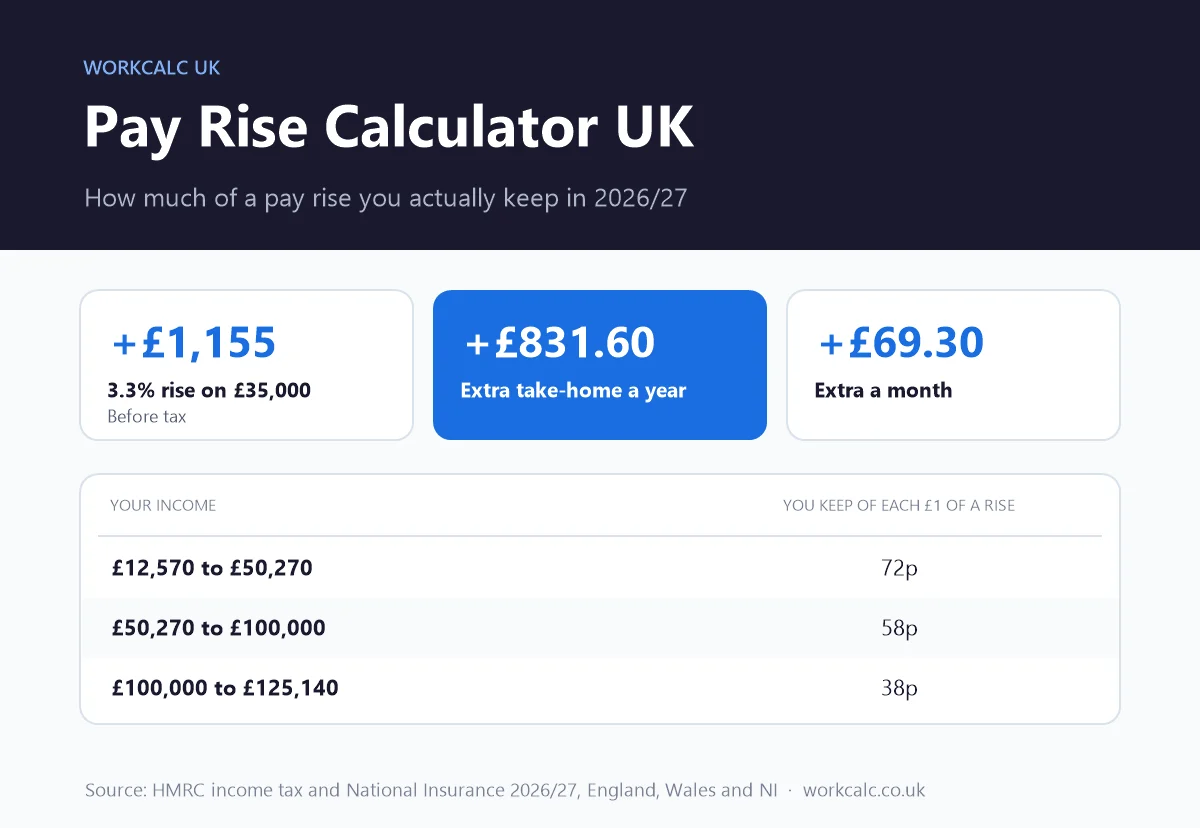
To calculate a pay rise, multiply your salary by the percentage and add it on: £35,000 × 3.3% = £1,155, so the new salary is £36,155. After 2026/27 income tax and National Insurance that adds £831.60 a year, or £69.30 a month, to take-home pay. Basic rate taxpayers keep 72% of any rise, higher rate taxpayers 58%, and people earning between £100,000 and £125,140 just 38%.
How to calculate a pay rise
There are two sums people need. The first turns a percentage into a new salary. The second works backwards from a new salary to the percentage you were given.
So a 3.3% pay rise on £35,000 is £35,000 × 1.033 = £36,155. And if your salary goes from £32,000 to £33,500, the rise is £1,500 ÷ £32,000 × 100 = 4.69%.
That is the gross figure your employer quotes. The number that matters for your budget is what reaches your bank account, and that is always smaller.
£35,000 with a 3.3% pay rise, 2026/27
That is £69.30 a month, not the £96.25 a month the gross rise suggests. Take-home pay goes from £28,719.60 to £29,551.20.
With a pension and a student loan
Deductions that grow with your salary take their own share of the rise. Here is the same £1,155 rise for someone paying 5% into a workplace pension and repaying a Plan 2 student loan:
£1,155 rise, 5% pension, Plan 2 loan
That leaves £56.79 a month, or 59% of the rise, as take-home pay. The £57.75 going into your pension is still your money, just not money you can spend today.
Related tool Take-Home Pay Calculator: your full payslip with tax codes and pension types →How much of a pay rise do you keep?
Your pay rise is taxed at your marginal rate: the combined income tax and National Insurance on the next pound you earn. It is usually much higher than your average tax rate, and it decides what a rise is really worth.
England, Wales and Northern Ireland
| Salary band | Tax + NI on each extra £1 | You keep |
|---|---|---|
| £12,570 to £50,270 | 20% + 8% = 28% | 72p |
| £50,270 to £100,000 | 40% + 2% = 42% | 58p |
| £100,000 to £125,140 | 60% effective + 2% = 62% | 38p |
| Over £125,140 | 45% + 2% = 47% | 53p |
Scotland
| Salary band | Tax + NI on each extra £1 | You keep |
|---|---|---|
| £12,570 to £16,537 | 19% + 8% = 27% | 73p |
| £16,537 to £29,526 | 20% + 8% = 28% | 72p |
| £29,526 to £43,662 | 21% + 8% = 29% | 71p |
| £43,662 to £50,270 | 42% + 8% = 50% | 50p |
| £50,270 to £75,000 | 42% + 2% = 44% | 56p |
| £75,000 to £100,000 | 45% + 2% = 47% | 53p |
| £100,000 to £125,140 | 67.5% effective + 2% = 69.5% | 30.5p |
| Over £125,140 | 48% + 2% = 50% | 50p |
Student loans come on top. Once you earn above your plan's threshold, 9p of every extra £1 goes to repayments (Plan 1 above £26,900, Plan 2 above £29,385, Plan 4 above £33,795, Plan 5 above £25,000), plus 6p for a Postgraduate Loan above £21,000. A Plan 2 graduate on £40,000 in England keeps only 63p of each extra £1.
Crossing a threshold
A rise that pushes you over £50,270 is split between two rates. Going from £49,000 to £52,000 adds £3,000 gross, but £946 goes in extra income tax and £136.20 in National Insurance. You keep £1,917.80, which is 64%.
The table above shows the odd result this creates: a 3.3% rise on £45,000 adds £89 a month, while the same percentage on £50,000 adds only £83, because most of the bigger rise lands in the higher rate band.
Does your pay rise beat inflation?
A pay rise only makes you better off if it grows faster than prices. CPI inflation was 2.9% in the 12 months to July 2026, up from 2.6% in June, and CPIH was 3.1%. To work out the real-terms change:
A 3.3% rise against 2.9% inflation is (1.033 ÷ 1.029 − 1) × 100 = 0.39% in real terms. The rise you needed just to stand still, sometimes called a keep-up or cost of living pay rise, is your salary multiplied by inflation: £1,015 on £35,000.
The calculator shows both measures side by side, so you can see whether your rise beats inflation before and after tax. Change the inflation figure to test a different measure, such as CPIH or RPI.
Pay rise 2026: who is getting what
These are the confirmed 2026/27 pay awards and official pay growth figures as at 13 September 2026.
| Group | 2026 rise | Effective from | How it is paid |
|---|---|---|---|
| NHS Agenda for Change staff, England | 3.3% | 1 April 2026 | In April 2026 pay |
| Council staff, NJC Green Book (England, Wales, NI) | 3.3% | 1 April 2026 | Backdated after the August 2026 deal |
| Teachers, England | 3.5% | 1 September 2026 | Backdated to 1 September; 3% more from September 2027 |
| National Living Wage, age 21+ | £12.21 to £12.71 (4.1%) | 1 April 2026 | Statutory minimum |
| Average regular pay, whole economy (ONS) | 3.5% | April to June 2026 | 4.1% including bonuses |
| Public sector regular pay (ONS) | 6.1% | April to June 2026 | Private sector: 2.8% |
For comparison, the 2025/26 awards were 3.6% for NHS Agenda for Change staff, 3.2% for NJC council staff and 4% for teachers in England. If you are checking an old payslip, change the percentage in the calculator to match.
NHS pay rise 2026/27
The 3.3% Agenda for Change uplift was confirmed on 12 February 2026, early enough to reach April payslips. On Band 2, pay rises from £24,465 to £25,272, an extra £807. That adds about £581 a year, or £48 a month, to take-home pay before NHS pension contributions. At the top of Band 7, pay rises from £54,710 to £56,515. Because that rise sits in the higher rate band, £1,805 gross becomes about £1,047 a year, or £87 a month.
The NHS Pension Scheme is a net pay arrangement with tiered contribution rates, so select your contribution percentage above, or use the NHS Pay Calculator to see every band and step with the pension tiers built in.
Council and local government pay rise 2026
The NJC deal gives 3.3% on spinal column points and allowances from 1 April 2026. GMB and UNISON accepted the employers' offer in August, so most council workers receive the new rate plus arrears back to April. Pay point 30, typical for a social worker outside London, rises from £40,777 to £42,123. That is £1,346 gross, or £969 a year after tax and National Insurance. If six months of arrears arrive in one payment, that is £673 gross and roughly £485 after deductions.
When do teachers get their pay rise?
Teachers in England get 3.5% from 1 September 2026, taking the average salary above £52,800, then a further 3% from September 2027. Because the rise starts in September, it covers seven months of the April-to-April tax year, so the extra income in 2026/27 is 7/12 of the annual figure the calculator shows.
National Living Wage rise
The National Living Wage for workers aged 21 and over rose by 50p an hour to £12.71 on 1 April 2026. On a 37.5-hour week that is £975 a year gross and about £702 after tax and National Insurance. Full rates for every age band are in the UK minimum wage 2026 guide.
Backdated pay rises and arrears
When a pay award is agreed after it takes effect, you are owed the difference for every month in between. To calculate back pay:
Enter the number of months in the calculator to see the gross figure and a take-home estimate. Arrears are added to one month's pay and taxed through PAYE. Income tax is cumulative across the tax year, so most people pay about the same tax as if the rise had been paid monthly. National Insurance and student loan repayments are worked out for each pay period, so the deductions in that one month can differ slightly. Pension contributions are normally taken from arrears too, because the back pay is pensionable.
If a large arrears payment looks over-taxed, check that your tax code has not switched to an emergency code. Any overpayment is normally corrected later in the tax year, or after it ends.
Pay rise thresholds that cost you money
A few income levels change far more than your tax rate. They are based on adjusted net income, which is your salary minus pension contributions made through a net pay scheme or salary sacrifice.
- £50,270: income tax on the extra rises from 20% to 40%, although National Insurance falls from 8% to 2%.
- £60,000 to £80,000: if you or your partner claim Child Benefit, the High Income Child Benefit Charge claws it back gradually and takes all of it by £80,000.
- £100,000: you lose £1 of personal allowance for every £2 over, creating the 62% marginal rate. At the same point, families lose Tax-Free Childcare and the extra funded childcare hours.
A £5,000 rise from £100,000 to £105,000 adds only £1,900 to take-home pay, because £3,000 goes in income tax and £100 in National Insurance. Paying some or all of the rise into your pension through salary sacrifice keeps adjusted net income at £100,000 and avoids the 62% rate on that slice.
Related tool Salary Sacrifice Calculator: keep more of a rise above £100,000 →Negotiating a pay rise: think in take-home pay
- Convert the offer before you answer. A 4% rise and a flat £1,500 can be worth very different amounts, depending on your salary and tax band.
- Compare with inflation, not just the headline. Anything below CPI is a real-terms pay cut, even if it is described as a rise.
- Consider asking for pension instead of salary. A £1,000 pay rise costs your employer £1,150 once 15% employer National Insurance is added. Paid as an employer pension contribution, the full £1,150 goes into your pension with no income tax or NI for either side. Use the Employers NI Calculator to see the cost to them.
- Check part-time pay pro rata. A rise on a full-time equivalent salary is paid in proportion to your hours; the Pro Rata Salary Calculator shows your actual figure.
What this calculator does not cover
- Universal Credit: if you claim it, your award can fall by 55p for every extra £1 of take-home pay above your work allowance.
- Bonuses, overtime and shift pay, which are taxed the same way but may not be pensionable.
- Non-standard tax codes, benefits in kind and second jobs. Use the Take-Home Pay Calculator for tax codes.
- Salary sacrifice pensions, which also save National Insurance. This page treats pension as a net pay scheme.
- Mid-year timing: results show a full year at each salary.
Sources
- HMRC income tax, National Insurance and student loan thresholds for 2026/27
- Office for National Statistics, Average weekly earnings in Great Britain: August 2026 (published 18 August 2026)
- Office for National Statistics, Consumer price inflation, UK: July 2026 (published 19 August 2026)
- NHS Employers, NHS Pay Review Body pay award announcement, 12 February 2026
- Department for Education, teacher pay award for 2026 and 2027
- National Joint Council for Local Government Services pay agreement 2026/27
Frequently asked questions
Pay rises, percentages, inflation and back pay.
How do I calculate a pay rise?
Multiply your current salary by the pay rise percentage, divide by 100 and add the result to your salary. A 3.3% rise on £35,000 is £1,155, giving a new salary of £36,155. After 2026/27 income tax and National Insurance that adds £831.60 a year to take-home pay, or £69.30 a month.
How do I work out my pay rise as a percentage?
Subtract your old salary from your new salary, divide the difference by the old salary and multiply by 100. Going from £32,000 to £33,500 is a £1,500 rise, and 1,500 divided by 32,000 multiplied by 100 is 4.69%.
How much of a pay rise do I actually keep?
It depends on your marginal rate, not your average tax rate. In England, Wales and Northern Ireland a basic rate taxpayer keeps 72p of every extra £1, a higher rate taxpayer keeps 58p, and someone earning between £100,000 and £125,140 keeps only 38p. A Plan 2 student loan takes a further 9p once you earn over £29,385.
What is the average UK pay rise in 2026?
Average regular pay, excluding bonuses, grew 3.5% in the year to April to June 2026, according to the ONS. Including bonuses it grew 4.1%. Public sector regular pay grew 6.1% and private sector regular pay 2.8%. After CPI inflation, regular pay rose 0.7% in real terms.
What is the NHS pay rise for 2026/27?
Staff on Agenda for Change contracts in England received a 3.3% consolidated rise from 1 April 2026. It was announced on 12 February 2026, so it arrived in April pay rather than as a later backdated lump sum. Doctors and dentists, and NHS staff in Scotland, Wales and Northern Ireland, have their own pay decisions.
What is the council pay rise for 2026?
Local government staff on NJC Green Book terms in England, Wales and Northern Ireland get a 3.3% rise for 2026/27, effective from 1 April 2026. Unions accepted the offer in August 2026, so the increase is backdated to April and arrears are paid once councils update payroll.
When do teachers get their pay rise?
Teachers in England get a 3.5% rise from 1 September 2026, followed by a further 3% from September 2027. The 2026 award is backdated to 1 September, so if your payroll applies it later you receive the difference as back pay.
Does my pay rise beat inflation?
Compare your percentage rise with the inflation rate. CPI inflation was 2.9% in the 12 months to July 2026, so a 3.3% rise is a real-terms gain of about 0.4%. Take-home pay grows more slowly than gross pay, though: on £35,000 a 3.3% rise lifts take-home pay by 2.9%, only just matching prices.
How is back pay from a pay rise taxed?
Back pay is taxed through PAYE in the month you receive it, together with that month's normal pay. Income tax is worked out cumulatively across the tax year, so most people pay roughly the same tax as if the rise had been paid monthly. National Insurance and student loan repayments are worked out on each pay period, so a large lump can change those deductions slightly in that month.
Why is my pay rise smaller on my payslip?
Because the rise is taxed at your marginal rate. Income tax, National Insurance, student loan and pension contributions all come off the extra pay, so a £1,155 gross rise on £35,000 adds £69.30 a month to take-home pay, not £96.25. A higher pension contribution takes a share too, but that money is still yours.