
Salary After Tax UK 2026/27
What common UK salaries leave you after income tax and National Insurance, by year, month and week. Check any salary with the quick calculator, see where the tax jumps are, and open a full breakdown for each salary.
Quick salary check
UK salaries after tax, 2026/27
Income tax and National Insurance for England, Wales and Northern Ireland, 1257L tax code, no pension or student loan. Select a salary for its full breakdown.
| Salary | Income tax | NI | Take-home a year | A month | A week | Effective rate | Next £1 taxed at | Scotland, a month |
|---|---|---|---|---|---|---|---|---|
| £25,000 | £2,486 | £994 | £21,520 | £1,793 | £414 | 13.9% | 28% | £1,797 |
| £30,000 | £3,486 | £1,394 | £25,120 | £2,093 | £483 | 16.3% | 28% | £2,096 |
| £35,000 | £4,486 | £1,794 | £28,720 | £2,393 | £552 | 17.9% | 28% | £2,392 |
| £40,000 | £5,486 | £2,194 | £32,320 | £2,693 | £622 | 19.2% | 28% | £2,688 |
| £45,000 | £6,486 | £2,594 | £35,920 | £2,993 | £691 | 20.2% | 28% | £2,960 |
| £50,000 | £7,486 | £2,994 | £39,520 | £3,293 | £760 | 21.0% | 28% | £3,169 |
| £60,000 | £11,432 | £3,211 | £45,357 | £3,780 | £872 | 24.4% | 42% | £3,634 |
| £70,000 | £15,432 | £3,411 | £51,157 | £4,263 | £984 | 26.9% | 42% | £4,101 |
| £80,000 | £19,432 | £3,611 | £56,957 | £4,746 | £1,095 | 28.8% | 42% | £4,555 |
| £100,000 | £27,432 | £4,011 | £68,557 | £5,713 | £1,318 | 31.4% | 62% | £5,438 |
| £110,000 | £33,432 | £4,211 | £72,357 | £6,030 | £1,391 | 34.2% | 62% | £5,692 |
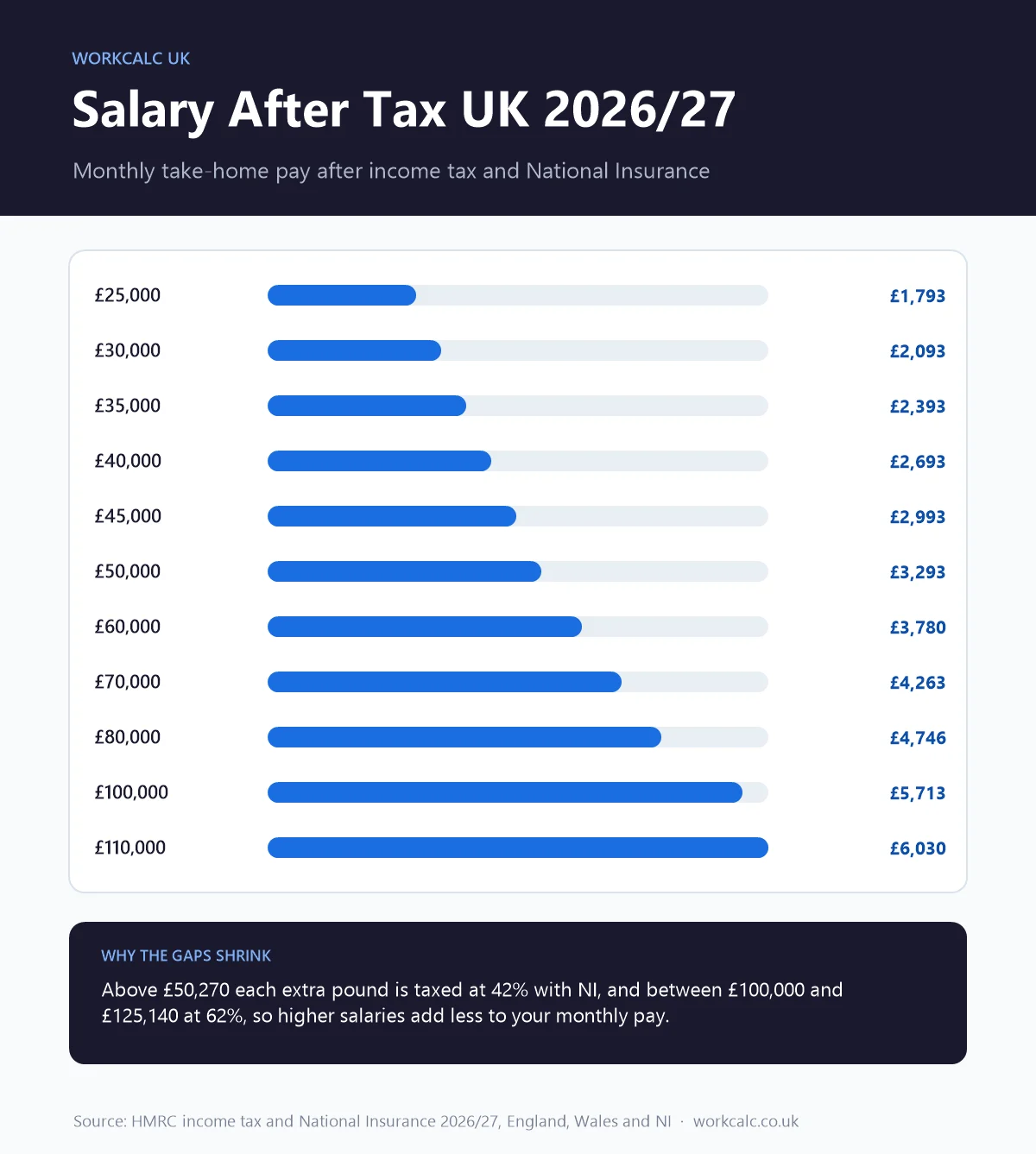
In 2026/27 a £30,000 salary leaves £25,120 a year (£2,093 a month) after income tax and National Insurance, £50,000 leaves £39,520 (£3,293 a month) and £100,000 leaves £68,557 (£5,713 a month). The first £12,570 is tax-free; above that you pay 20% income tax and 8% National Insurance, rising to 40% and 2% above £50,270.
How take-home pay is worked out
Two deductions come off every salary before any pension or student loan:
- Income tax. The first £12,570 is your tax-free Personal Allowance. The next £37,700 is taxed at 20%, income up to £125,140 at 40%, and anything above at 45%.
- National Insurance. Employees pay 8% on earnings between £12,570 and £50,270, and 2% on everything above.
£35,000 salary, 2026/27
Where the tax jumps are
Your average tax rate rises smoothly, but the rate on each extra pound jumps at a few thresholds. These are the lines worth knowing before a pay rise, bonus or job change:
| Income | What changes | Tax and NI on the next £1 |
|---|---|---|
| £12,570 | Income tax and National Insurance start | 28% |
| £50,270 | 40% income tax starts; NI falls to 2% | 42% |
| £60,000 | High Income Child Benefit Charge begins, if you claim Child Benefit | 42% plus the charge |
| £100,000 | Personal Allowance withdrawn at £1 for every £2 | 62% |
| £125,140 | Allowance fully gone; 45% additional rate starts | 47% |
The £100,000 line is the one that catches people out: between £100,000 and £125,140 you keep only 38p of each extra pound. Pension contributions through salary sacrifice can bring your income back under it.
Why a bigger salary is not proportionally more take-home
Because more of each extra pound is taxed as you earn more, take-home pay grows more slowly than salary. Doubling from £25,000 to £50,000 raises take-home pay by 84%, from £21,520 to £39,520. Doubling again to £100,000 raises it by only 73%. That is why the Pay Rise Calculator focuses on what a rise adds after tax rather than the headline figure.
What changes your take-home pay
The table assumes no deductions beyond tax and National Insurance. Here is how the most common extras change a £35,000 salary:
| On £35,000 | Take-home a year | Change |
|---|---|---|
| Tax and NI only | £28,719.60 | None |
| 5% pension, net pay scheme | £27,319.60 | −£1,400.00 |
| 5% pension, salary sacrifice | £27,459.60 | −£1,260.00 |
| Plan 2 student loan | £28,214.25 | −£505.35 |
| Scottish taxpayer | £28,704.53 | −£15.07 |
A £1,750 pension contribution costs £1,400 of take-home pay through a net pay scheme, or £1,260 through salary sacrifice, because tax relief does part of the work. Model your own mix with the Take-Home Pay Calculator or the Pension Contribution Calculator.
Scottish taxpayers
Scotland has six income tax bands, including a 19% starter rate and a 21% intermediate rate, and its 42% higher rate starts at £43,662. Below about £33,500 a Scottish taxpayer keeps slightly more than someone elsewhere in the UK; above it they keep less, £1,496 a year less on £50,000 and £3,300 less on £100,000. National Insurance is the same across the UK. The last column of the table shows Scottish monthly take-home.
How your salary compares
The ONS Annual Survey of Hours and Earnings put median pay for full-time employees at £39,039 in April 2025. After 2026/27 tax and National Insurance, that leaves £31,628 a year or about £2,636 a month. A full-time job on the £12.71 National Living Wage, at 37.5 hours a week, pays £24,785 before tax.
What salary do you need for a monthly take-home?
Working backwards, these are the salaries needed to take home a round monthly figure in 2026/27, with a 1257L tax code and no pension or student loan:
| Take-home a month | Salary needed |
|---|---|
| £2,000 | £28,445 |
| £2,500 | £36,778 |
| £3,000 | £45,112 |
| £3,500 | £54,211 |
| £4,000 | £64,556 |
| £5,000 | £85,246 |
The gap between each £500 step widens above £50,270, because every extra pound is taxed at 42% rather than 28%. If you are paid by the hour, convert first with the Hourly to Annual Salary Calculator.
What these figures assume
- A 1257L tax code and one job paid through PAYE for the whole 2026/27 tax year
- England, Wales or Northern Ireland, except the Scotland column
- No pension, student loan, salary sacrifice or taxable benefits unless shown
- HMRC 2026/27 rates; the Personal Allowance and higher rate threshold are frozen until April 2031
Sources
- HMRC income tax, National Insurance and student loan rates and thresholds for 2026/27
- Scottish Government, Scottish income tax rates and bands 2026/27
- Office for National Statistics, Employee earnings in the UK: 2025
Frequently asked questions
Salary, tax and take-home pay in 2026/27.
What is the average UK salary after tax?
Median pay for full-time employees was £39,039 in April 2025, according to the ONS. After 2026/27 income tax and National Insurance that leaves £31,627.68 a year, or about £2,636 a month, in England, Wales and Northern Ireland.
What salary do I need to take home £3,000 a month?
About £45,112 a year in 2026/27, assuming a 1257L tax code with no pension or student loan. To take home £2,500 a month you need about £36,778, and for £4,000 a month about £64,556.
At what salary do you pay 40% tax?
Income above £50,270 is taxed at 40% in England, Wales and Northern Ireland. Only the part above that line is taxed at 40%, and National Insurance falls from 8% to 2% there, so the combined rate on each extra pound is 42%. In Scotland the 42% higher rate starts at £43,662.
Why does take-home pay not rise in line with salary?
Because each extra pound is taxed at your marginal rate, which rises as you cross thresholds. Doubling a salary from £25,000 to £50,000 raises take-home pay by 84%, and doubling it again to £100,000 raises it by only 73%.
How much of my salary goes on tax and National Insurance?
In 2026/27 it is 13.9% of a £25,000 salary, 17.9% of £35,000, 21.0% of £50,000 and 31.4% of £100,000. That is your effective rate; the rate on your next pound earned is higher, at 28%, 42% or 62% depending on your band.
Do Scottish taxpayers take home less?
Only above about £33,500. On £25,000 and £30,000 a Scottish taxpayer keeps slightly more than someone in the rest of the UK, because of the 19% starter rate. Above that the gap grows: £1,496 a year less on £50,000 and £3,300 less on £100,000.