
Pension Contribution Calculator
See what your workplace pension contribution really costs after tax relief, what your employer adds, and how the three ways of paying in compare, from net pay to salary sacrifice.
Your pension
| Scheme type | Cost to your take-home | A month | Per £1 in pot |
|---|---|---|---|
| Net pay | |||
| Relief at source | |||
| Salary sacrifice |
Minimum auto-enrolment contributions by salary, 2026/27
5% from you and 3% from your employer on qualifying earnings, net pay scheme, England, Wales and Northern Ireland.
| Salary | Qualifying earnings | You (5%) | Employer (3%) | Total a month | Cost to take-home a month |
|---|---|---|---|---|---|
| £15,000 | £8,760 | £438 | £263 | £58 | £29 |
| £25,000 | £18,760 | £938 | £563 | £125 | £63 |
| £30,000 | £23,760 | £1,188 | £713 | £158 | £79 |
| £35,000 | £28,760 | £1,438 | £863 | £192 | £96 |
| £40,000 | £33,760 | £1,688 | £1,013 | £225 | £113 |
| £50,000 | £43,760 | £2,188 | £1,313 | £292 | £146 |
| £60,000 | £44,030 | £2,202 | £1,321 | £294 | £110 |
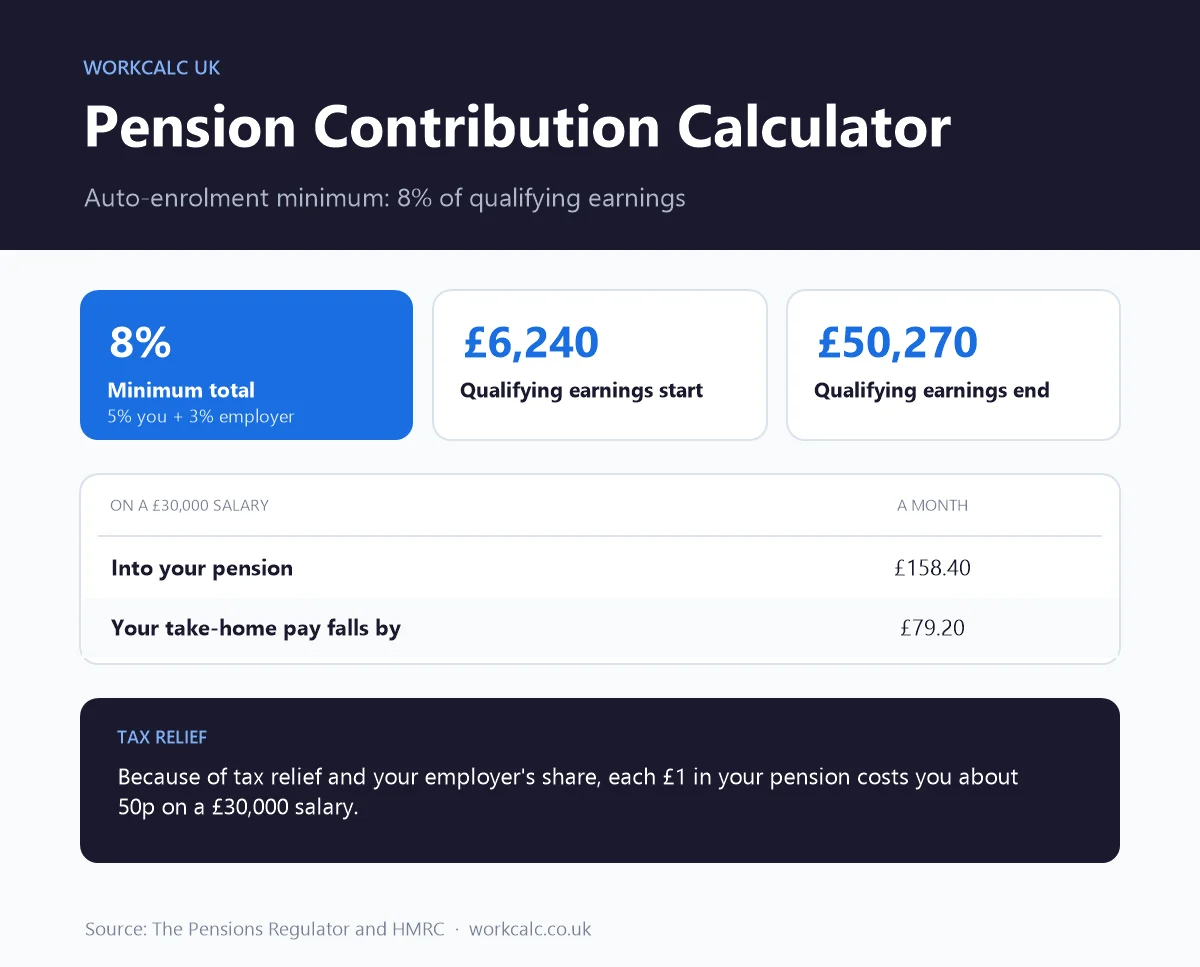
The legal minimum for a workplace pension in 2026/27 is 8% of qualifying earnings, the part of your pay between £6,240 and £50,270: at least 3% from your employer and the rest, usually 5%, from you. Tax relief means your share costs less than it looks. On £30,000, £158.40 a month goes into your pension but your take-home pay falls by only £79.20, so each £1 in your pot costs you about 50p.
How workplace pension contributions work
If you are aged 22 to State Pension age and earn over £10,000 a year, your employer must enrol you in a workplace pension. The minimum contribution is worked out on qualifying earnings, not your whole salary:
On £30,000 that is £23,760. Your 5% is £1,188 a year and your employer's 3% is £712.80, so £1,900.80 goes into your pension. Many employers are more generous and calculate contributions on your full basic salary, or pay more than 3%. Some match extra contributions you choose to make.
£30,000 salary, 5% and 3% on qualifying earnings
Net pay, relief at source and salary sacrifice
Your employer's scheme uses one of three methods to give you tax relief. The amount that reaches your pension is the same; what changes is how the relief arrives and whether you save National Insurance.
| Method | How it works | Relief | Saves NI? |
|---|---|---|---|
| Net pay | Contribution taken from pay before income tax | Automatic, at your highest rate | No |
| Relief at source | You pay 80% from taxed pay; the provider claims 20% from HMRC | 20% automatic; higher rate relief must be claimed | No |
| Salary sacrifice | You give up salary and your employer pays it into the pension | Automatic, at your highest rate | Yes |
Higher rate taxpayers: claim your relief
Under relief at source, the provider adds only 20%. If you pay 40% tax, you must claim the other 20% through Self Assessment or by contacting HMRC. On £60,000 with a 5% contribution on full salary, that is £600 a year you lose if you do not claim. Scottish taxpayers at the 21% intermediate rate and above can also claim the difference.
Low earners: relief at source is better below £12,570
If you earn less than the £12,570 Personal Allowance, you pay no income tax, so a net pay scheme gives you no relief. Relief at source still adds 20%. HMRC is now closing this gap: from 2026 it is contacting people in net pay schemes who earned under the allowance in 2024/25 to make a top-up payment, without them needing to apply.
Related tool Salary Sacrifice Calculator: how much extra you save, and the £100,000 sweet spot → Related guide Is salary sacrifice worth it? The savings, the catches and who gains most →Salary sacrifice and the 2029 cap
Salary sacrifice saves employee National Insurance: 8p for every £1 below £50,270 and 2p above it. Your employer also saves 15%, and some pass that on. From April 2029 the National Insurance saving will only apply to the first £2,000 a year sacrificed into a pension. Income tax relief is not affected, and contributions below £2,000 a year, which covers most people paying the minimum, keep the full saving.
Salary sacrifice cannot take your pay below the National Minimum Wage, and a lower contractual salary can affect some mortgage applications and salary-linked benefits.
What happens if you pay more
Increasing your own contribution costs less than it looks because of tax relief. On £30,000, raising your contribution from 5% to 8% of qualifying earnings puts an extra £712.80 a year into your pension and reduces take-home pay by £570.24, or £47.52 a month, in a net pay scheme. Ask whether your employer matches extra contributions; some add another 1% for each 1% you add, up to a limit.
How much can you pay in?
- Tax relief applies to personal contributions up to 100% of your earnings in the year.
- The annual allowance is £60,000 of total contributions from you and your employer. Above it, a tax charge applies, although unused allowance from the previous three years can usually be carried forward.
- Very high earners have a tapered allowance, falling to £10,000.
- If you have flexibly taken money from a pension, the money purchase annual allowance of £10,000 applies.
What this calculator does not cover
- Defined benefit schemes such as the NHS, teachers' and civil service pensions. Use the NHS Pension Calculator for the NHS scheme.
- Student loans, which are reduced by salary sacrifice but not by other methods.
- Pay rises, charges and investment risk. The projection assumes the same contributions in today's money and a steady growth rate after charges and inflation. Real returns vary and can be negative.
- Financial advice. This is not a recommendation to pay more or less into a pension.
Sources
- GOV.UK, Workplace pensions: what you, your employer and the government pay
- DWP, Review of the automatic enrolment earnings trigger and qualifying earnings band for 2026/27
- HM Treasury, Budget November 2025: salary sacrifice pension contributions from April 2029
- HMRC, Pensions relief relating to net pay arrangements
Frequently asked questions
Pension contributions, tax relief and auto-enrolment.
What is the minimum pension contribution in 2026/27?
8% of qualifying earnings, which are your earnings between £6,240 and £50,270 a year. At least 3% must come from your employer, and the rest, usually 5%, from you, including tax relief. On a £30,000 salary that is £1,900.80 a year in total.
What are qualifying earnings for a pension?
Qualifying earnings are the part of your pay between £6,240 and £50,270 a year in 2026/27, including salary, overtime, bonuses and commission. Auto-enrolment minimums are worked out on this band, so on £30,000 contributions are based on £23,760. Many employers use full basic salary instead, which is more generous.
What does a 5% pension contribution actually cost me?
Less than 5%, because of tax relief. On £30,000 with contributions on qualifying earnings, a 5% contribution is £1,188 a year but reduces take-home pay by £950.40, or £79.20 a month. With your employer's 3%, £1,900.80 goes into your pension, so each £1 in your pot costs you about 50p.
Are pension contributions taken before or after tax?
It depends on the scheme. In a net pay arrangement, contributions come off before income tax. Under relief at source, they come off after tax and the pension provider adds 20% basic rate relief. With salary sacrifice, your salary is reduced before both income tax and National Insurance.
How do higher rate taxpayers get pension tax relief?
In a net pay or salary sacrifice scheme, relief at your highest rate is automatic. Under relief at source, the provider only adds 20%, so higher and additional rate taxpayers must claim the rest through Self Assessment or by contacting HMRC. On a £3,000 gross contribution at 40%, the extra relief is £600 a year.
Is salary sacrifice better for pension contributions?
Usually, because it saves National Insurance as well as income tax: 8p in every £1 for basic rate taxpayers and 2p above £50,270. From April 2029 the National Insurance saving will only apply to the first £2,000 a year sacrificed into a pension.
Do I get a workplace pension if I earn under £10,000?
You will not be automatically enrolled, but you can ask to join. If you earn more than £6,240 a year and opt in, your employer must contribute. Under £6,240 you can still join, but your employer does not have to pay in.
How much can I pay into a pension with tax relief?
You get tax relief on personal contributions up to 100% of your earnings, and total contributions from you and your employer are limited by the £60,000 annual allowance before a tax charge applies. The allowance is lower for very high earners and for people who have flexibly accessed a pension.