
5.6 Weeks Holiday Explained: Where It Comes From and What It Means
5.6 weeks is the legal minimum paid holiday in the UK. It is an odd number for a reason, and understanding its two parts tells you how much leave you get, how it is paid and what you can carry over.
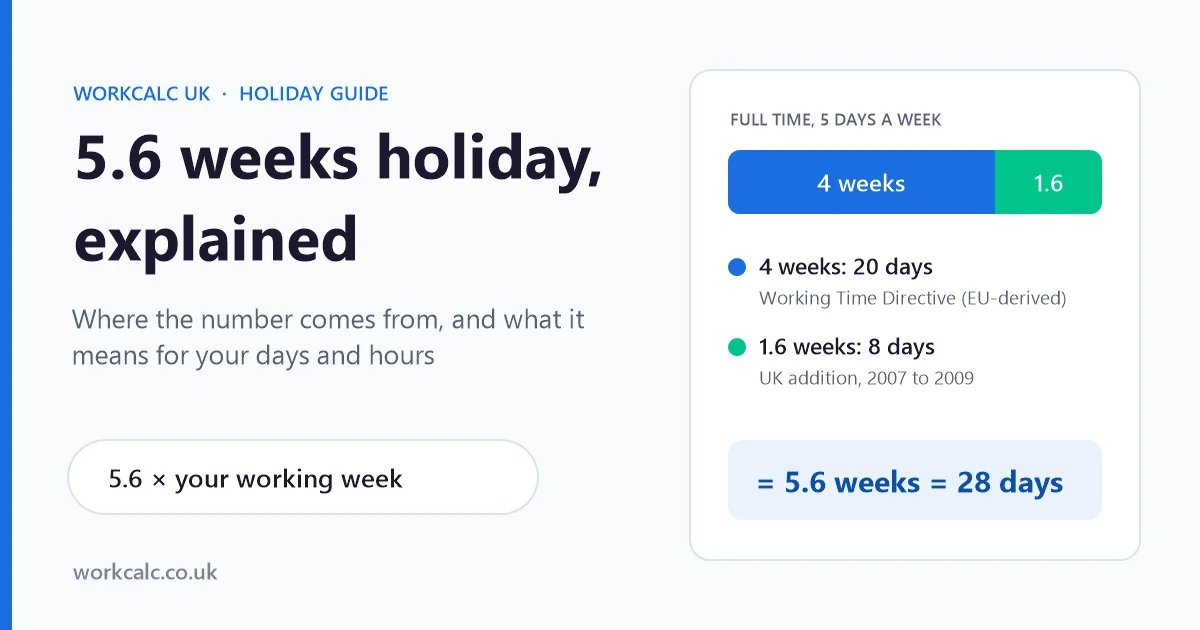
5.6 weeks is the minimum paid holiday for almost every UK worker. It is made up of 4 weeks from the Working Time Regulations 1998 plus 1.6 weeks the UK added between 2007 and 2009. A "week" means your own working week, so multiply 5.6 by the days or hours you work: 28 days for a 5-day week, 16.8 days for 3 days, or 210 hours for 37.5 hours a week.
Key points
- 5.6 weeks = 4 weeks + 1.6 weeks. For a 5-day week that is 20 + 8 = 28 days.
- Multiply 5.6 by your working days or hours. Statutory leave is capped at 28 days.
- The 1.6 weeks was added so bank holidays no longer ate into the 4 weeks.
- The 4 weeks must be paid at normal pay; the 1.6 weeks can be basic pay and can be carried over by agreement.
- 12.07% for irregular hours is simply 5.6 ÷ 46.4.
What 5.6 weeks means
The law measures holiday in weeks, not days, so that it works for every pattern. A week of holiday is one of your working weeks: five days if you work five days, three days if you work three, and 20 hours if you work 20 hours. You get 5.6 of them each leave year.
That is why the familiar "28 days" only applies to people working five days a week. It is 5.6 × 5, not a number that applies to everyone.
Where 5.6 weeks comes from
The UK had no general right to paid holiday until the Working Time Regulations 1998, which brought in the EU Working Time Directive. They started at 3 weeks and rose to 4 weeks in November 1999. That is regulation 13, often called the EU leave.
Four weeks is 20 days for a five-day worker, and employers were allowed to count the 8 bank holidays within it, leaving some people with only 12 days to choose. To fix that, the Working Time (Amendment) Regulations 2007 added regulation 13A in two steps: 0.8 weeks from October 2007 and another 0.8 weeks from April 2009. The result was 5.6 weeks: the original 4 weeks plus 1.6 weeks, or 8 days, the same as the number of bank holidays in England and Wales.
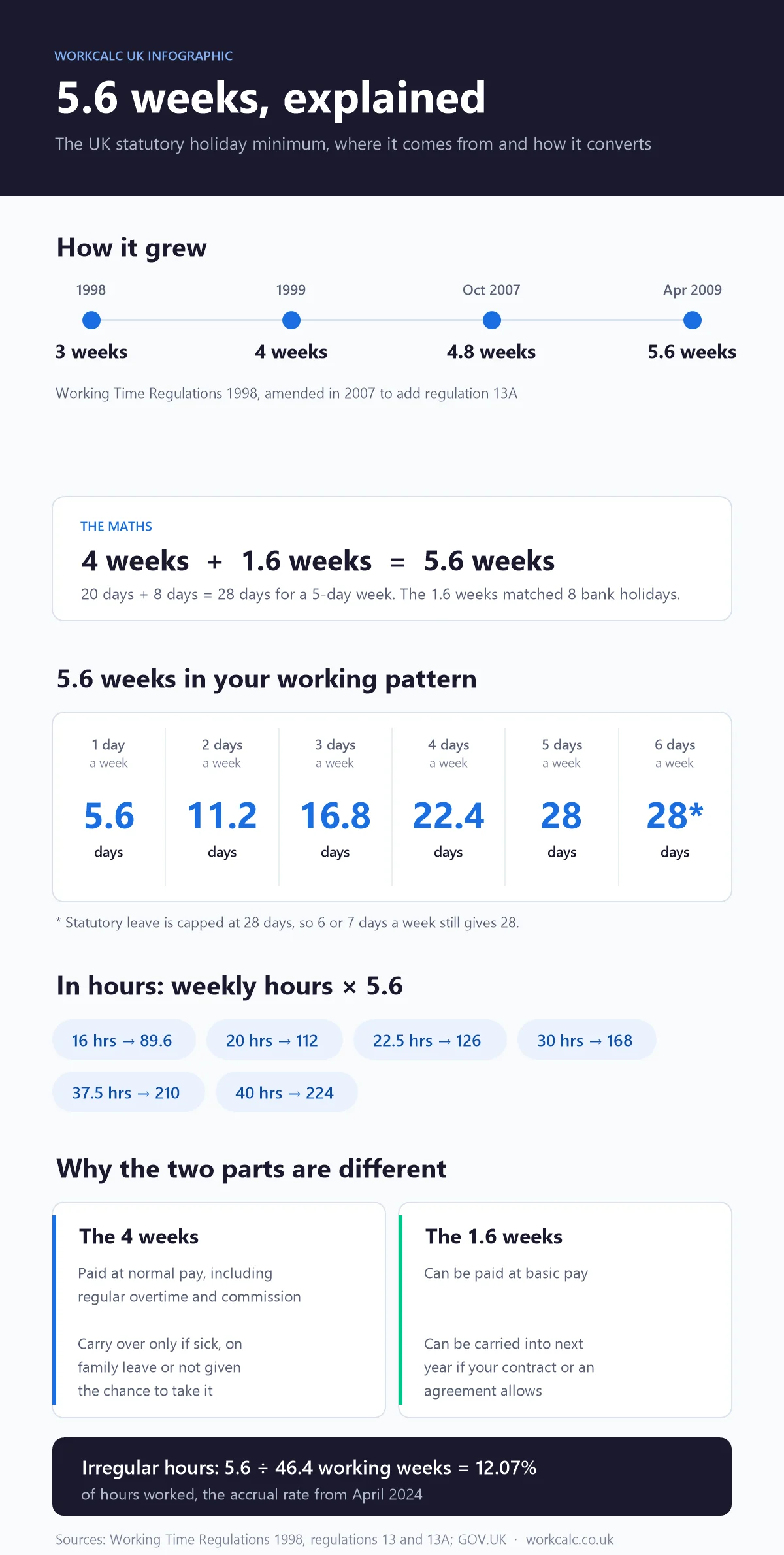
Employers can still count bank holidays as part of the 5.6 weeks, which is why "28 days including bank holidays" is lawful. See does 28 days holiday include bank holidays for how to read your contract.
5.6 weeks in days
| Days worked a week | 5.6 weeks in days | Made up of 4 weeks + 1.6 weeks |
|---|---|---|
| 1 | 5.6 days | 4 + 1.6 |
| 2 | 11.2 days | 8 + 3.2 |
| 3 | 16.8 days | 12 + 4.8 |
| 4 | 22.4 days | 16 + 6.4 |
| 5 | 28 days | 20 + 8 |
| 6 or 7 | 28 days (capped) | 20 + 8 |
The 28-day cap: someone working six days a week would get 33.6 days on the formula, but statutory leave is capped at 28 days. Employers can give more, but the law does not require it.
Part days are normal. 16.8 days is a valid entitlement; employers can round it up, but should not round statutory leave down.
Related tool Holiday Entitlement Calculator: your 5.6 weeks for any pattern, including part-year →5.6 weeks in hours
If your days are not all the same length, count holiday in hours instead: weekly hours × 5.6.
| Hours a week | 5.6 weeks in hours |
|---|---|
| 16 | 89.6 hours |
| 20 | 112 hours |
| 22.5 | 126 hours |
| 30 | 168 hours |
| 37.5 | 210 hours |
| 40 | 224 hours |
Compressed hours work the same way. 37.5 hours over four 9.375-hour days still gives 210 hours, which is 22.4 of those longer days.
Related tool Part-Time Holiday Calculator: 5.6 weeks in hours, with bank holidays on your days →Why the 4 weeks and 1.6 weeks follow different rules
Because the two parts come from different regulations, some rules apply to one and not the other.
| The 4 weeks (regulation 13) | The 1.6 weeks (regulation 13A) | |
|---|---|---|
| Holiday pay | Normal pay, including regular overtime, commission and similar payments | Can be paid at basic pay |
| Carrying over | Only if you were sick, on family leave, or not given a proper chance to take it | Into the next leave year if your contract or an agreement allows |
| Sickness carry-over | Up to 4 weeks, used within 18 months of the end of the leave year | Not required by law |
| Paid instead of taken | Only when you leave | Only when you leave |
Many employers ignore the split and pay all leave at the same rate, which is simpler and lawful. But if your pay includes regular overtime or commission, check that at least 4 weeks of your holiday are paid at that higher rate. The Holiday Pay Calculator shows both figures.
Irregular hours and 12.07%
For irregular-hours and part-year workers, holiday for leave years starting on or after 1 April 2024 builds up as a percentage of hours worked. The percentage comes straight from 5.6 weeks:
So every hour worked earns 0.1207 hours of holiday. Work 30 hours in a pay period and you build up 3.62 hours. Employers can also pay it as rolled-up holiday pay, adding 12.07% to each payslip, as long as it is shown separately.
Related tool Zero Hours Holiday Pay Calculator: the 12.07% rule in practice →Is 5.6 weeks the most you can get?
No, it is the least. Many employers offer more, often 25 days plus bank holidays, which is 33 days or 6.6 weeks for a five-day worker. NHS staff start at 27 days plus bank holidays and rise with service; see the NHS Annual Leave Calculator. Anything above 5.6 weeks is contractual, so your contract sets the rules for how it is paid and carried over.
Sources
- The Working Time Regulations 1998, regulations 13, 13A and 16
- The Working Time (Amendment) Regulations 2007
- GOV.UK, Holiday entitlement
- The Employment Rights (Amendment, Revocation and Transitional Provision) Regulations 2023
Frequently asked questions
5.6 weeks, days, hours and the rules behind them.
What does 5.6 weeks holiday mean?
It is the minimum paid holiday almost every UK worker is entitled to each year. A week means one of your own working weeks, so you multiply 5.6 by the days or hours you work in a week. For a 5-day week that is 28 days.
How many days is 5.6 weeks holiday?
5.6 multiplied by the days you work each week: 5.6 days for 1 day a week, 11.2 for 2, 16.8 for 3, 22.4 for 4 and 28 for 5. Statutory leave is capped at 28 days, so working 6 or 7 days a week still gives 28.
Why is UK holiday 5.6 weeks?
The Working Time Regulations 1998 gave 4 weeks, based on the EU Working Time Directive. The UK added 1.6 weeks between October 2007 and April 2009, equal to the 8 bank holidays for a 5-day worker, so employers could no longer use the 4 weeks to cover bank holidays.
How many hours is 5.6 weeks holiday?
Your weekly hours multiplied by 5.6. A 37.5-hour week gives 210 hours, a 40-hour week 224 hours, and a 20-hour week 112 hours. Hours are the fairest way to count leave if your days are different lengths.
Is 5.6 weeks the same as 28 days?
Only for someone working 5 days a week. 28 days is 5.6 × 5. A part-time worker on 3 days a week gets 16.8 days, which is still 5.6 of their working weeks.
What is the difference between the 4 weeks and the 1.6 weeks?
The first 4 weeks must be paid at your normal rate, including regular overtime and commission, and can usually only be carried over if you were sick, on family leave or not given the chance to take it. The extra 1.6 weeks can be paid at basic pay and can be carried into the next year if your contract or an agreement allows.
Where does 12.07% come from?
It is 5.6 weeks of holiday divided by the 46.4 weeks a full-year worker actually works (52 minus 5.6). For irregular-hours and part-year workers with leave years starting on or after 1 April 2024, holiday builds up at 12.07% of hours worked, so 30 hours worked earns 3.62 hours of leave.
Can my employer give less than 5.6 weeks?
No. 5.6 weeks is the legal minimum and employers cannot give less, although they can include bank holidays in it. Many give more, such as 25 days plus bank holidays, which is 6.6 weeks for a 5-day week.