
Is Redundancy Pay Taxable? The £30,000 Rule Explained
Most redundancy pay is tax-free, but most redundancy packages are not. The difference is in what each payment is for, and in when it is paid. Here is how it works, with 2026/27 figures.
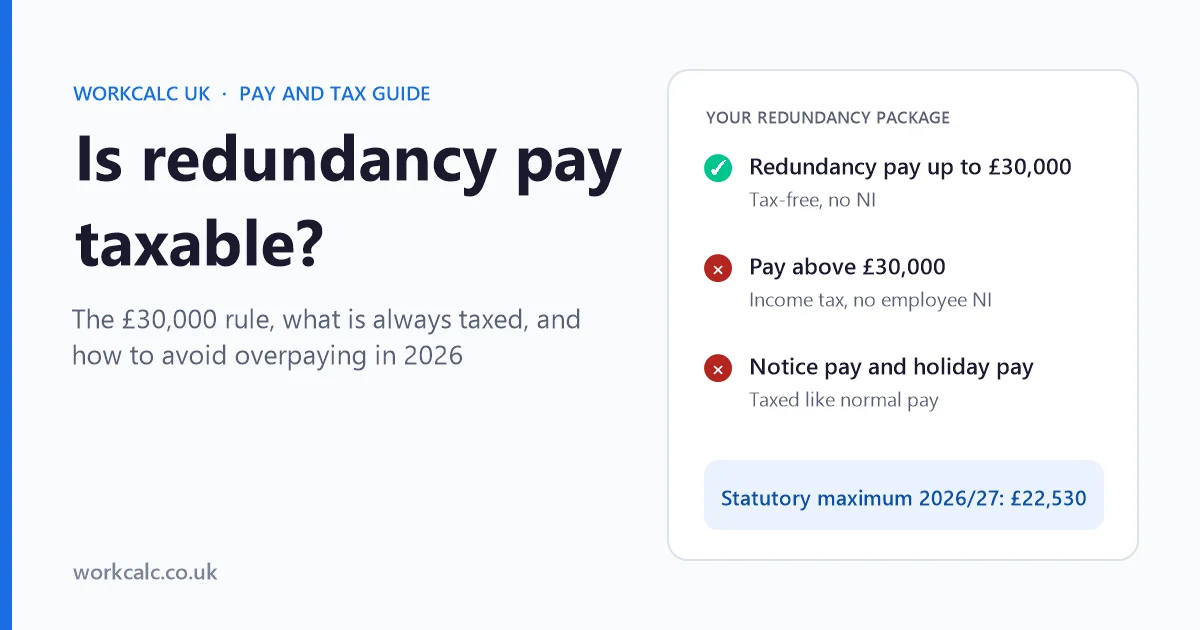
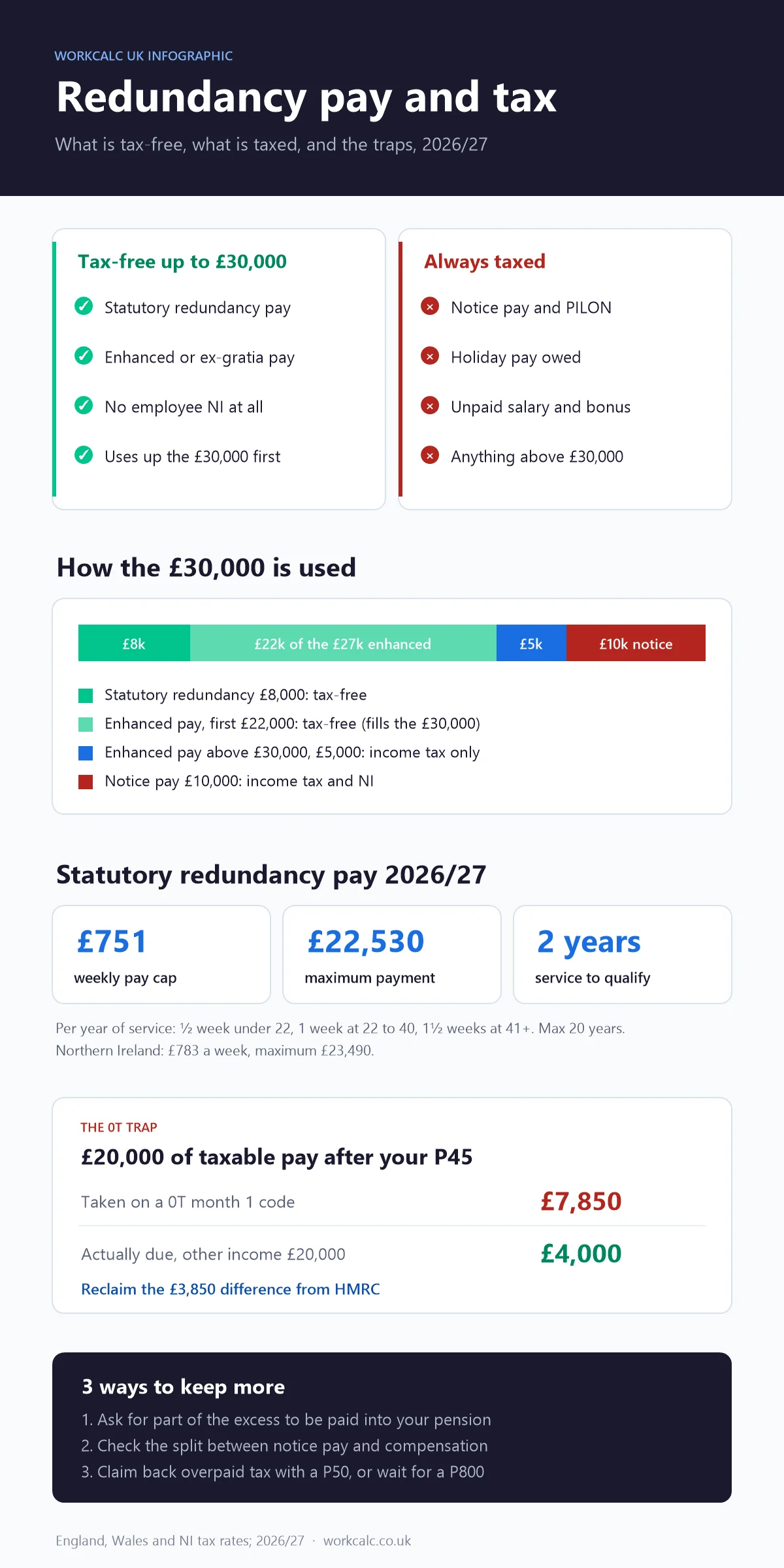
The first £30,000 of redundancy pay is tax-free, and there is no employee National Insurance on any of it. That £30,000 covers statutory and enhanced redundancy pay together. Anything above £30,000 is taxed as income. Notice pay, holiday pay, unpaid salary and bonuses are always taxed, with National Insurance, because they are earnings rather than compensation for losing your job.
Key points
- Statutory redundancy pay uses up the £30,000 first. The 2026/27 maximum is £22,530.
- No employee National Insurance on redundancy compensation, even above £30,000.
- Pay in lieu of notice has been fully taxable since April 2018.
- Payments after your P45 are taxed on a 0T month 1 code, which often takes far too much. You can claim it back.
- Part of a taxable excess can go into your pension tax-free if agreed before it is paid.
The £30,000 rule
Under the Income Tax (Earnings and Pensions) Act 2003, a payment made because your job has ended, and not for work you have done, is a termination award. The first £30,000 of termination awards from the same employer is exempt from income tax. It includes:
- Statutory redundancy pay, which counts towards the £30,000 rather than sitting outside it
- Enhanced or ex-gratia redundancy pay above the statutory minimum
- Compensation for loss of office agreed in a settlement
None of it attracts employee National Insurance, even the part above £30,000. Your employer pays 15% Class 1A National Insurance on anything over £30,000, but that is their cost, not yours.
What is always taxed
Anything you would have earned by working is taxed as normal pay, with income tax and National Insurance, and cannot use the £30,000:
- Notice pay, including pay in lieu of notice (PILON) and post-employment notice pay (PENP). Since April 2018 this is taxable even if your contract has no PILON clause.
- Holiday pay for leave you built up but did not take.
- Salary, overtime, commission and bonuses owed up to your leaving date.
- Payments for restrictive covenants, such as agreeing not to work for a competitor.
That is why the split in your settlement letter matters as much as the total.
Worked examples
Statutory redundancy only
Someone aged 45 with 10 years' service on £600 a week gets 12 weeks' pay: 1.5 weeks for each of the 4 years aged 41 and over, and 1 week for each of the 6 years before that. That is £7,200, entirely tax-free, with no National Insurance.
£45,000 package, £20,000 already earned this tax year
A larger payout
If the whole £60,000 is genuine compensation and you had already earned £40,000 that tax year, £30,000 is tax-free and the other £30,000 is added to your income. Part falls in the basic rate band and part in the higher rate band, so the tax is £9,946 and you keep £50,054. There is still no employee National Insurance on it.
Related tool Redundancy Tax Calculator: enter your package and see exactly what you keep →Statutory redundancy pay in 2026/27
You qualify after 2 years' continuous service. For each complete year of service you get:
| Age during the year of service | Pay for that year |
|---|---|
| Under 22 | Half a week's pay |
| 22 to 40 | One week's pay |
| 41 and over | One and a half weeks' pay |
Only the last 20 years count, and weekly pay is capped. From 6 April 2026 the cap is £751 a week in England, Scotland and Wales, so the maximum statutory payment is £22,530. In Northern Ireland the cap is £783 and the maximum £23,490. Someone receiving the maximum has only £7,470 of the £30,000 left for any enhanced payment.
NHS staff are covered by Section 16 of the Agenda for Change handbook instead, which is usually more generous. The tax rules are the same; see the NHS Redundancy Calculator.
The 0T trap after your P45
Timing can matter as much as the rules. If any taxable part of your package is paid after your employer has issued your P45, payroll must tax it using a 0T code on a month 1 basis. That means no personal allowance, and the higher and additional rate bands are reached after just one-twelfth of the year's limits.
£20,000 taxable excess paid after your P45
To get it back:
- Starting a new job this tax year: give your new employer your P45; the refund usually comes through their payroll.
- Not working and not claiming benefits: claim with form P50 online or through your HMRC personal tax account.
- Otherwise: HMRC normally sends a P800 calculation after the tax year ends, or you can claim through Self Assessment.
If you can, ask your employer to pay everything in your final salary run, before the P45 is issued.
Paying some into your pension
The main legal way to reduce tax on a large package is to ask your employer to pay part of the taxable excess straight into your pension as an employer contribution. That avoids income tax and National Insurance entirely, within the £60,000 annual allowance. It must be agreed before the money is paid; once it reaches your bank account, you can only make a personal contribution, which gets income tax relief but no National Insurance saving.
Related tool Pension Contribution Calculator: how tax relief works on what you pay in →Scottish taxpayers
The £30,000 exemption and the National Insurance rules are the same across the UK. Any taxable excess, notice pay and holiday pay are taxed at Scottish income tax rates, so a Scottish taxpayer can pay a little more on the same package, particularly between £43,662 and £50,270, where the Scottish rate is already 42%.
Before you sign a settlement agreement
- Check the split between notice pay, holiday pay and compensation. Only compensation uses the £30,000.
- Check your statutory entitlement using your age, years of service and the £751 cap.
- Ask about timing, so taxable payments go through your final payslip rather than after your P45.
- Ask about pension contributions for any excess over £30,000.
- Get independent legal advice, which is required for a valid settlement agreement. Fees paid directly by your employer to your adviser for this are normally tax-free.
Work out your notice and last day with the Notice Period Calculator and the value of untaken leave with the Holiday Accrual Calculator.
Sources
- Income Tax (Earnings and Pensions) Act 2003, sections 401 to 404, and HMRC Employment Income Manual on termination payments
- GOV.UK, Redundancy: your rights, and statutory redundancy pay limits from 6 April 2026
- HMRC, Post-employment notice pay and Class 1A National Insurance on termination awards
- HMRC, Payments made after a P45 is issued
Frequently asked questions
Redundancy pay, tax and National Insurance.
Is redundancy pay taxable?
The first £30,000 of genuine redundancy pay, statutory and enhanced combined, is tax-free, and there is no employee National Insurance on any of it. Anything above £30,000 is subject to income tax. Notice pay, holiday pay, unpaid salary and bonuses are not redundancy pay and are taxed like normal earnings.
Is statutory redundancy pay taxable?
No, as long as your total redundancy compensation is £30,000 or less. Statutory redundancy pay counts towards the £30,000 tax-free amount, and the maximum statutory payment for 2026/27 is £22,530 in England, Scotland and Wales.
Do I pay National Insurance on redundancy pay?
No employee National Insurance is due on redundancy compensation, even above £30,000. Your employer pays 15% Class 1A National Insurance on the amount above £30,000. Notice pay and holiday pay do have employee National Insurance deducted.
Is notice pay taxable when I am made redundant?
Yes. Since April 2018, pay for any notice you do not work, including pay in lieu of notice and post-employment notice pay, is taxed and has National Insurance deducted like normal pay. It cannot use the £30,000 tax-free amount.
Why was so much tax taken from my redundancy pay?
Usually because it was paid after your P45 was issued. Payments after a P45 are taxed on a 0T code, month 1 basis, with no personal allowance and higher rates applied quickly. £20,000 of taxable pay can have £7,850 deducted when only £4,000 is due. You can claim the difference back from HMRC.
Can I put redundancy pay into my pension tax-free?
Yes, if your employer agrees before the payment is made. An employer contribution to your pension from the taxable part of a package avoids income tax and National Insurance, within the £60,000 annual allowance. Once the money is paid to you, the chance is gone.
How much is statutory redundancy pay in 2026?
You need 2 years' service. You get half a week's pay for each year worked under age 22, one week's pay for each year aged 22 to 40, and one and a half weeks' pay for each year aged 41 or over, up to 20 years. Weekly pay is capped at £751 from April 2026, giving a maximum of £22,530, or £783 and £23,490 in Northern Ireland.
Is redundancy pay taxed differently in Scotland?
The £30,000 exemption is the same across the UK. Any taxable excess, notice pay and holiday pay are taxed at Scottish income tax rates if you are a Scottish taxpayer, so the tax on the excess can be slightly higher.