
Holiday Entitlement Calculator
Work out your statutory annual leave in days or hours — full-time, part-time, pro-rata, starting or leaving mid-year, and zero-hours contracts. Results update as you type.
Your working pattern
Statutory holiday entitlement by days worked per week
The legal minimum of 5.6 weeks, before any extra your employer chooses to give.
| Days worked per week | Statutory entitlement | If bank holidays come out of it | Equivalent at 7.5 hours a day |
|---|---|---|---|
| 1 day | 5.6 days | Bank holidays rarely fall on the working day | 42 hours |
| 2 days | 11.2 days | Depends which days you work | 84 hours |
| 3 days | 16.8 days | Depends which days you work | 126 hours |
| 4 days | 22.4 days | Depends which days you work | 168 hours |
| 5 days | 28 days | 20 days left if all 8 are counted | 210 hours |
| 6 days | 28 days | Capped — 5.6 × 6 would be 33.6 | 210 hours |
| 7 days | 28 days | Capped — the ceiling applies to everyone | 210 hours |
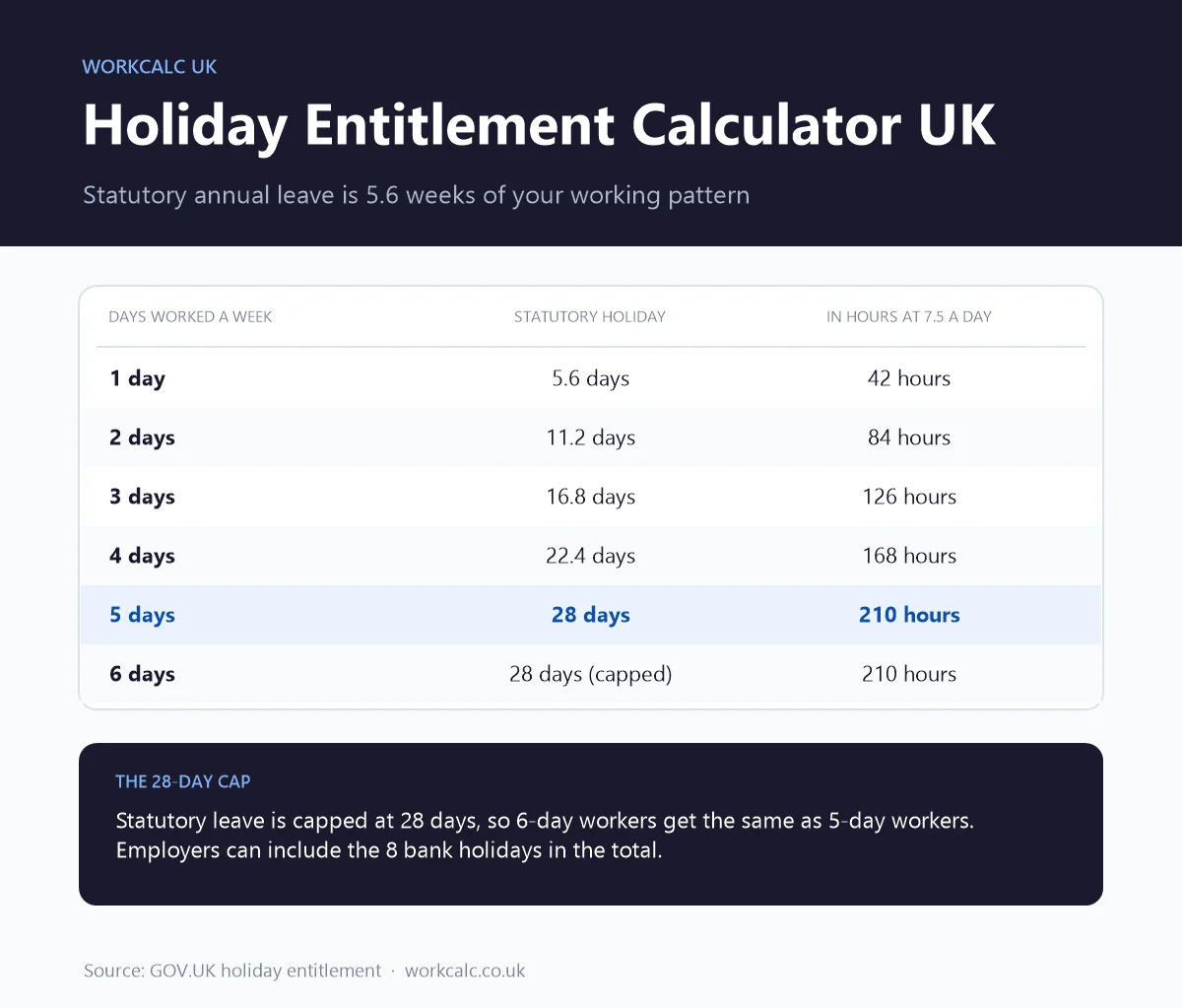
How holiday entitlement is calculated in the UK
Almost every worker in the UK is entitled to 5.6 weeks of paid holiday a year under the Working Time Regulations 1998. The important word is weeks — not days. A week means a working week for you, so the answer depends entirely on your own pattern.
That is why 28 days gets quoted so often: it is simply 5 × 5.6. Someone on three days a week is entitled to 16.8 days, and someone on six days a week still gets 28, because the statutory cap bites. Nobody has a legal right to more than 28 days, however many days a week they work.
Two things sit on top of that baseline. Your employer can give more than the minimum, and they can decide whether bank holidays come out of the allowance or sit on top of it. Both are contractual choices, so your contract is the document that settles them.
Working it out in hours instead of days
If your shifts vary in length, days are a clumsy unit — a 12-hour shift and a 4-hour shift are not the same amount of holiday. Working in hours avoids that. The method is identical: take your full-time colleagues' allowance in hours, then scale it to your weekly hours.
Worked example — 20 hours a week at a 37.5-hour employer
112 hours is the same as 5.6 weeks for someone working 20 hours a week (20 × 5.6 = 112). The two routes agree, which is the useful check: if your employer's figure differs materially from 5.6 × your weekly hours, something has gone wrong.
Starting or leaving part way through the leave year
If you are employed for only part of the leave year, you get a proportion of the full-year figure. There are two lawful methods, and they do not always give the same answer — which is the single most common source of holiday disputes.
- Pro-rata by calendar days. Full entitlement × (days employed in the leave year ÷ days in the leave year). Employed exactly half the year on 28 days gives 14 days.
- Monthly accrual. One-twelfth of the annual entitlement for each month, with the month you join usually counting in full. On 28 days that is 2.33 days a month, so three months gives 7 days.
Monthly accrual tends to be slightly more generous to someone joining mid-month, because they get credit for the whole month. The calculator above shows both figures side by side so you can see which one your employer has used.
The rounding rule most calculators ignore
Part days are normal — 16.8 days and 11.2 days are perfectly valid entitlements. What matters is the direction of any rounding.
ACAS is explicit that employers cannot round part days down. During your first year of employment they must round part days up to the nearest half day. After the first year they may round up, but they are not obliged to, so an entitlement of 16.8 days can lawfully remain 16.8 days rather than becoming 17.
Irregular hours and zero-hours contracts
For leave years beginning on or after 1 April 2024, irregular hours workers and part-year workers accrue holiday differently. Instead of a fixed annual figure, they build up 12.07% of the hours actually worked in each pay period.
| Step | Figure |
|---|---|
| Hours worked in the pay period | 30 hours |
| Accrual rate | 12.07% |
| Leave accrued (30 × 0.1207) | 3.621 hours |
| Rounded (part hour is 0.5 or more, so round up) | 4 hours |
The 12.07% figure is not arbitrary. A year has 52 weeks; take away the 5.6 weeks of holiday and 46.4 working weeks remain. 5.6 ÷ 46.4 = 12.07%. It is the rate that makes holiday work out to 5.6 weeks of the time you actually spend working.
A part-year worker is someone with periods of at least a week in the leave year where they are not required to work and are not paid — term-time-only staff are the classic case. An irregular hours worker is someone whose paid hours in a pay period often or always vary.
Related tool Zero-Hours Holiday Calculator — 12.07% accrual per pay period → Related tool Part-Time Holiday Calculator: uneven days and which bank holidays fall on your working days →Do bank holidays count towards your holiday?
There is no legal right to paid time off on a bank holiday. An employer may include them in the 5.6 weeks or give them on top. Both are lawful, and the practical difference is significant:
| What the contract says | Days you choose yourself | Total paid time off |
|---|---|---|
| 28 days including bank holidays | 20 days | 28 days |
| 20 days plus bank holidays | 20 days | 28 days |
| 25 days plus bank holidays | 25 days | 33 days |
The first two rows are the same deal described two ways, and both meet the legal minimum. The third is genuinely better. Note also that bank holiday counts differ across the UK: England and Wales normally have 8, Scotland has 9 and Northern Ireland has 10, so a "plus bank holidays" contract is worth more in Belfast than in Bristol.
One quirk catches part-time staff out. If you never work Mondays, a bank holiday Monday is simply a day you were not working — it should not be deducted from your allowance. Many employers handle this by giving part-time staff a pro-rata bank holiday allowance in hours rather than tying it to specific dates.
What this calculator does not cover
The calculator applies the statutory rules and the standard pro-rata methods. It does not model:
- Holiday pay rates — how much each day is worth, including the 52-week reference period for variable pay
- Enhanced schemes tied to service length — such as NHS Agenda for Change, where entitlement steps up at 5 and 10 years
- Carry-over — up to 8 of the 28 statutory days can normally be carried over, with wider rights after sickness or family leave
- Sector agreements — agricultural workers in Scotland and Northern Ireland have their own separate rules
If you need to know what each day of leave is worth in pounds rather than how many days you get, use the Holiday Pay Calculator. NHS staff on Agenda for Change should use the NHS Annual Leave Calculator instead, because entitlement there steps up with length of service. Working in Australia? Leave there follows different rules, so use the annual leave calculator for Australia on WorkCalc Australia.
For anything binding, ACAS is the best free source of guidance, and the GOV.UK holiday calculator is the official tool.
Planning next year?All UK bank holidays 2027, with long weekends and the Christmas three-day week →Frequently asked questions
Common questions about UK holiday entitlement and annual leave.
How do I calculate my holiday entitlement in the UK?
Multiply the number of days you work each week by 5.6. Someone working 5 days a week gets 28 days; someone working 3 days a week gets 16.8 days (3 × 5.6). Statutory entitlement is capped at 28 days, so working 6 or 7 days a week does not increase it. If your employer gives more than the statutory minimum, your part-time entitlement is that larger figure scaled to your working pattern instead.
How many days holiday am I entitled to in the UK?
By law almost all workers get 5.6 weeks of paid holiday a year. For a 5-day week that is 28 days. Part-time workers get the same 5.6 weeks, which comes to fewer days: 22.4 days for 4 days a week, 16.8 days for 3 days, 11.2 days for 2 days. Many employers offer more than the legal minimum, so check your contract.
Does 28 days holiday include bank holidays?
It can, but it does not have to. There is no legal right to paid time off on a bank holiday. An employer can count bank holidays towards your 5.6 weeks, or give them on top. If your contract says 20 days plus bank holidays, you effectively have 28 days. If it says 28 days including bank holidays, you have 20 days of your own choosing. Both are lawful.
How many days is 5.6 weeks?
It depends on how many days a week you work, because a week means a working week for you. For a 5-day week, 5.6 weeks is 28 days. For a 4-day week it is 22.4 days, and for a 3-day week it is 16.8 days. The 28-day figure people quote is simply 5 × 5.6, not a universal number.
How do I work out pro rata holiday entitlement?
Take the full-year entitlement for your working pattern and scale it by the portion of the leave year you are employed. If you get 28 days and work exactly half the leave year, that is 14 days. Employers may instead use a monthly accrual system giving one-twelfth of the annual entitlement per month. Both methods are permitted and they can produce slightly different answers.
Is there an HMRC holiday calculator?
No. HMRC deals with tax and National Insurance, not holiday entitlement. Annual leave is set by the Working Time Regulations 1998 and enforced through employment tribunals, with guidance from ACAS and the official GOV.UK calculator. If you have seen a reference to an HMRC holiday calculator, it is a common mix-up rather than a real tool.
How much holiday do I accrue each month?
Under a monthly accrual system you build up one-twelfth of your annual entitlement each month. On 28 days a year that is 2.33 days a month, so after three months you would have 7 days. During your first year of employment your employer must round part days up to the nearest half day.
How is holiday entitlement calculated on a zero-hours contract?
For leave years starting on or after 1 April 2024, irregular hours and part-year workers accrue 12.07% of the hours they actually work in each pay period. Work 30 hours in a week and you accrue 3.621 hours of leave, rounded up to 4 because the part hour is 0.5 or more. The 12.07% figure comes from 5.6 weeks divided by the 46.4 working weeks left in the year.
Can my employer round my holiday entitlement down?
No. Employers cannot round part days down. In your first year of employment they must round part days up to the nearest half day. After the first year they may round up but are not obliged to, so an entitlement of 16.8 days can lawfully stay at 16.8 days rather than becoming 17.