
NHS Annual Leave Calculator
Work out your exact NHS holiday entitlement in hours and days under Agenda for Change — annual leave plus your 8 general public holidays, pro-rated to your contracted hours.
Your NHS contract
NHS annual leave entitlement by length of service
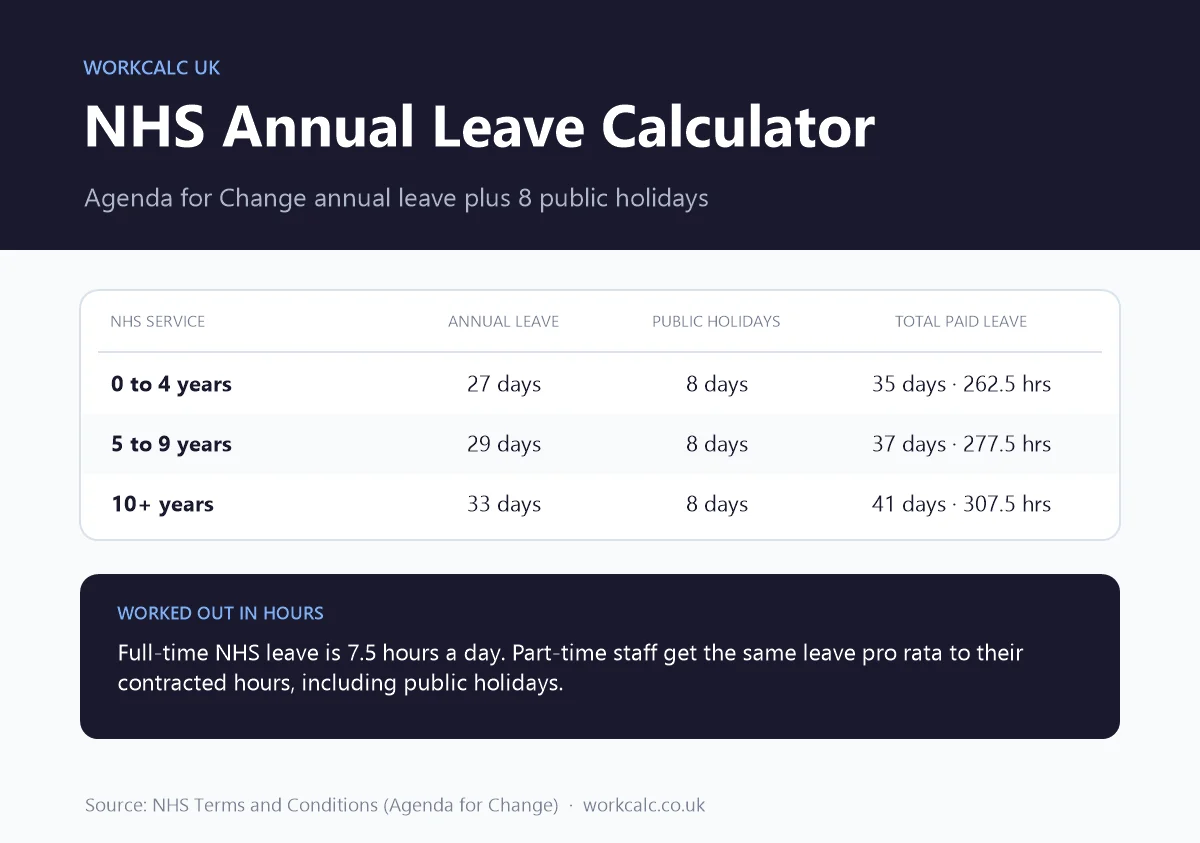
The full NHS holiday entitlement table under Agenda for Change Section 13, for a full-time member of staff on a 37.5-hour week.
| Length of service | Annual leave | In hours | Public holidays | Total paid leave |
|---|---|---|---|---|
| On appointment (0–4 years) | 27 days | 202.5 hrs | 8 days / 60 hrs | 35 days · 262.5 hrs |
| After 5 years (5–9 years) | 29 days | 217.5 hrs | 8 days / 60 hrs | 37 days · 277.5 hrs |
| After 10 years (10+ years) | 33 days | 247.5 hrs | 8 days / 60 hrs | 41 days · 307.5 hrs |
How your NHS annual leave allowance is calculated
Annual leave in the NHS sits under Section 13 of the NHS Terms and Conditions of Service Handbook — the Agenda for Change handbook. Every NHS annual leave policy across England, Scotland, Wales and Northern Ireland is built on the same three-tier ladder, based on how long you have worked in the NHS. The tiers are identical whether you are a healthcare assistant or a service manager.
That last point is where NHS leave differs most from the rest of the UK labour market. Under the statutory minimum, an employer is allowed to count bank holidays towards your 5.6 weeks. Agenda for Change does not — the 27, 29 and 33-day figures are exclusive of public holidays. At the top tier that means 41 days of paid leave a year, which is among the most generous allowances of any large UK employer.
Not on Agenda for Change? Holiday Entitlement Calculator — the statutory 5.6-week rules →NHS annual leave after 5 years and after 10 years
The two step-ups are the moments worth watching. NHS annual leave after 5 years rises from 27 to 29 days — two extra days, or 15 hours for a full-time member of staff. NHS annual leave after 10 years jumps again from 29 to 33 days, a further four days or 30 hours.
Both increases apply from your service anniversary, not from the start of the leave year. Hit ten years in October and your NHS holiday allowance for that leave year is a blend: 29 days' worth up to the anniversary, 33 days' worth after it.
Your band does not affect your leave
This catches people out constantly. Pay band determines what you earn; it has no bearing at all on how much leave you get. A Band 2 healthcare assistant with twelve years of service has more annual leave than a Band 8a manager who joined last year. The only thing that moves you up the ladder is reckonable service.
Why NHS leave is counted in hours
Holiday entitlement in the NHS is managed differently from most employers. Where others talk in days, NHS leave entitlement is expressed in hours — and for good reason: a ward nurse on three 12.5-hour shifts and an administrator on five 7.5-hour days both work 37.5 hours a week, but "27 days" would mean wildly different amounts of time off. Counting in hours makes the two equal.
The formula is simple:
Worked example — 22.5 hours a week, 12 years' service
Whole time equivalent here is 0.6 (22.5 ÷ 37.5), and 184.5 hours is exactly 60% of the 307.5 hours a full-time colleague on the same tier receives. The two routes always agree — if your ESR balance differs materially from this, it is worth querying.
Scotland's 36-hour week changes every calculation
If you are using this as an NHS Scotland annual leave calculator, switch the nation selector before you read the result. NHS Scotland reduced the Agenda for Change full-time working week from 37.5 to 36 hours from 1 April 2026. Because entitlement is derived from weekly hours, every hours figure north of the border shifted with it:
| Tier | England, Wales & NI (37.5h) | Scotland (36h) |
|---|---|---|
| On appointment — 27 days | 202.5 hrs | 194.5 hrs |
| After 5 years — 29 days | 217.5 hrs | 209.0 hrs |
| After 10 years — 33 days | 247.5 hrs | 237.5 hrs |
| Public holidays — 8 days | 60 hrs | 60 hrs |
Note the last row. Fewer annual leave hours, but the public holiday allocation for full-time staff stays at 60 hours — a deliberate quirk of how Scotland rounds public holidays. Fewer hours of annual leave does not mean less time off: 194.5 hours at 7.2 hours a day is still 27 days.
What counts as reckonable service
Your tier depends on total NHS service, not time at your current trust. That matters enormously — someone who worked four years at one trust, left for a year, then joined another is often much closer to the five-year tier than they realise.
- Counts: previous employment with any NHS trust, board or health authority across the UK, including part-time and fixed-term contracts.
- Usually counts: service that transferred under TUPE from an NHS organisation to a provider.
- Usually does not count: agency work through a commercial agency, and employment with private healthcare providers.
Starting or leaving part way through the leave year
Most NHS leave years run from 1 April to 31 March. Join or leave mid-year and your entitlement is pro-rated by the proportion of the year you are employed. Someone joining on 1 September on the 27-day tier has roughly 58% of the year left, so about 15.7 days rather than 27.
Your service anniversary can also fall mid-year. If you hit five or ten years' service part way through the leave year, the increase applies from that date — so your entitlement for that year is a blend of two tiers rather than a jump on 1 April.
Related tool NHS Pay Calculator — take-home pay by band and spine point →Carrying leave over
Most trusts and boards allow up to five days to be carried into the next leave year, but this is set locally rather than by the national handbook — check your own policy, because the figure genuinely varies.
Two situations give you stronger rights that come from the Working Time Regulations rather than local policy: if you could not take leave because of long-term sickness, or because you were on maternity, paternity, adoption or shared parental leave. In both cases leave continues to accrue while you are away and untaken leave carries over.
Related guide Does 28 days holiday include bank holidays? What your contract wording means →What this calculator does not cover
- Doctors and dentists in training — separate terms with their own leave arrangements, not Agenda for Change Section 13
- Consultants and career-grade doctors — 32 or 34 days depending on service, under a different contract
- Bank-only staff — no fixed contracted hours, so leave accrues at 12.07% of hours worked
- Local enhancements — a small number of trusts offer above the national minimum
If you hold both a substantive contract and bank shifts, the two accrue separately — your substantive leave from this calculator, and your bank leave via the zero-hours accrual method. Working out what those hours are worth in pounds is a separate question again: see the Holiday Pay Calculator.
Every figure on this NHS leave calculator follows Section 13 of the NHS Terms and Conditions of Service Handbook, published by NHS Employers. Your trust or board will also hold its own NHS annual leave policy — always check your contract and ESR record against it.
Frequently asked questions
Common questions about NHS annual leave under Agenda for Change.
How much annual leave do NHS staff get?
Under Agenda for Change Section 13, full-time NHS staff get 27 days on appointment, 29 days after five years of service and 33 days after ten years. All three tiers come with 8 general public holidays on top, so total paid leave runs from 35 to 41 days a year. Part-time staff get the same entitlement pro-rated to their contracted hours.
Does NHS annual leave include bank holidays?
No. The 27, 29 and 33-day figures are exclusive of public holidays. NHS staff receive 8 general public holidays in addition, worth 60 hours a year for a full-time member of staff. This is why NHS leave is far more generous than the statutory minimum, which allows employers to count bank holidays towards the 5.6 weeks.
Does NHS annual leave depend on your band?
No. Entitlement is set purely by length of reckonable NHS service, not by pay band. A Band 2 healthcare assistant and a Band 8a manager with the same years of service receive exactly the same number of days. Band affects your pay, not your leave.
How is NHS annual leave calculated for part-time staff?
Divide your contracted weekly hours by 5 to get your daily hours, then multiply by 27, 29 or 33 depending on your service tier. Someone working 22.5 hours a week has 4.5-hour days, so at the ten-year tier they get 148.5 hours of annual leave. Part-time entitlement is rounded to the nearest half hour.
How many hours annual leave do NHS staff get?
For full-time staff on 37.5 hours a week: 202.5 hours on appointment, 217.5 hours after five years and 247.5 hours after ten years. Public holidays add a further 60 hours. Entitlement is managed in hours rather than days so that staff on 12-hour shifts and staff on short days are treated equally.
What counts as reckonable service for NHS annual leave?
Previous NHS employment counts towards your service tier, including time at a different trust or board, provided the break in service is not too long. Agency work and time with private providers usually does not count unless it transferred under TUPE. If you have earlier NHS service, tell your employer at the point of appointment because it will not appear automatically.
What is the NHS full-time working week in Scotland?
NHS Scotland reduced the Agenda for Change full-time week from 37.5 to 36 hours from 1 April 2026. That changes every hours-based figure north of the border: 27 days becomes 194.5 hours instead of 202.5. Public holiday allocation for full-time staff remains at 60 hours.
Can NHS staff carry over annual leave?
Most trusts and boards allow up to five days of untaken leave to be carried into the next leave year, though the exact figure is set locally rather than by the national handbook. Staff who could not take leave because of long-term sickness or family leave have stronger rights to carry it over, which come from the Working Time Regulations rather than local policy.
How does annual leave work for NHS bank staff?
Bank staff without fixed contracted hours are irregular hours workers, so they accrue holiday at 12.07% of the hours actually worked in each pay period rather than receiving a fixed annual figure. Staff who hold both a substantive contract and bank shifts accrue separately on each.