
Hourly to Annual Salary Calculator
Turn an hourly rate into a yearly, monthly and weekly salary, or work backwards from a salary to an hourly rate. See your take-home pay after tax and whether the rate meets the 2026 minimum wage.
Your pay
| Pay | Before tax | Take-home |
|---|---|---|
| A year | ||
| A month | ||
| A week | ||
| A day | ||
| An hour |
Hourly rate to annual salary, 2026/27
52 paid weeks. Take-home is after income tax and National Insurance in England, Wales and Northern Ireland on a 37.5-hour week, with no pension or student loan.
| Hourly rate | A year (37.5 hrs) | A month | A year (40 hrs) | Take-home a year | Take-home a month |
|---|---|---|---|---|---|
| £8.00 (under 18, apprentice) | £15,600 | £1,300 | £16,640 | £14,752 | £1,229 |
| £10.85 (age 18 to 20) | £21,158 | £1,763 | £22,568 | £18,753 | £1,563 |
| £12.71 (age 21 and over) | £24,785 | £2,065 | £26,437 | £21,364 | £1,780 |
| £13 | £25,350 | £2,113 | £27,040 | £21,772 | £1,814 |
| £14 | £27,300 | £2,275 | £29,120 | £23,176 | £1,931 |
| £15 | £29,250 | £2,438 | £31,200 | £24,580 | £2,048 |
| £16 | £31,200 | £2,600 | £33,280 | £25,984 | £2,165 |
| £17 | £33,150 | £2,763 | £35,360 | £27,388 | £2,282 |
| £18 | £35,100 | £2,925 | £37,440 | £28,792 | £2,399 |
| £20 | £39,000 | £3,250 | £41,600 | £31,600 | £2,633 |
| £22 | £42,900 | £3,575 | £45,760 | £34,408 | £2,867 |
| £25 | £48,750 | £4,063 | £52,000 | £38,620 | £3,218 |
| £30 | £58,500 | £4,875 | £62,400 | £44,487 | £3,707 |
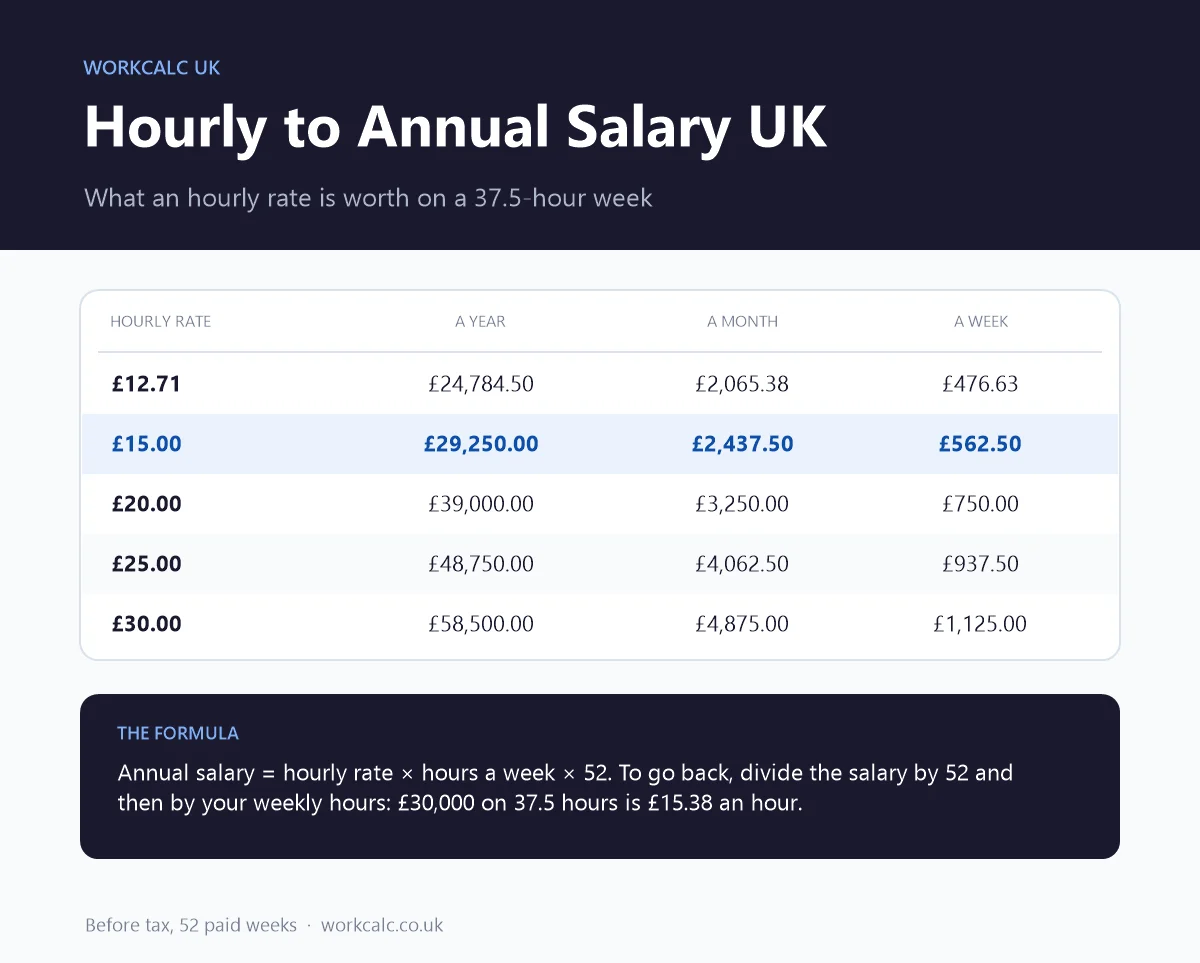
To turn an hourly rate into an annual salary, multiply it by your paid hours a week and then by 52. £15 an hour on a 37.5-hour week is £29,250 a year, or £2,437.50 a month before tax. To go the other way, divide the salary by 52 and then by your weekly hours: £30,000 on 37.5 hours is £15.38 an hour.
How to convert an hourly rate to a salary
A full-time year is 1,950 paid hours on a 37.5-hour week, 2,080 on a 40-hour week and 1,820 on a 35-hour week. Divide the annual figure by 12 for a monthly salary and by 52 for a weekly one. For a daily rate, divide the weekly figure by the days you work.
At the £12.71 National Living Wage, that gives £24,784.50 a year on 37.5 hours, £2,065.38 a month, £476.63 a week and £95.33 a day.
How to convert a salary to an hourly rate
The same salary gives a different hourly rate depending on your contracted hours, so always use the hours in your contract rather than a standard figure.
| Salary | 35 hours | 37.5 hours | 40 hours | Take-home an hour |
|---|---|---|---|---|
| £20,000 | £10.99 | £10.26 | £9.62 | £9.19 |
| £25,000 | £13.74 | £12.82 | £12.02 | £11.04 |
| £30,000 | £16.48 | £15.38 | £14.42 | £12.88 |
| £35,000 | £19.23 | £17.95 | £16.83 | £14.73 |
| £40,000 | £21.98 | £20.51 | £19.23 | £16.57 |
| £45,000 | £24.73 | £23.08 | £21.63 | £18.42 |
| £50,000 | £27.47 | £25.64 | £24.04 | £20.27 |
| £60,000 | £32.97 | £30.77 | £28.85 | £23.26 |
Take-home an hour is after 2026/27 income tax and National Insurance, on a 37.5-hour week.
37.5 or 40 hours: the minimum wage trap
Salaried jobs are often advertised without saying how many hours they involve, but the hours decide whether the pay is even legal. £25,000 a year on a 37.5-hour week is £12.82 an hour, just above the £12.71 National Living Wage. On a 40-hour week it is £12.02, which is below the legal minimum for anyone aged 21 or over.
To meet the National Living Wage in 2026, a full-time salary needs to be at least £24,784.50 on 37.5 hours or £26,436.80 on 40 hours. The calculator checks your rate against every minimum wage band.
| Minimum wage from April 2026 | Hourly | A year, 37.5 hrs | A year, 40 hrs |
|---|---|---|---|
| Age 21 and over (National Living Wage) | £12.71 | £24,784.50 | £26,436.80 |
| Age 18 to 20 | £10.85 | £21,157.50 | £22,568.00 |
| Under 18 and apprentices | £8.00 | £15,600.00 | £16,640.00 |
Why you should use 52 weeks, not 48
A common mistake is multiplying by 48 weeks to allow for holidays. Almost every worker is entitled to 5.6 weeks of paid leave, and a salary is paid across all 52 weeks, so holiday weeks count as paid weeks. Using 48 would make £15 an hour look like £27,000 a year instead of £29,250.
Only reduce the weeks if some are genuinely unpaid, for example a term-time contract where you are not paid in school holidays. Irregular-hours workers may have holiday pay added to each payslip at 12.07% instead, as explained in the Zero Hours Holiday Pay Calculator.
Your hourly rate after tax
Take-home pay per hour falls as your rate rises, because more of each extra pound is taxed. At £12.71 you keep £10.96 of each hour's pay; at £20 you keep £16.20; at £30 you keep £22.81. The calculator shows take-home by hour, day, week, month and year, with pension and student loan deductions if you add them.
Related tool Take-Home Pay Calculator: tax codes, salary sacrifice and every pension type →Part-time hours, breaks and overtime
- Part-time: enter your own weekly hours. 20 hours at £15 is £15,600 a year. To compare with a full-time salary, use the Pro Rata Salary Calculator.
- Unpaid breaks: count paid hours only. 9am to 5.30pm with an unpaid 30-minute lunch is 7.5 hours a day.
- Overtime: enter your contracted hours for the base salary. Regular overtime adds to annual pay, and it can also raise your holiday pay.
- Daily rates: contractors paid by the day should use the Day Rate Calculator, which allows for unpaid holidays and IR35.
What this calculator does not cover
- Non-standard tax codes, benefits in kind and second jobs.
- Salary sacrifice pensions, which also save National Insurance. Pension here is treated as a net pay scheme.
- Self-employed income, which is taxed through Self Assessment with Class 4 National Insurance.
- Pay that varies week to week. Results assume the same hours and rate all year.
Sources
- HMRC income tax, National Insurance and student loan thresholds for 2026/27
- GOV.UK, National Minimum Wage and National Living Wage rates from 1 April 2026
- GOV.UK, Holiday entitlement
Frequently asked questions
Hourly rates, salaries and working hours.
£12.71 an hour is how much a year?
£24,784.50 a year on a 37.5-hour week, or £26,436.80 on a 40-hour week. £12.71 is the National Living Wage for workers aged 21 and over from April 2026. After tax and National Insurance, the 37.5-hour figure leaves £21,364.44 a year, or £1,780.37 a month.
£15 an hour is how much a year?
£29,250 a year on a 37.5-hour week, which is £15 × 37.5 hours × 52 weeks. On 40 hours a week it is £31,200. After 2026/27 tax and National Insurance, £29,250 leaves £24,579.60, or £2,048.30 a month.
How many working hours are there in a year in the UK?
1,950 hours on a 37.5-hour week, 2,080 on a 40-hour week and 1,820 on a 35-hour week, counting 52 paid weeks. Paid holiday is included, because you are paid for those weeks even though you do not work them.
How do I work out my hourly rate from my salary?
Divide your annual salary by 52, then by your contracted hours a week. £30,000 on a 37.5-hour week is £30,000 ÷ 52 ÷ 37.5 = £15.38 an hour. On a 40-hour week it is £14.42.
Should I use 52 weeks to convert an hourly rate to a salary?
Yes, if you get paid holiday. Employees and workers are paid for their 5.6 weeks of leave, so a salary covers all 52 weeks. Using 48 weeks would understate annual pay. Only use fewer weeks if you genuinely have unpaid time off, such as a term-time contract.
Is £25,000 a year above minimum wage?
It depends on your hours. On 37.5 hours a week £25,000 is £12.82 an hour, above the £12.71 National Living Wage. On 40 hours a week it is £12.02 an hour, which is below the minimum for workers aged 21 and over.
How much is £20 an hour after tax?
On a 37.5-hour week, £20 an hour is £39,000 a year before tax. After 2026/27 income tax and National Insurance you keep £31,599.60 a year, £2,633.30 a month, or £16.20 for each hour worked.
Are unpaid breaks counted in my hours?
No. Only paid hours count. A 9am to 5.30pm day with an unpaid 30-minute lunch is 7.5 paid hours, which is 37.5 hours over a 5-day week.