
Zero Hours Holiday Pay Calculator
Work out holiday pay for a zero hours contract — 12.07% of the hours you actually work, with rolled-up holiday pay and the 28-day cap handled properly. A zero hours contract holiday pay calculator that follows the current rules.
Your hours and pay
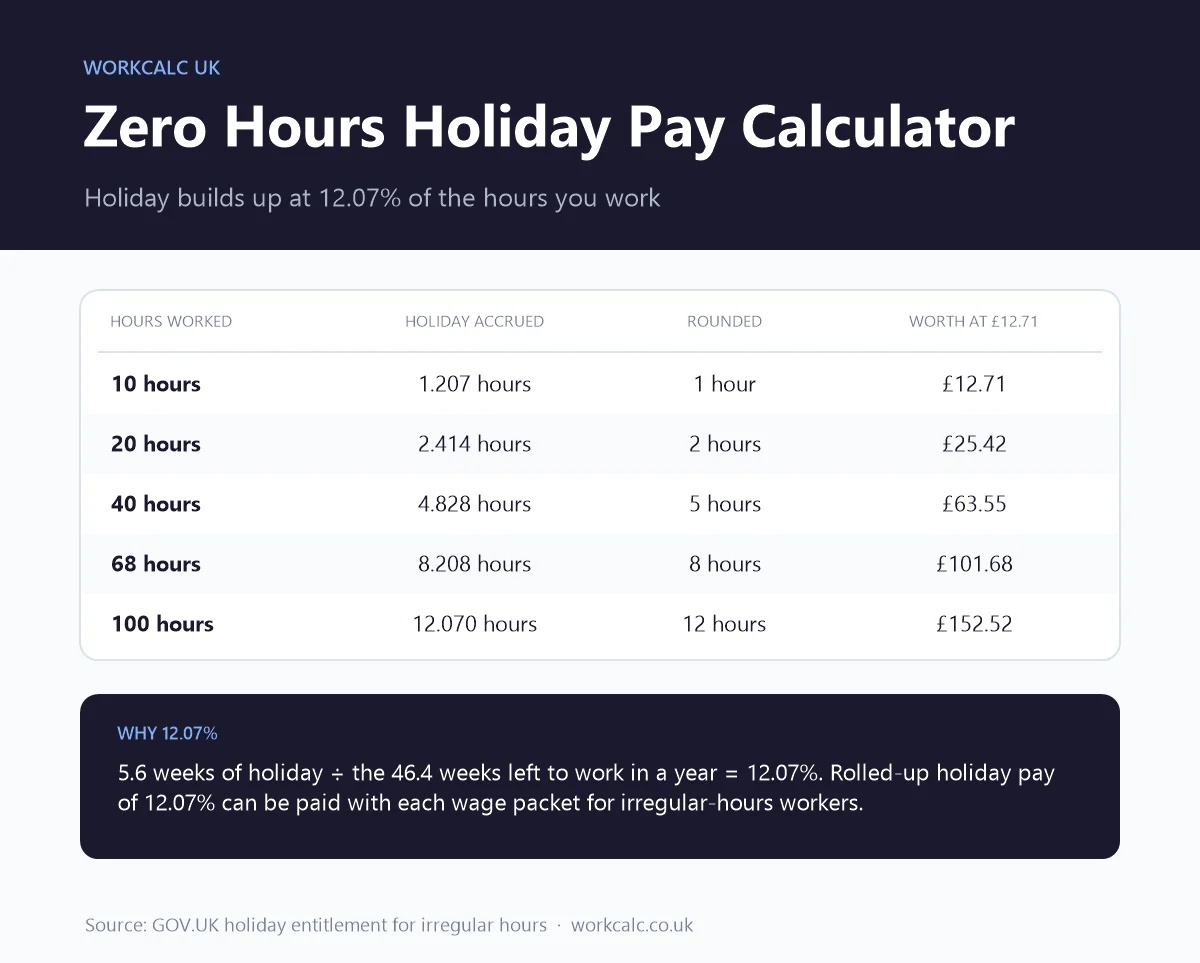
Holiday pay 12.07 calculator — accrual by hours worked
Statutory accrual for irregular hours and part-year workers, rounded to the nearest hour as the GOV.UK guidance requires.
| Hours worked in the pay period | Exact accrual | Rounded | In 8-hour shifts | Worth at £12.71 |
|---|---|---|---|---|
| 10 hours | 1.207 | 1 hour | 0.13 | £12.71 |
| 20 hours | 2.414 | 2 hours | 0.25 | £25.42 |
| 30 hours | 3.621 | 4 hours | 0.50 | £50.84 |
| 40 hours | 4.828 | 5 hours | 0.63 | £63.55 |
| 68 hours | 8.208 | 8 hours | 1.00 | £101.68 |
| 100 hours | 12.070 | 12 hours | 1.50 | £152.52 |
| 160 hours | 19.312 | 19 hours | 2.38 | £241.49 |
Holiday pay for zero hours contract workers — how it works
Zero hour contract holiday pay works like everyone else’s in principle — you get paid leave. What differs is how it builds up. Instead of a fixed annual allowance, you accrue it as you work.
Work 68 hours in a month and you accrue 8 hours of paid leave. Work 160 hours and you accrue 19. The accrual happens at the end of each pay period, and it is based on hours actually worked — not contracted hours, because on a zero hours contract there are none.
Where the 12.07 holiday pay figure comes from
It looks arbitrary. It is not.
The arithmetic behind the figure
It is the rate that makes your holiday work out to 5.6 weeks of the time you actually spend working — the same entitlement everyone else gets, expressed as a percentage rather than a fixed number of days.
Why the rules changed twice
This is where most online guidance is out of date, so it is worth being precise.
| When | What applied |
|---|---|
| Before July 2022 | 12.07% was standard practice for irregular hours workers |
| July 2022 | Harpur Trust v Brazel — the Supreme Court ruled 12.07% unlawful for part-year workers, who were instead entitled to the full 5.6 weeks |
| 2022 to 2024 | Part-year workers could end up with more holiday than part-timers working the same hours |
| From 1 April 2024 | The government reinstated 12.07% by regulation for irregular hours and part-year workers, reversing Brazel |
When the new rules actually started for you
The reforms apply to leave years beginning on or after 1 April 2024 — not to any leave year running on that date. The start date of your leave year decides when it bit:
- Leave year starting 1 April — new rules applied from 1 April 2024
- Leave year starting 1 January — new rules applied from 1 January 2025
- Leave year starting 1 September — new rules applied from 1 September 2024
By now every leave year has turned over at least once, so the new rules apply to essentially everyone in Great Britain. But if you are checking historic accrual or arrears, the start date still matters.
Who gets holiday entitlement for zero hours contract rules?
The 12.07% method only applies to two groups, and misclassification is common.
| Category | Definition | Typical examples |
|---|---|---|
| Irregular hours worker | Paid hours in each pay period are wholly or mostly variable under the contract | Zero hours contracts, bank staff, casual workers |
| Part-year worker | Required to work only part of the year, with periods of at least a week unpaid | Term-time-only staff, seasonal workers |
Another common error: someone who works term-time only but is paid a level salary across all twelve months is not a part-year worker, because they are paid throughout the year.
Not irregular hours? Holiday Entitlement Calculator — the standard 5.6-week rules → Related tool Holiday Pay Calculator: a day's holiday pay for regular hours, overtime and leaving pay →Rolled-up holiday pay
Since April 2024 employers have had a choice about when they pay your accrued holiday. Accrual and payment are two separate things.
- Pay when taken — you build up hours, book them off, and get paid at the time
- Rolled-up holiday pay — 12.07% is added to every payslip as you go, and you take the time off unpaid
Rolled-up holiday pay was unlawful for years following a European Court ruling, and became lawful again for irregular hours and part-year workers from April 2024. Where it is used, three conditions apply:
- It must be calculated at 12.07% of all your pay in the period, not just basic pay
- It must be itemised separately on your payslip
- You must still actually take the leave — the employer remains under a duty to ensure you rest
Holiday entitlement on a zero hour contract — the 28-day cap
Zero hour contract holiday entitlement accrues at 12.07% but is capped at the statutory maximum of 28 days. In hours that depends on your typical shift length — 224 hours on 8-hour shifts, 336 on 12-hour shifts.
In practice the cap rarely bites, because reaching it means working roughly full-time hours all year. If you are consistently at that level on a zero hours contract, it is worth asking whether the contract still reflects reality.
Related tool Part-Time Holiday Calculator: for regular part-time hours, with 2026 bank holidays →What happens when you are off sick or on family leave
There are no hours worked to apply 12.07% to, so the regulations use a different method: your employer takes an average of the hours you worked over the previous 52 weeks, ignoring any weeks where you did no work.
This matters. Without it, long-term sickness or maternity leave would wipe out accrual entirely for someone on a zero hours contract. If you have been off and your accrual shows zero, that is worth querying.
Related guide 5.6 weeks holiday explained: including where 12.07% comes from →What this calculator does not cover
- Contractual holiday above the statutory minimum — some employers offer more than 5.6 weeks, in which case a higher percentage applies
- Northern Ireland accrual rules — the pre-2024 position still applies there
- Agency workers — accrual normally runs through the agency, not the end client
- Bank and substantive contracts held together — these accrue separately and must be added
- Historic arrears — depends on your leave year start date and which rules applied at the time
Every figure in this zero hours contract holiday pay calculator follows the Working Time Regulations as amended for leave years beginning on or after 1 April 2024. For the standard rules that apply to fixed-hours staff, see the Holiday Entitlement Calculator, or check what your hourly rate is worth over a year with the hourly to annual converter. For advice on a specific dispute, contact ACAS on 0300 123 1100.
Frequently asked questions
Common questions about holiday pay on zero hours contracts and the 12.07% rule.
How is holiday pay calculated on a zero hours contract?
For leave years starting on or after 1 April 2024, holiday accrues at 12.07% of the hours you actually work in each pay period. Work 68 hours in a month and you accrue 8 hours of paid leave. Your employer can either pay that when you take the time off, or add 12.07% to every payslip as rolled-up holiday pay.
What is the 12.07% holiday pay rule?
It is the rate at which irregular hours and part-year workers build up statutory holiday. A year has 52 weeks; take away the 5.6 weeks of statutory leave and 46.4 working weeks remain. Divide 5.6 by 46.4 and you get 12.07% — the rate that makes holiday work out to 5.6 weeks of the time you actually spend working.
How much holiday am I entitled to on a zero hours contract?
There is no fixed annual figure. You accrue 12.07% of the hours you work, capped at the equivalent of 28 days a year. Someone working 1,000 hours over the year accrues about 121 hours of paid leave; someone working 500 hours accrues about 60.
What is rolled-up holiday pay?
It is holiday pay added to each payslip as a 12.07% uplift on your earnings, rather than paid when you take time off. It became lawful again for irregular hours and part-year workers for leave years starting on or after 1 April 2024. It must be shown as a separate line on your payslip and calculated on all your pay.
Is rolled-up holiday pay legal in Northern Ireland?
No. The 2024 reforms apply in Great Britain only. Rolled-up holiday pay is not permitted in Northern Ireland, where the previous rules continue to apply. Employers operating across the UK need to run different arrangements either side of the Irish Sea.
Am I an irregular hours worker?
You are if the number of paid hours in each pay period is wholly or mostly variable under your contract. Zero hours contracts and bank work usually qualify. A fixed rotating shift pattern generally does not, because the hours are predictable even though the days change — that is one of the most common misclassifications.
What is a part-year worker?
Someone required to work only part of the year, with periods of at least a week where they are not working and not paid. Term-time-only staff are the classic case. Someone paid a level salary across twelve months is not a part-year worker even if they only work during term.
Does holiday still accrue when I am off sick or on maternity leave?
Yes. Because there are no hours worked to apply 12.07% to, your employer uses an average of the hours you worked over the previous 52 weeks, ignoring any weeks with no work. This stops long-term sickness or family leave wiping out your accrual.