
Overtime Calculator UK
Work out your overtime pay at time and a half, double time or any rate, and see how much you actually keep after income tax, National Insurance, student loan and pension.
| Week | Month | Year |
|---|
2026/27 rates, 1257L tax code. The extra deductions are worked out by comparing your pay with and without the overtime, so they include any move into a higher tax band.
Overtime pay is your basic hourly rate × the overtime rate × the hours worked. On a £30,000 salary for 37.5 hours a week your hourly rate is £15.38, so time and a half is £23.08 an hour and 5 hours of overtime pays £115.38. After 20% tax and 8% National Insurance you keep £83.08, or 72%. Overtime is not taxed more than normal pay; it is taxed at your top rate.
How to calculate overtime pay
- Find your hourly rate. If you are paid hourly, you already know it. If you are salaried, divide your annual salary by 52 and then by your weekly contracted hours.
- Apply the overtime rate. Multiply your hourly rate by 1.25 for time and a quarter, 1.5 for time and a half or 2 for double time.
- Multiply by the hours of overtime you worked.
- Take off tax and deductions at your top rate to see what you keep.
Worked example: £30,000 salary, 5 hours at time and a half
Done every week for a year, that is £6,000 of overtime and £4,320 extra in your pocket.
Time and a half and double time rates
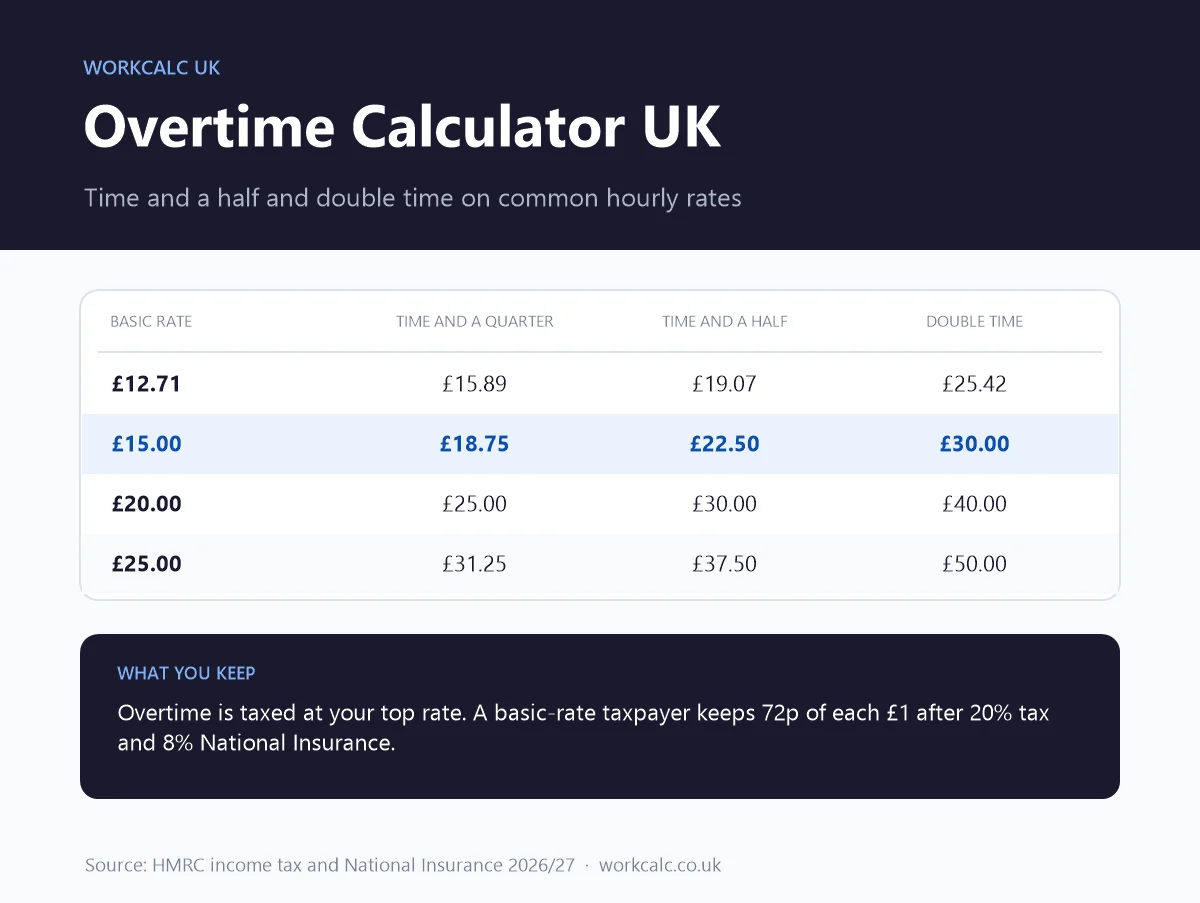
These are the most common overtime rates. The table shows what each is worth at different basic hourly rates, including the £12.71 National Living Wage for 2026/27:
| Basic rate | Time and a quarter (1.25x) | Time and a half (1.5x) | Double time (2x) |
|---|---|---|---|
| £12.71 | £15.89 | £19.07 | £25.42 |
| £15.00 | £18.75 | £22.50 | £30.00 |
| £20.00 | £25.00 | £30.00 | £40.00 |
| £25.00 | £31.25 | £37.50 | £50.00 |
Double time is most often paid for Sundays, bank holidays or night work, and time and a half for evenings and Saturdays, but it all depends on your contract. Some employers pay flat-rate overtime at your normal hourly rate, or give time off in lieu instead.
How much of your overtime you keep
Overtime is added to the rest of your pay, so it is taxed at your highest rate. In 2026/27, in England, Wales and Northern Ireland:
| Your income | Tax and NI on overtime | You keep of each £1 |
|---|---|---|
| £12,570 to £50,270 | 20% + 8% | 72p |
| Same, with a Plan 2 student loan | 20% + 8% + 9% | 63p |
| £50,270 to £100,000 | 40% + 2% | 58p |
| £100,000 to £125,140 | 60% + 2% | 38p |
| Over £125,140 | 45% + 2% | 53p |
Regular overtime can push you into a higher band. On £45,000, 5 hours a week at time and a half adds £9,000 a year, taking you past £50,270, so you keep 66% of it rather than 72%. Scottish taxpayers pay different income tax rates; choose Scotland in the tax settings. To see your whole payslip, use the salary calculator.
Is overtime taxed more?
No. There is no special tax on overtime. It can look that way for two reasons. First, it is taxed at your top rate, so a bigger share goes than on your pay as a whole. Second, if a lot of overtime lands in one month, PAYE can take more tax that month. Because PAYE works cumulatively across the tax year, any overpayment is normally corrected in later months or at the end of the year. National Insurance is worked out per pay period, so a very large overtime month can even mean slightly less NI overall, as pay above £4,189 in a month is charged at 2% rather than 8%.
Your overtime rights
- No legal overtime premium. Employers do not have to pay more for overtime. Your contract sets the rate, and it can be your normal rate or even unpaid, as long as the next point is met.
- Minimum wage. Your total pay, divided by all the hours you work in a pay period, including overtime, must not fall below the National Minimum Wage, which is £12.71 an hour for workers aged 21 and over from April 2026.
- The 48-hour limit. You cannot be made to work more than 48 hours a week on average, usually over 17 weeks, including overtime, unless you sign an opt-out. You can cancel an opt-out by giving notice.
- Compulsory or voluntary. If your contract says overtime is compulsory, you may have to do it. If it is voluntary, you can say no.
- Part-time staff are often paid their normal rate until they go beyond full-time hours. That is lawful if full-time colleagues are treated the same way.
Overtime and holiday pay
If you work overtime regularly, it should be reflected in your holiday pay. For leave years starting on or after 1 April 2024, employers in Great Britain must include regular overtime, as well as things like commission, in holiday pay for the first 4 weeks of your statutory leave. Occasional overtime does not have to be included. The Holiday Pay Calculator works out what a day of leave should be worth.
Overtime, student loans, pensions and benefits
- Student loans take 9% of your earnings above the threshold, so overtime is included. With a Plan 2 loan you keep about 63p of each £1 of basic-rate overtime.
- Pensions may or may not be taken from overtime. Many schemes use basic pay only; others count all earnings.
- Universal Credit falls by 55p for every extra £1 of take-home pay once you are above your work allowance, so overtime is worth much less if you claim it.
If you are an NHS employee, overtime and unsocial hours rates are set by Agenda for Change; see the NHS Pay Calculator for your band.
Sources
- GOV.UK, Overtime: your rights
- GOV.UK, Maximum weekly working hours
- HMRC, Income tax and National Insurance rates 2026 to 2027
- GOV.UK, National Minimum Wage and National Living Wage rates from April 2026
- The Employment Rights (Amendment, Revocation and Transitional Provision) Regulations 2023, holiday pay
Overtime: frequently asked questions
Overtime pay, tax and your rights in the UK.
How is overtime pay calculated?
Multiply your basic hourly rate by the overtime rate, then by the hours worked. On a £30,000 salary for 37.5 hours a week, the hourly rate is £15.38, so time and a half is £23.08 an hour and 5 hours of overtime pays £115.38 before tax. If you are salaried, your hourly rate is your salary divided by your weekly hours and 52 weeks.
What is time and a half?
Time and a half means 1.5 times your normal hourly rate. If you normally earn £15 an hour, time and a half is £22.50 an hour. Double time is twice your normal rate, so £30 an hour, and time and a quarter is 1.25 times, so £18.75.
Is overtime taxed more than normal pay?
No. Overtime is taxed at the same rates as the rest of your pay. It can feel higher because it is taxed at your top rate, which is 28% including National Insurance for most basic-rate taxpayers, and because a big overtime month can push part of that month's pay into a higher band. Any tax overpaid in one month is normally balanced out later in the tax year.
Do employers have to pay extra for overtime?
No. There is no legal right to a higher rate for overtime in the UK. Your contract decides whether you are paid time and a half, double time, your normal rate, time off in lieu or nothing extra. Your average pay for all the hours you work must still be at least the National Minimum Wage.
How much overtime do I keep after tax?
For a basic-rate taxpayer in England, Wales or Northern Ireland, 72p of every £1 of overtime, after 20% income tax and 8% National Insurance. A student loan takes another 9p, and a higher-rate taxpayer keeps 58p. Between £100,000 and £125,140 of income you keep just 38p.
Does overtime count towards holiday pay?
Regular overtime should. For leave years starting on or after 1 April 2024, employers in Great Britain must include regular overtime in holiday pay for the first 4 weeks of statutory leave. Occasional, one-off overtime does not have to be included.
How much overtime can I legally work?
Adult workers cannot be made to work more than 48 hours a week on average, normally measured over 17 weeks, including overtime. You can choose to opt out of this limit in writing, and you can cancel the opt-out with notice. Some jobs, such as the armed forces and some transport roles, have different rules.
Does overtime affect my student loan and pension?
Usually yes. Student loan repayments are 9% of earnings above your plan's threshold, so they apply to overtime too. Whether pension contributions are taken from overtime depends on your scheme, as many only count basic pay.