
NHS Maternity Pay Calculator
Work out your NHS maternity pay week by week and month by month: 8 weeks full pay, 18 weeks half pay plus SMP, then SMP only. See what changes if you spread it over 9 or 12 months.
Gross figures before tax, National Insurance and pension. SMP at £194.32 a week for 2026/27. Your trust's payroll confirms the final figures.
Your maternity pay, week by week
Each phase of your 52 weeks of leave, with the weekly amount and the total for that phase.
| Weeks | What you get | A week | Phase total |
|---|
Month by month
Pay allocated to each calendar month from your leave start date. Your actual payslips follow your trust's pay dates.
| Month | Maternity pay |
|---|
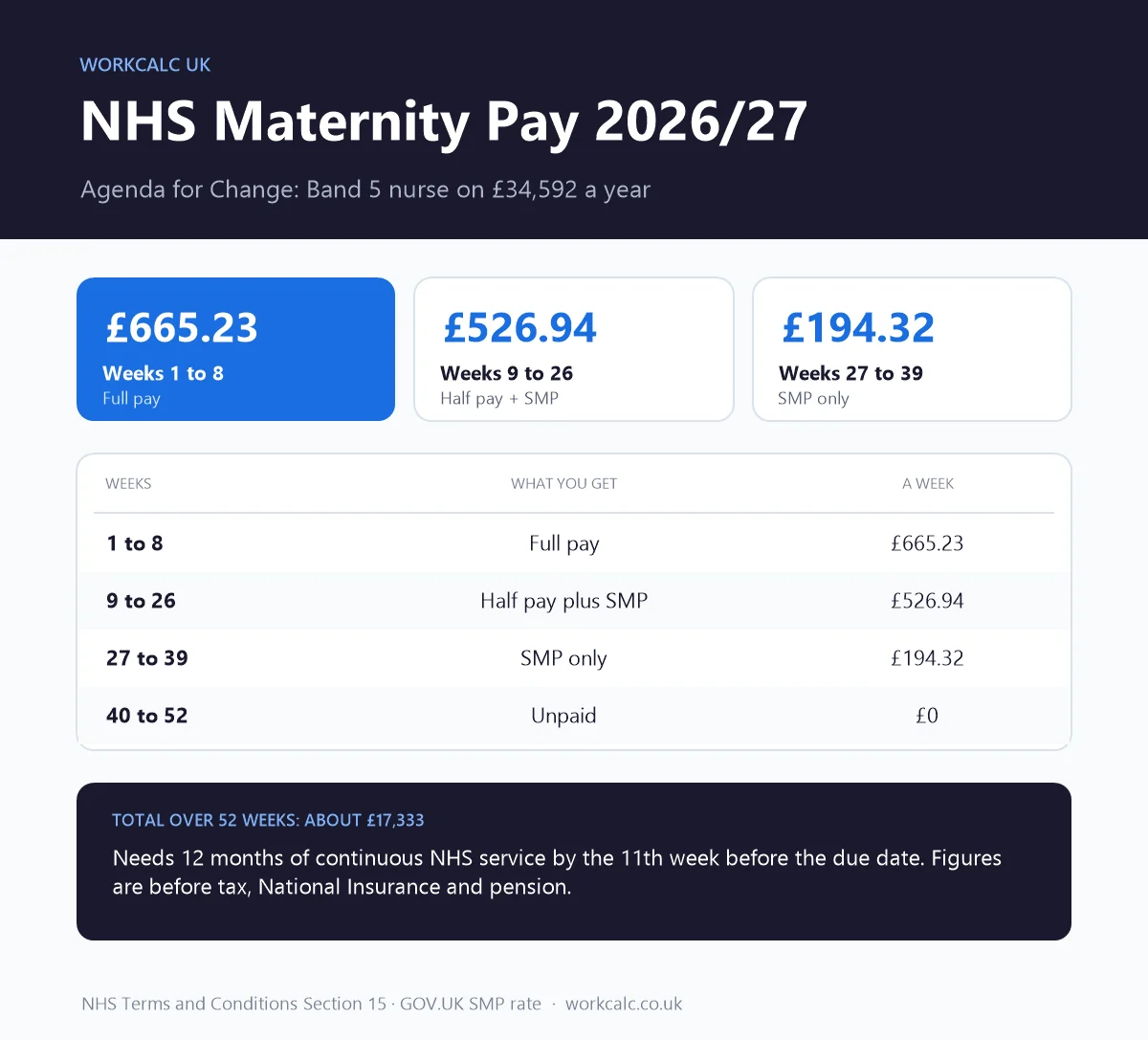
With 12 months of NHS service you get 8 weeks at full pay, then 18 weeks at half pay plus SMP, then 13 weeks of SMP only (£194.32 a week in 2026/27), then 13 weeks unpaid. On Band 5 (£34,592) that is £665.23 a week, then £526.94, then £194.32: about £17,333 over the year before tax, against £10,005 with SMP alone.
How NHS maternity pay works
Under Section 15 of the Agenda for Change terms, the NHS tops up Statutory Maternity Pay with occupational maternity pay (OMP). Your employer pays both through payroll. Here is how it works for a Band 5 nurse on £34,592 a year:
| Weeks | What you get | Band 5 a week |
|---|---|---|
| 1 to 8 | Full pay, made up of SMP plus occupational pay | £665.23 |
| 9 to 26 | Half pay plus SMP, up to full pay | £526.94 |
| 27 to 39 | SMP only | £194.32 |
| 40 to 52 | Unpaid | £0 |
Full pay is your normal weekly pay, which is your annual pay divided by 52. In the first 6 weeks SMP is 90% of your average weekly earnings, so the NHS adds the other 10%. In weeks 9 to 26 half pay and SMP together cannot go above full pay, which only affects part-time staff on low weekly pay. On Band 5, half pay of £332.62 plus SMP of £194.32 gives £526.94.
Who qualifies for NHS maternity pay
- Occupational maternity pay: you need 12 months of continuous service with one or more NHS employers at the start of the 11th week before your expected week of childbirth, and you must say you intend to return to NHS work. Time with different NHS employers counts if there is no break.
- Statutory Maternity Pay: you need 26 weeks of continuous employment with your current employer by the 15th week before your due date, and average earnings of at least £129 a week. SMP lasts 39 weeks: 90% of your average weekly earnings for 6 weeks, then £194.32 or 90% if lower.
- Maternity Allowance: if you have moved trusts recently and do not qualify for SMP, you may get Maternity Allowance from Jobcentre Plus instead. The NHS still tops it up if you qualify for OMP.
Everyone gets 52 weeks of maternity leave, whatever their pay entitlement. Annual leave and bank holidays keep building up while you are off. Check how much you will have with the NHS Annual Leave Calculator.
Spreading NHS maternity pay over 9 or 12 months
Agenda for Change lets you agree with your employer to have your occupational maternity pay paid in a different way, and many trusts will spread it evenly. The total you receive is the same, but the steep drop after week 26 is gone. SMP is set by law and is still paid for 39 weeks, so only the occupational part is spread. For Band 5:
| Pattern | Weeks 11 to 26 | Later weeks | Total |
|---|---|---|---|
| Standard (8 weeks full, 18 weeks half) | £526.94 | £194.32 | £17,333 |
| Spread over 9 months (39 weeks) | £382.22 | £382.22 | £17,333 |
| Spread over 12 months (52 weeks) | £335.24 | £140.92 | £17,333 |
"Later weeks" means weeks 27 to 39 for the standard and 9-month patterns, and weeks 40 to 52 for the 12-month pattern. Spreading over 12 months is the only way to get some pay in the last 13 weeks. Ask your payroll team well before your leave starts, because the arrangement usually has to be agreed in advance.
NHS maternity pay by band, 2026/27
Full-time figures on the 2026/27 Agenda for Change scale for England, with SMP and the standard payment pattern:
| Band and pay | Weeks 1 to 8 | Weeks 9 to 26 | Total, 52 weeks |
|---|---|---|---|
| Band 3 entry (£25,760) | £495.38 | £442.01 | £14,445 |
| Band 4 entry (£28,392) | £546.00 | £467.32 | £15,306 |
| Band 5 entry (£32,073) | £616.79 | £502.71 | £16,509 |
| Band 5 top (£39,043) | £750.83 | £569.73 | £18,788 |
| Band 6 entry (£39,959) | £768.44 | £578.54 | £19,087 |
| Band 6 top (£48,117) | £925.33 | £656.98 | £21,754 |
| Band 7 entry (£49,387) | £949.75 | £669.19 | £22,170 |
| Band 7 top (£56,515) | £1,086.83 | £737.73 | £24,500 |
| Band 8a entry (£57,528) | £1,106.31 | £747.47 | £24,831 |
Weeks 27 to 39 are £194.32 a week on every band shown. Scotland, Wales and Northern Ireland use the same maternity pay structure but their own pay scales, so enter your own salary in the calculator. For your normal take-home pay, use the NHS Pay Calculator.
What counts as your pay
- Average weekly earnings: maternity pay is based on what you earned in the weeks before the 15th week before your due date. If you are paid monthly, this is usually your last two payslips before then, scaled up to a year and divided by 52.
- Regular extras count: unsocial hours payments and high cost area supplements are included. Add their yearly average in the calculator.
- Salary sacrifice lowers it: lease cars, childcare and cycle schemes taken through salary sacrifice reduce the pay your maternity pay is based on.
- Pay rises are passed on: if a pay award or an increment takes effect before or during your paid leave, your maternity pay should be recalculated.
- Part-time: enter your contracted hours and the calculator pro-rates your salary.
Going back to work
To keep your occupational maternity pay you must return to NHS work for at least 3 months, with any NHS employer. If you do not, you may have to repay the occupational part, though never SMP, and employers can waive repayment where it would cause hardship. You can work up to 10 keeping in touch (KIT) days during your leave without ending it or losing your maternity pay, and the first 2 weeks after the birth are compulsory leave. Going back part-time? The Pro Rata Salary Calculator shows your new pay.
Tax, National Insurance and pension
Occupational maternity pay and SMP are taxed and have National Insurance taken off like normal pay. Because your income drops, many people pay less tax than usual during the half-pay and SMP months, and some get a refund through payroll. NHS pension contributions continue on the pay you receive during paid leave. Unpaid weeks may not count towards your pension unless you pay the contributions, so ask payroll or NHS Pensions about your options.
Sources
- NHS Employers, NHS Terms and Conditions of Service Handbook, Section 15: leave and pay for new parents
- GOV.UK, Maternity pay and leave: pay and eligibility (2026/27 rates)
- BMA, Maternity leave pay entitlements under the NHS scheme
- NHS Scotland Workforce, Maternity policy guide for managers
- NHS Employers, Agenda for Change pay scales 2026/27
NHS maternity pay: frequently asked questions
Quick answers about NHS maternity pay and leave.
How much is NHS maternity pay?
If you have 12 months of continuous NHS service, Agenda for Change maternity pay is 8 weeks at full pay, then 18 weeks at half pay plus Statutory Maternity Pay (as long as the total is no more than full pay), then 13 weeks of SMP only at up to £194.32 a week, and the last 13 weeks unpaid. On Band 5 (£34,592) that is about £17,333 over the year before tax.
How much is band 7 NHS maternity pay?
On the Band 7 entry point of £49,387, full pay is £949.75 a week for the first 8 weeks, then £669.19 a week for weeks 9 to 26, then SMP of £194.32 a week for weeks 27 to 39. That totals about £22,170 before tax. Use the calculator for your own pay point.
Can NHS maternity pay be spread over 12 months?
Yes, if your employer agrees. Agenda for Change allows occupational maternity pay to be paid in a different way, and many trusts will spread it evenly. The total does not change, but your monthly pay is steadier. Statutory Maternity Pay is still paid for 39 weeks as normal, so weeks 40 to 52 get only the spread occupational pay. Ask your payroll team before your leave starts.
Can NHS maternity pay be spread over 9 months?
Yes, on the same basis as spreading over 12 months. Spreading over 39 weeks, the length of SMP, gives an even weekly amount for 9 months and nothing for the last 13 weeks. On Band 5 that is about £786.61 a week, against £739.63 a week spread over 12 months.
Do I have to pay back NHS maternity pay if I do not go back?
You only get occupational maternity pay if you say you intend to return to NHS work. If you then do not return for at least 3 months, you may have to repay the occupational part, but not Statutory Maternity Pay. The return can be to any NHS employer, and employers can waive repayment where it would cause hardship.
What if I have worked in the NHS for less than a year?
You will not get occupational maternity pay, but you can still get Statutory Maternity Pay if you have worked for your current employer for 26 weeks by the 15th week before your due date and earn at least £129 a week on average. SMP is 90% of your pay for 6 weeks, then £194.32 or 90% if lower for 33 weeks. If you do not qualify for SMP, you may get Maternity Allowance.
Does unsocial hours pay count for NHS maternity pay?
Yes. Regular unsocial hours payments count towards contractual maternity pay, as do other regular payments such as high cost area supplements. Maternity pay is based on your average weekly earnings in the weeks before your leave, so enter your regular extras in the calculator. Salary sacrifice schemes reduce the figure.
Is NHS maternity pay taxed?
Yes. Occupational maternity pay and SMP are taxed and have National Insurance taken off like normal pay, and NHS pension contributions continue during paid leave. Because your pay drops, you often pay less tax than usual, and you may get a tax refund through payroll in the lower-paid months.