
Tax Rebate Calculator UK
Check whether HMRC owes you money. Enter the pay and tax from your P60, add any uniform, job expenses, mileage or marriage allowance, and see your estimated refund for each of the last four tax years. Also works for CIS subcontractors.
Estimate using the income tax rates for the year you choose. It assumes the pay on your P60 is all your taxable income and that you had the standard personal allowance. HMRC's own calculation is final.
You are due a tax rebate if you paid more income tax than you owed. Compare the tax on your P60 with the tax due on your pay for that year, then add relief for job expenses HMRC does not know about. For example, on £28,000 of pay in 2025/26 with £3,400 tax paid and a £60 uniform claim, the refund is about £326.00. You can claim for the last four tax years, so 2022/23 claims close on 5 April 2027.
Why you might be owed a tax refund
- Emergency tax code: starting a new job without a P45 often puts you on a code such as 1257L W1/M1 or BR, so too much tax comes off until it is fixed.
- Changing or leaving a job: if you worked part of the year, or stopped working before 5 April, you may not have used all your personal allowance.
- Two jobs at once: if all your allowance went to the wrong job, or the second job was taxed at BR when you had allowance left.
- Work expenses: uniform cleaning, tools, professional subscriptions, mileage in your own car and working from home when your employer requires it.
- Pension contributions: higher rate taxpayers paying into a relief at source pension get only 20% automatically and must claim the rest.
- CIS deductions: subcontractors have 20% taken from their labour, which is often more than the tax and National Insurance actually due once expenses are taken off.
If you think your tax code is wrong right now, check it with the Tax Code Calculator before the year ends.
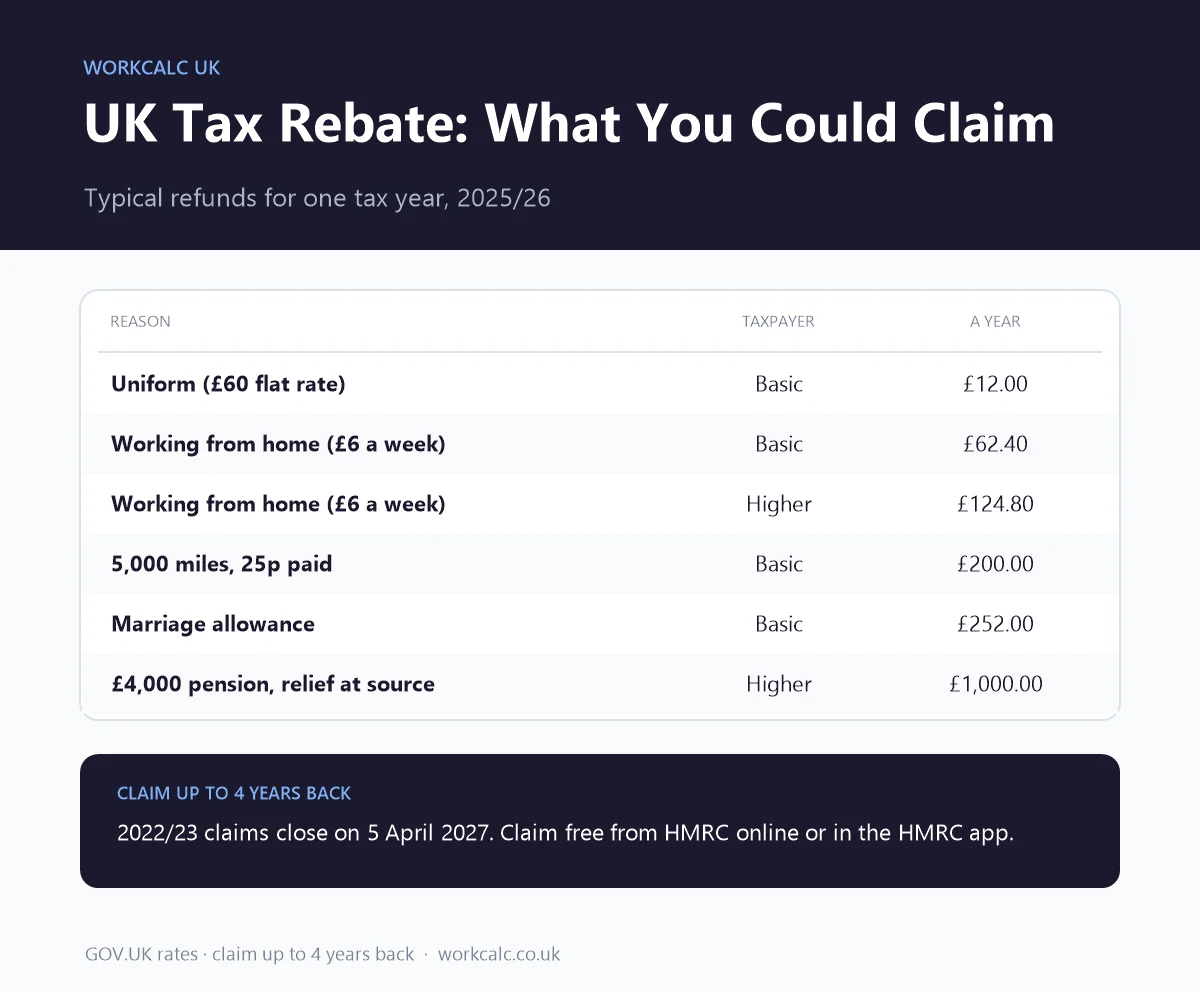
How much is each type of tax rebate worth?
Typical refunds for one tax year (2025/26, outside Scotland). Each one can be backdated up to four years:
| Reason | Taxpayer | Refund a year |
|---|---|---|
| Uniform or work clothing (£60 flat rate) | Basic rate | £12.00 |
| Working from home, required by employer (£6 a week) | Basic rate | £62.40 |
| Working from home, required by employer (£6 a week) | Higher rate | £124.80 |
| 5,000 business miles, employer pays 25p a mile | Basic rate | £200.00 |
| Marriage allowance from your partner | Basic rate | £252.00 |
| £4,000 into a relief at source pension | Higher rate | £1,000.00 |
Expenses only reduce the tax on your pay, so you get relief at your own rate: 20% for basic rate, 40% for higher rate and 45% for additional rate taxpayers, or the Scottish rates if you live in Scotland. Mileage relief is the difference between HMRC's approved rates, 45p a mile for the first 10,000 business miles and 25p after that, and what your employer paid you.
Claim deadlines: the last four tax years
| Tax year | Runs from | Claim by |
|---|---|---|
| 2022/23 | 6 April 2022 to 5 April 2023 | 5 April 2027 |
| 2023/24 | 6 April 2023 to 5 April 2024 | 5 April 2028 |
| 2024/25 | 6 April 2024 to 5 April 2025 | 5 April 2029 |
| 2025/26 | 6 April 2025 to 5 April 2026 | 5 April 2030 |
If you were overtaxed in 2022/23, you have until 5 April 2027 to claim. After the deadline the money is lost, even if HMRC agrees you overpaid.
How to claim your tax refund
- P800 from HMRC: after each tax year HMRC checks PAYE records and sends a P800 calculation between June and March if you paid too much. Many refunds are paid this way without you doing anything.
- Overpaid PAYE: if you have not had a P800, claim through your Personal Tax Account or the HMRC app, or call HMRC.
- Job expenses: claim uniform, fees, mileage and working from home online through GOV.UK. If you already send a Self Assessment return, claim on the return instead.
- CIS refunds: send a Self Assessment tax return for the year. The CIS deductions on your payment statements count as tax already paid.
- Marriage allowance: your partner applies online, and it can be backdated up to four years if you were both eligible.
You do not need a refund company. They often keep a share of the refund, and HMRC never texts or emails about refunds, so ignore messages that ask you to click a link to claim one.
CIS tax rebates for subcontractors
Under the Construction Industry Scheme contractors deduct 20% from the labour part of your pay, or 30% if you are not registered, and pass it to HMRC. That is an advance payment towards your income tax and National Insurance, not your final bill. On £40,000 of CIS income with £6,000 of expenses and £8,000 deducted in 2025/26, the bill is £4,286.00 income tax and £1,285.80 Class 4 National Insurance, so the refund is about £2,428.20. In 2023/24, with Class 4 at 9% and Class 2 still compulsory, the same figures gave about £1,605.90. For your tax as a self-employed worker this year, use the Self-Employed Tax Calculator.
What this calculator does not cover
- Other income: savings interest (see the personal savings allowance), dividends, rental income and benefits such as Jobseeker's Allowance are not included.
- Non-standard allowances: it assumes the standard personal allowance, reduced only for income over £100,000.
- Benefits in kind and P11D items.
- National Insurance refunds, which are a separate claim.
Sources
- GOV.UK, Income Tax rates and allowances for current and past years
- gov.scot, Scottish Income Tax rates and bands 2022 to 2023 to 2025 to 2026
- GOV.UK, Rates and allowances: National Insurance contributions
- GOV.UK, Tax overpayments and underpayments; Claim tax relief for your job expenses
- GOV.UK, Construction Industry Scheme: a guide for contractors and subcontractors
Tax rebates: frequently asked questions
Quick answers about claiming tax back from HMRC.
How do I calculate my UK tax refund?
Take your total taxable pay and the tax you paid from your P60, or from each P45 if you changed jobs. Work out the tax that should have been due on that pay for the tax year, after any job expenses you can claim, then subtract it from the tax you actually paid. If the answer is positive, that is your refund. The calculator above does this for every tax year from 2022/23 to 2025/26.
How do I check if I am due a tax refund?
HMRC checks PAYE records after each tax year ends and sends a P800 tax calculation between June and March of the following year if you paid too much or too little. You can also check your Personal Tax Account or the HMRC app, which show your income and tax for each year. If you have work expenses HMRC does not know about, such as uniform or mileage, you have to claim them yourself.
How far back can I claim a tax refund?
Four tax years. For the 2022/23 tax year the deadline is 5 April 2027, for 2023/24 it is 5 April 2028, for 2024/25 it is 5 April 2029 and for 2025/26 it is 5 April 2030. After that, HMRC will not refund the overpaid tax.
How much is the uniform tax rebate?
The standard flat rate expense for uniforms and work clothing is £60 a year, and some jobs have higher amounts set by HMRC. You get tax relief at your rate, so £60 is worth £12 a year to a basic rate taxpayer. Backdated over the four years from 2022/23 to 2025/26 that is about £48.
Can I claim a tax rebate for working from home?
Only if your employer requires you to work from home, not if you choose to. You can claim £6 a week without receipts, which is £62.40 a year in tax relief for a basic rate taxpayer and £124.80 for a higher rate taxpayer. You cannot claim if you have the option to go into a workplace.
How do I get a CIS tax rebate?
Construction Industry Scheme deductions are an advance payment of your tax and National Insurance, usually at 20% of your labour. You claim back any overpayment by sending a Self Assessment tax return. On £40,000 of CIS income with £6,000 of expenses and £8,000 deducted, the 2025/26 refund would be about £2,428.
Is it worth using a tax refund company?
You can claim directly from HMRC for free, online or through the HMRC app. Refund companies often keep a percentage of the refund as a fee. HMRC never contacts people by text or email about a tax refund, so treat any message like that as a scam.
Can I get National Insurance back in a tax rebate?
Not usually. A tax rebate is a refund of income tax. National Insurance is worked out on each pay period separately, so it is not recalculated at the end of the year in the same way. You can apply for a National Insurance refund in some cases, such as paying too much across two or more jobs.