
£25,000 After Tax
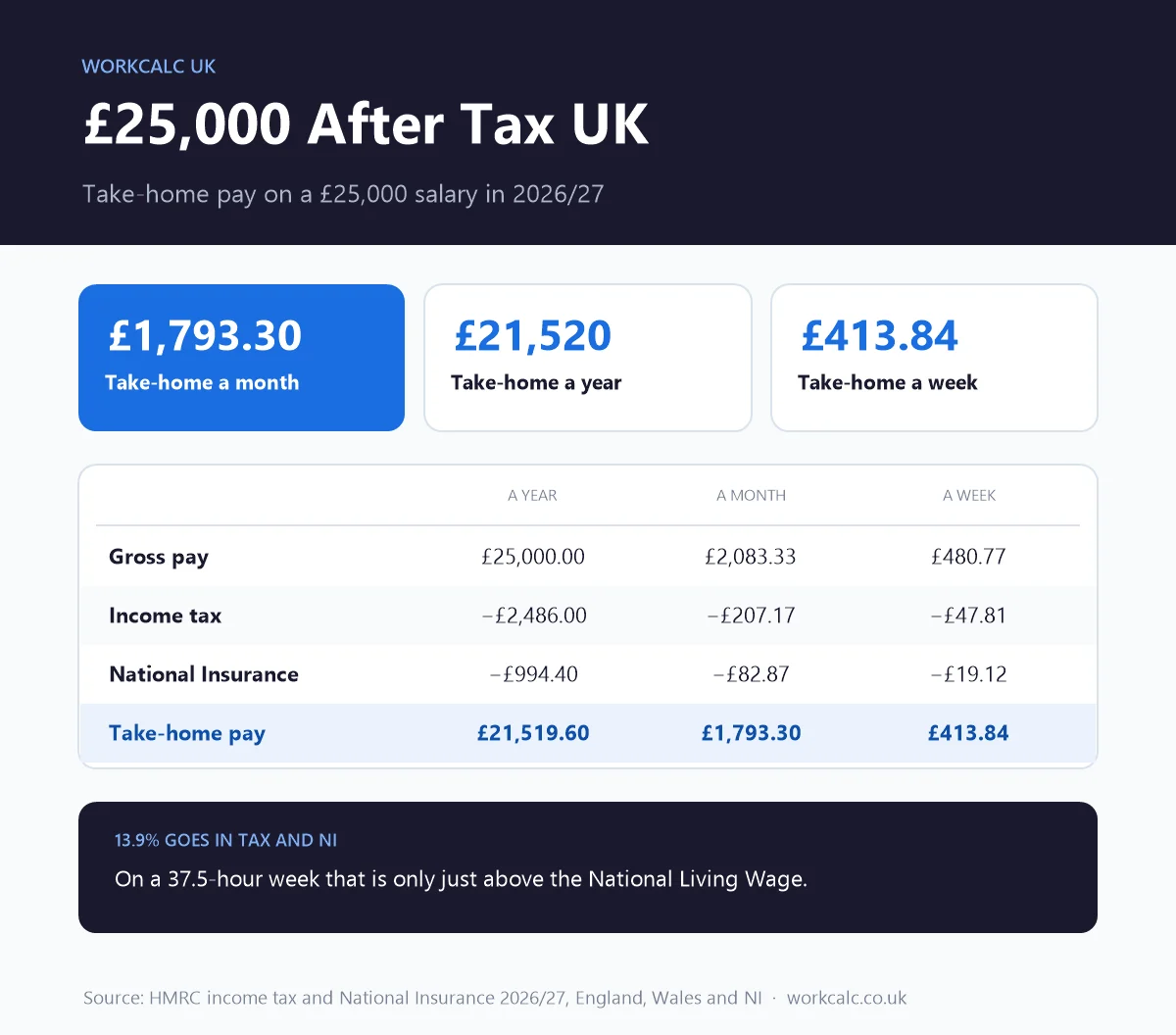
A £25,000 salary leaves £21,520 a year after income tax and National Insurance, which is £1,793 a month or £414 a week in 2026/27. On a 37.5-hour week that is only just above the National Living Wage.
Adjust for your situation
£25,000 after tax: the short answer
A salary of £25,000 leaves £21,519.60 after income tax and National Insurance in 2026/27. Paid monthly that is £1,793.30, and 13.9% of the salary goes on the two deductions.
| Year | Month | Week | |
|---|---|---|---|
| Gross pay | £25,000.00 | £2,083.33 | £480.77 |
| Income tax | −£2,486.00 | −£207.17 | −£47.81 |
| National Insurance | −£994.40 | −£82.87 | −£19.12 |
| Take-home pay | £21,519.60 | £1,793.30 | £413.84 |
How the tax on £25,000 is worked out
- Personal allowance: the first £12,570 is tax-free
- Basic rate: 20% on £12,430 = £2,486.00
- National Insurance: 8% on £12,430 = £994.40
Your effective rate is 13.9%, but the rate on the next pound you earn is 28%. That second figure is the one to use when you weigh up overtime, a bonus or a pay rise.
Is £25,000 above the minimum wage?
Only just, and it depends on your hours. On a standard 37.5-hour week £25,000 works out at £12.82 an hour, 11p above the £12.71 National Living Wage that applies from age 21. Spread the same salary over a 40-hour week and it falls to £12.02 an hour, which is below the legal minimum for anyone aged 21 or over.
That matters if you are offered £25,000 for a job with long contracted hours. Check the hours written into the contract as well as the salary, and see the minimum wage rates for 2026 if you are under 21 or an apprentice.
Student loans barely touch this salary
£25,000 sits below the repayment thresholds for Plans 1, 2 and 4, and exactly on the Plan 5 threshold, so none of those loans take anything yet. The exception is a Postgraduate Loan, which takes 6% of income above £21,000: £240.00 a year.
Support worth checking at this income
Some households on this salary still qualify for Universal Credit, particularly with children or high rent. Each extra £1 of take-home pay above the work allowance reduces the award by 55p, so a rise can be worth less than it first appears. If your spouse or civil partner earns under £12,570, Marriage Allowance can also cut your tax by up to £252 a year.
£25,000 a year as an hourly rate
| Contracted week | Before tax, per hour | After tax, per hour |
|---|---|---|
| 35 hours | £13.74 | £11.82 |
| 37.5 hours | £12.82 | £11.04 |
| 40 hours | £12.02 | £10.35 |
The 40-hour row is the one to check. £12.02 an hour is below the £12.71 National Living Wage, so a £25,000 salary is only lawful for someone aged 21 or over if the contract is for 37.8 hours a week or fewer. Over 260 working days a year, £25,000 is £96.15 a day before tax and £82.77 after.
£25,000 pro rata: part-time and job-share pay
If £25,000 is the full-time salary and you work fewer days, your pay is cut in proportion but your tax falls faster. The £12,570 personal allowance is not reduced for part-time workers, so a bigger share of a smaller salary is tax-free.
| Working pattern | Pro rata salary | Take-home a year | A month |
|---|---|---|---|
| Full time, 5 days | £25,000 | £21,519.60 | £1,793.30 |
| 4 days (80%) | £20,000 | £17,919.60 | £1,493.30 |
| 3 days (60%) | £15,000 | £14,319.60 | £1,193.30 |
Dropping to four days gives up 20% of your hours but only 16.7% of your take-home pay. At three days, £15,000 leaves £14,319.60, which is 66.5% of the full-time figure for 60% of the hours. The Pro Rata Salary Calculator handles other patterns.
£25,000 after tax with a student loan
| Plan | Repays above | A year | Take-home |
|---|---|---|---|
| Plan 1 | £26,900 | £0.00 | £21,520 |
| Plan 2 | £29,385 | £0.00 | £21,520 |
| Plan 4 (Scotland) | £33,795 | £0.00 | £21,520 |
| Plan 5 | £25,000 | £0.00 | £21,520 |
| Postgraduate Loan | £21,000 | £240.00 | £21,280 |
Plan 1, Plan 2, Plan 4 (Scotland) and Plan 5 do not take anything at this salary. The others take 9% of income above their threshold, or 6% for a Postgraduate Loan.
Pension contributions on £25,000
A 5% contribution puts £1,250 a year into your pension. Through a net pay scheme it reduces take-home pay by £1,000, because the contribution comes off before income tax. Through salary sacrifice, which also saves National Insurance, the cost falls to £900. Your employer adds at least 3% on top under auto-enrolment. The Salary Sacrifice Calculator shows other percentages.
Many auto-enrolment schemes work out the minimum on qualifying earnings, the slice of pay between £6,240 and £50,270, not on your full salary. On that basis the 5% minimum on £25,000 is £938.00 a year and your employer's 3% is £562.80. Your pension statement or scheme booklet says which basis applies.
What a pay rise is worth on £25,000
| Rise | Gross | Extra take-home a year | A month | You keep |
|---|---|---|---|---|
| 3.3% (NHS and council award) | £825 | £594 | £50 | 72% |
| 5% | £1,250 | £900 | £75 | 72% |
| £1,000 | £1,000 | £720 | £60 | 72% |
| £5,000 | £5,000 | £3,600 | £300 | 72% |
For a rise that includes a pension, student loan or back pay, use the Pay Rise Calculator.
One £25,000 salary or two of £12,500
How a household's income is split changes how much tax it pays. One person earning £25,000 takes home £21,519.60. Two people earning £12,500 each take home the full £25,000, because each stays under the £12,570 personal allowance and the National Insurance threshold. That is £3,480.40 a year more from the same total pay.
Neither part-time earner pays National Insurance at that level, but both still build State Pension entitlement as long as each job pays above the lower earnings limit. The same logic applies in reverse: when one partner stops work, the household loses that person's tax-free allowance as well as their pay.
£25,000 after tax in Scotland
| England, Wales and NI | Scotland | |
|---|---|---|
| Income tax | £2,486.00 | £2,446.33 |
| National Insurance | £994.40 | £994.40 |
| Take-home a year | £21,519.60 | £21,559.27 |
| Take-home a month | £1,793 | £1,797 |
You pay Scottish income tax if your main home is in Scotland, and your tax code starts with S. On £25,000 a Scottish taxpayer keeps £39.67 more a year. National Insurance is the same across the UK.
How £25,000 compares
Median pay for full-time employees was £39,039 in April 2025, according to the ONS Annual Survey of Hours and Earnings, so £25,000 is £14,039 (36.0%) below that figure.
| Salary | Take-home a year | A month | Difference |
|---|---|---|---|
| £20,000 | £17,920 | £1,493 | −£3,600 a year |
| £25,000 | £21,520 | £1,793 | This page |
| £30,000 | £25,120 | £2,093 | +£3,600 a year |
What these figures assume
- A 1257L tax code and a single job paid through PAYE
- England, Wales or Northern Ireland unless the Scotland table says otherwise
- No pension, student loan or taxable benefits unless shown
- HMRC 2026/27 rates; the personal allowance and higher rate threshold are frozen until April 2031
For a different tax code, pension type or bonus, use the Take-Home Pay Calculator.
Questions about £25,000
Do I repay my student loan on £25,000?
Not on Plans 1, 2 or 4, and not on Plan 5 either, because its threshold is exactly £25,000 and repayments only start above it. A Postgraduate Loan is different: it takes 6% of income over £21,000, which is £240.00 a year on £25,000.
Is £25,000 a year above minimum wage?
Yes on a 37.5-hour week, where it works out at £12.82 an hour against the £12.71 National Living Wage for workers aged 21 and over. On a 40-hour week it is £12.02 an hour, which is below the minimum for that age group.
How much is £25,000 a year per hour?
£25,000 a year is £12.82 an hour on a 37.5-hour week, £13.74 on a 35-hour week and £12.02 on a 40-hour week. After income tax and National Insurance, the 37.5-hour figure is £11.04 an hour.
What is £25,000 pro rata for four days a week?
Four days a week is 80% of full time, so £25,000 pro rata is £20,000. That leaves £17,919.60 a year after tax and National Insurance, or £1,493.30 a month.
How much is £25,000 a month after tax with a pension?
With a 5% pension contribution on full salary, £25,000 leaves £1,709.97 a month, against £1,793.30 with no pension. If your scheme uses qualifying earnings, the contribution is smaller, at £938 a year.