
£40,000 After Tax
A £40,000 salary leaves £32,320 a year after income tax and National Insurance, which is £2,693 a month or £622 a week in 2026/27. That is just above median full-time pay, with plenty of room before the 40% band.
Adjust for your situation
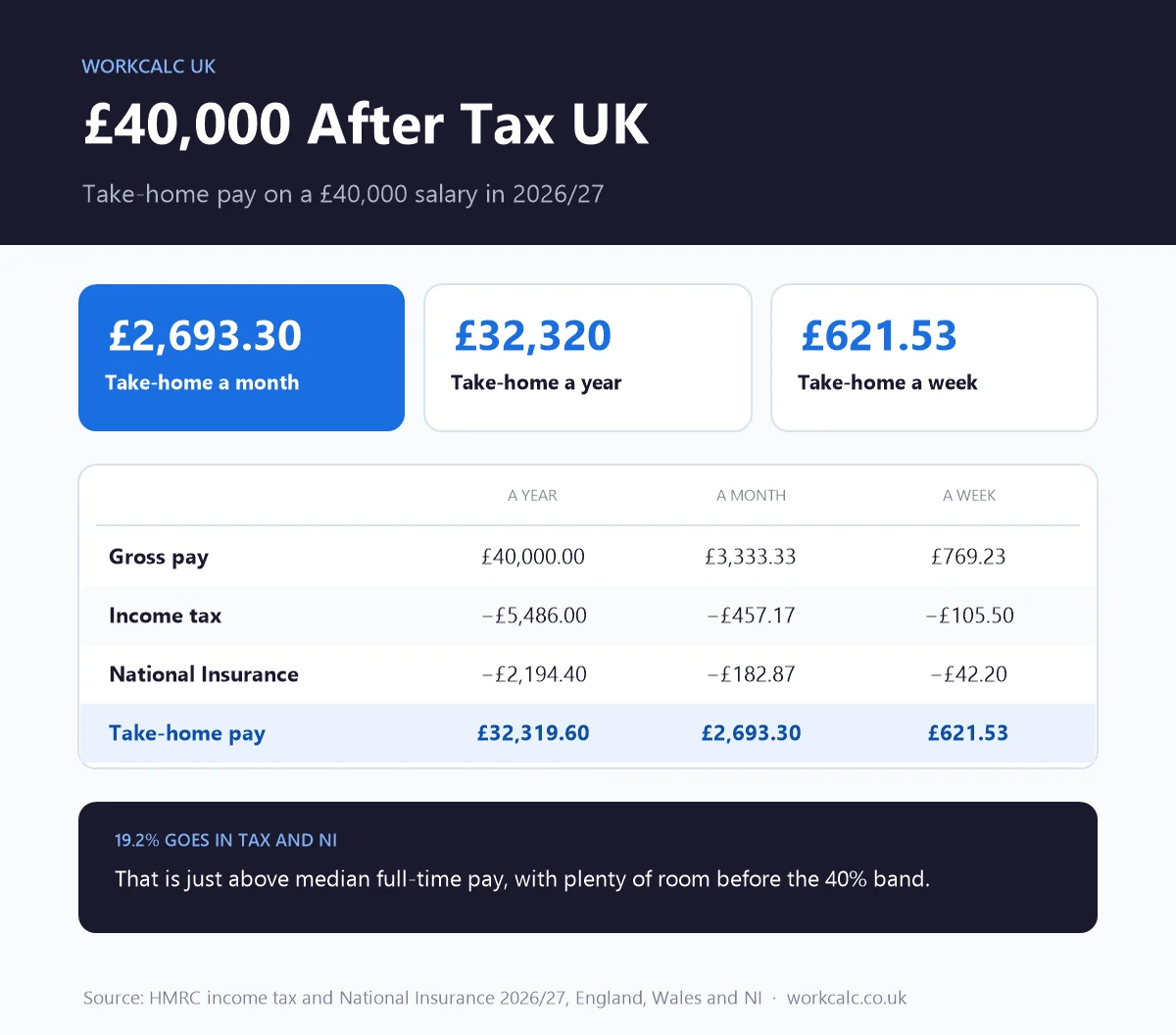
£40,000 after tax: the short answer
A salary of £40,000 leaves £32,319.60 after income tax and National Insurance in 2026/27. Paid monthly that is £2,693.30, and 19.2% of the salary goes on the two deductions.
| Year | Month | Week | |
|---|---|---|---|
| Gross pay | £40,000.00 | £3,333.33 | £769.23 |
| Income tax | −£5,486.00 | −£457.17 | −£105.50 |
| National Insurance | −£2,194.40 | −£182.87 | −£42.20 |
| Take-home pay | £32,319.60 | £2,693.30 | £621.53 |
How the tax on £40,000 is worked out
- Personal allowance: the first £12,570 is tax-free
- Basic rate: 20% on £27,430 = £5,486.00
- National Insurance: 8% on £27,430 = £2,194.40
Your effective rate is 19.2%, but the rate on the next pound you earn is 28%. That second figure is the one to use when you weigh up overtime, a bonus or a pay rise.
£40,000 and the next tax band
In England, Wales and Northern Ireland you can earn another £10,270 before any income reaches the 40% higher rate at £50,270, so each pound of a rise up to that point is taxed at 20% plus 8% National Insurance. In Scotland the line comes much sooner: the 42% higher rate starts at £43,662, only £3,662 away.
That is why the same rise is worth less to a Scottish taxpayer once it passes £43,662. A £5,000 rise adds £3,600 to take-home pay in the rest of the UK, but £3,269 in Scotland.
£40,000 against the UK median
The ONS median for full-time employees was £39,039 in April 2025, so £40,000 is £961 (2.5%) above it. In hourly terms it is £20.51 on a 37.5-hour week.
The graduate squeeze
With a Plan 2 loan, £955.35 a year goes on repayments at this salary, leaving £31,364. Above £29,385 each extra £1 loses 37p to income tax, National Insurance and the loan together.
£40,000 a year as an hourly rate
| Contracted week | Before tax, per hour | After tax, per hour |
|---|---|---|
| 35 hours | £21.98 | £17.76 |
| 37.5 hours | £20.51 | £16.57 |
| 40 hours | £19.23 | £15.54 |
£40,000 crosses £20 an hour on a 37.5-hour week, though not on a 40-hour one, where it is £19.23. Over 260 working days a year, £40,000 is £153.85 a day before tax and £124.31 after.
One £40,000 salary or two of £20,000
One earner on £40,000 takes home £32,319.60. Two earners on £20,000 each take home £35,839.20 between them, which is £3,519.60 a year more from the same total pay.
The gap has two parts, and both come from the second earner having their own allowances. A second £12,570 personal allowance saves 20% income tax on that amount, which is £2,514. A second National Insurance threshold saves 8% on the same £12,570, which is £1,005.60. Whenever each earner makes more than £12,570 and the single salary would be under £50,270, the difference is this same £3,519.60. It is one reason a second income, even a part-time one, is worth more than it looks on paper.
£40,000 after tax with a student loan
| Plan | Repays above | A year | Take-home |
|---|---|---|---|
| Plan 1 | £26,900 | £1,179.00 | £31,141 |
| Plan 2 | £29,385 | £955.35 | £31,364 |
| Plan 4 (Scotland) | £33,795 | £558.45 | £31,761 |
| Plan 5 | £25,000 | £1,350.00 | £30,970 |
| Postgraduate Loan | £21,000 | £1,140.00 | £31,180 |
Every plan is in repayment at this salary. Each takes 9% of income above its own threshold, or 6% for a Postgraduate Loan, so two loans stack rather than replace each other.
Pension contributions on £40,000
A 5% contribution puts £2,000 a year into your pension. Through a net pay scheme it reduces take-home pay by £1,600, because the contribution comes off before income tax. Through salary sacrifice, which also saves National Insurance, the cost falls to £1,440. Your employer adds at least 3% on top under auto-enrolment. The Salary Sacrifice Calculator shows other percentages.
Many auto-enrolment schemes work out the minimum on qualifying earnings, the slice of pay between £6,240 and £50,270, not on your full salary. On that basis the 5% minimum on £40,000 is £1,688.00 a year and your employer's 3% is £1,012.80. Your pension statement or scheme booklet says which basis applies.
What a pay rise is worth on £40,000
| Rise | Gross | Extra take-home a year | A month | You keep |
|---|---|---|---|---|
| 3.3% (NHS and council award) | £1,320 | £950 | £79 | 72% |
| 5% | £2,000 | £1,440 | £120 | 72% |
| £1,000 | £1,000 | £720 | £60 | 72% |
| £5,000 | £5,000 | £3,600 | £300 | 72% |
For a rise that includes a pension, student loan or back pay, use the Pay Rise Calculator.
Renting and borrowing on £40,000
Two rules of thumb are used by landlords and lenders, and both work from gross salary, not take-home pay:
- Rent: referencing checks commonly look for a salary of 30 times the monthly rent. On £40,000 that is a rent of up to £1,333 a month, which would be 49.5% of your £2,693.30 monthly take-home pay.
- Mortgage: many lenders cap borrowing at around 4.5 times income, which is £180,000 on £40,000. Two applicants on this salary could be assessed on £80,000 between them.
Both are upper limits, not targets. Lenders also check your outgoings, debts and deposit, and a student loan or pension contribution lowers the take-home pay that actually has to cover the payments.
£40,000 after tax in Scotland
| England, Wales and NI | Scotland | |
|---|---|---|
| Income tax | £5,486.00 | £5,551.07 |
| National Insurance | £2,194.40 | £2,194.40 |
| Take-home a year | £32,319.60 | £32,254.53 |
| Take-home a month | £2,693 | £2,688 |
You pay Scottish income tax if your main home is in Scotland, and your tax code starts with S. On £40,000 a Scottish taxpayer keeps £65.07 less a year. National Insurance is the same across the UK.
How £40,000 compares
Median pay for full-time employees was £39,039 in April 2025, according to the ONS Annual Survey of Hours and Earnings, so £40,000 is £961 (2.5%) above that figure.
| Salary | Take-home a year | A month | Difference |
|---|---|---|---|
| £35,000 | £28,720 | £2,393 | −£3,600 a year |
| £40,000 | £32,320 | £2,693 | This page |
| £45,000 | £35,920 | £2,993 | +£3,600 a year |
What these figures assume
- A 1257L tax code and a single job paid through PAYE
- England, Wales or Northern Ireland unless the Scotland table says otherwise
- No pension, student loan or taxable benefits unless shown
- HMRC 2026/27 rates; the personal allowance and higher rate threshold are frozen until April 2031
For a different tax code, pension type or bonus, use the Take-Home Pay Calculator.
Questions about £40,000
Is £40,000 above the average UK salary?
Slightly. The ONS median for full-time employees was £39,039 in April 2025, so £40,000 is £961 (2.5%) above it. After tax it leaves £32,320 a year, or £2,693 a month.
How much tax and National Insurance do I pay on £40,000?
£5,486.00 in income tax and £2,194.40 in National Insurance, £7,680.40 in total. That is 19.2% of the salary, although the rate on each extra pound you earn is 28%.
How much is £40,000 a year per hour?
£40,000 a year is £20.51 an hour on a 37.5-hour week, £21.98 on a 35-hour week and £19.23 on a 40-hour week. After tax and National Insurance, the 37.5-hour figure is £16.57 an hour.
How much is £40,000 a month after tax with a pension?
With a 5% pension contribution on full salary, £40,000 leaves £2,559.97 a month, against £2,693.30 with no pension. With a Plan 2 student loan as well it is £2,480.35.
How much can I borrow for a mortgage on £40,000?
Many lenders cap borrowing at around 4.5 times income, which is £180,000 on a £40,000 salary. The amount you are offered also depends on your deposit, outgoings, debts and credit record.